I invite you to join my friend Bryce Riemer and I on a 24-hour fast for the Amazon rainforest and its indigenous peoples.

We will eat dinner on the evening of Monday, September 30, and then not eat again until 24 hours later on Tuesday, October 1. We will only be drinking water during that time.

During the fast, we will be seek to draw near to God and will also pray for one of the most remarkable features of God’s earth – the Amazon rainforest. Where ever you are, we would love to have you join us

As you likely already know, large numbers of fires have been set in the Amazon this year to clear land for agriculture and other uses.


I urge you to read this interview with Carlos Nobre, who has been studying the Amazon for over 40 years. He explains that the combination of fires and climate change is pushing the Amazon forest to a critical tipping point. Before long, it could begin to change from a tropical rainforest to more of a dry, hot savanna.

This would mean a slow-motion apocalypse for the Amazon’s diverse animals and plants and of the peoples who depend on that life. It would also mean a dramatic decrease in the ability of the Amazon to store carbon. It currently stores, according to estimates, somewhere between one and two billion tons of carbon each year.

As the interview makes clear, deforestation and the spread of fires are no accident. Government policy and international agricultural institutions (like Cargill and JBS) are, by sins of commission and omission, incentivizing the burning.

You and I cannot fly to the Amazon. We can’t directly stop the fires and deforestation and the harm caused to indigenous peoples. But we can pray even as we act in our own local communities. And by fasting we can intensify our prayers and our focus.

King David fasted for his son’s life. Ezra prayed for safety when he and Israelite exiles set out from Persia to return to Jerusalem. In Jonah we read of the people and livestock of Ninevah fasting as a way of repenting and turning away from evils ways and violence. Jesus fasted as he prepared for his last three years of ministry.

Let’s write a new chapter in faithful people praying and fasting for God’s will to be done on earth.

During the fast, we will open our hearts to God and remember his love and goodness. We will plead for God to intervene for the future of the Amazon rainforest and its people. We will pray for the hearts and minds of the people who have created the conditions for this destruction to be undertaken. And we will repent for what we have done and are doing to harm God’s earth.

I’ve found that repeating a Bible verse or phrase that expresses your thoughts and feelings throughout the day is a good way to center yourself. Those words will take on great power. I’d encourage you, too, to use your normal time of eating lunch to take a walk, pray, and open your heart.

This fasting will also be a way to grieve. When I spoke to a local Mennonite church this summer, several members shared a common challenge. They asked, “How do we deal with the grief?” The grief they spoke of was seeing God’s earth damaged and declining. We tend to flee from grief or allow it to paralyze us. Through this fast I want to open myself to letting grief fully take my heart. And then, I hope, there will be Spirit-led commitment to act on the other side of that heartbreak.

I’m still learning how to experience a fast in a deeply spiritual way. So if you haven’t fasted before, be easy on yourself as you experience it for the first time.

Please join us. Please email me at wholefaithlivingearth@gmail.com if you will be fasting with us.


P.S. If you haven’t fasted before, I’d recommend reading The Sacred Art of Fasting and/or this blog post on fasting for beginners.

P.P.S. In general, I would ask that you choose not to eat meat from any major company – like Costco, McDonalds, and Burger King – that sources meat from suppliers connected with the deforestation of the Amazon. Instead, support local, sustainable livestock farmers in your own area.

What exactly is a whole faith?

The assumption of this blog site is that too often the Christian faith we hear in church and try to live out is incomplete.

Much of what I write highlights just one area of theology and Christian life that lacks wholeness. Specifically, most Christians have not heard that God’s earth matters. Nor have we heard that how we treat God’s earth matters.

But the lack of wholeness in the Chrisitianity people encounter in churches goes beyond that. I believe there are other elements, even some at a fundamental level, that are missing in much of what we encounter at church.

And you can’t get more fundamental than how we define salvation and what it means to be a Christian.

That’s why I want to share a podcast interview that Carey Nieuwhof recently did with John Ortberg, the senior pastor of Menlo Church. Ortberg’s words riveted me. And I believe your heart and mind, too, will be struck by his insights. He delivers them with modesty, great clarity, and a pinch of good humor as well.

Just click on the podcast title below, and you should be good to go to listen to it through your computer. You can also search for the interview through whatever system you use to listen to podcasts.

CNLP 246: John Ortberg On What’s Wrong With How We Define Salvation and What It Really Means to Follow Jesus

Here’s just one Ortberg statement that gives you an idea of what he learned from a close look at the Bible and from Dallas Willard:

“Heaven isn’t so much about relocation as it is about transformation.”

What Ortberg shares helps me make sense of a number of verses and themes I see in the Bible. Acts 5:20 is just one example. In this verse, an angel is speaking to the apostles, and the angel says:

“Go stand in the temple courts,” he said, “and tell the people all about this new life.”

What is this new life that we can live now? What is the abundant life Jesus offered during his life and still offers today?

John Ortberg has helped me get a better sense of what that life is. He is helping us understand what a whole faith is. I’m profoundy grateful.

I hope you will be, too.

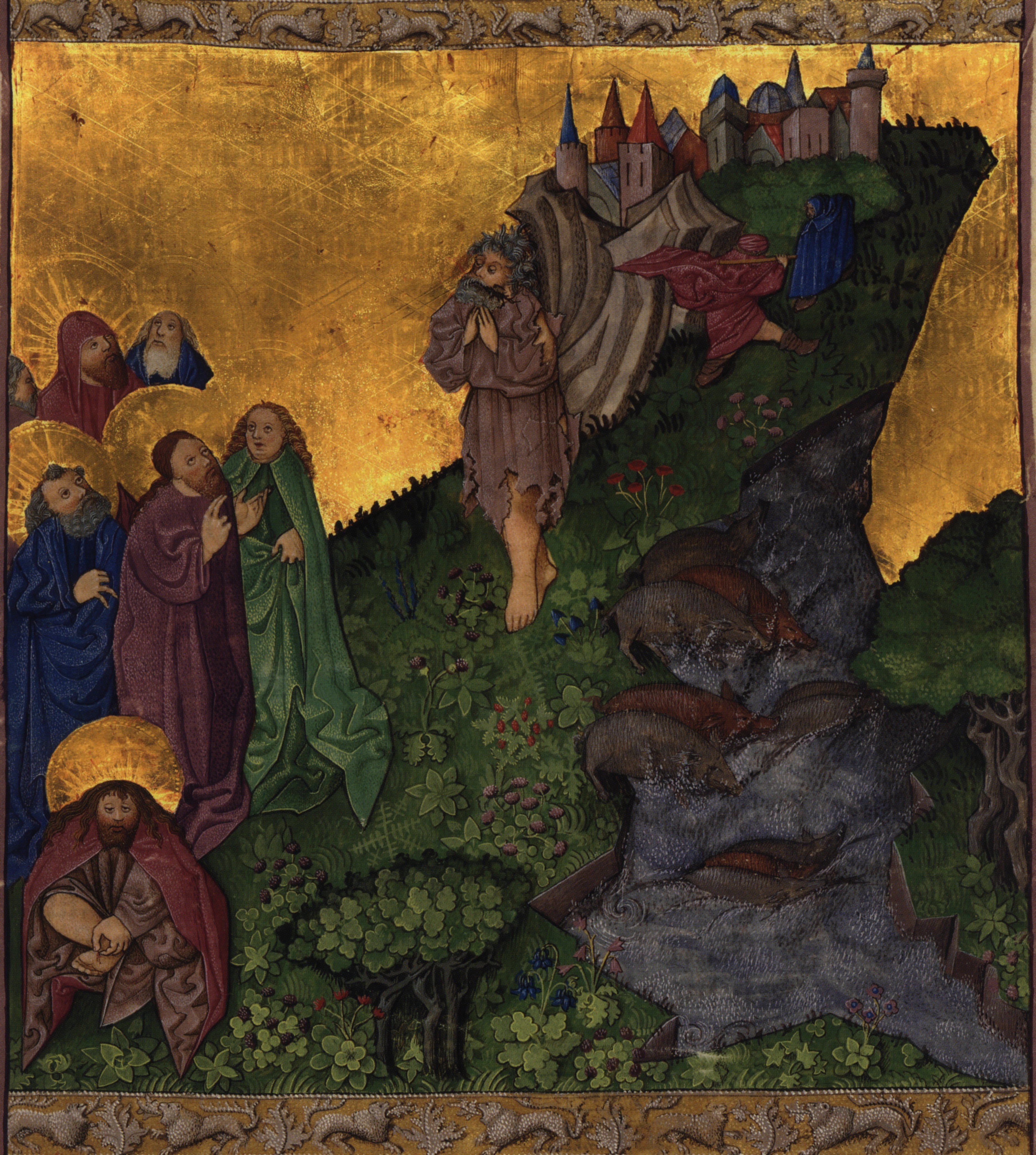
Medieval illumination of Jesus casting out demons and into pigs

A medieval illumination of Jesus exorcizing the Gerasene demoniac from the Ottheinrich Folio. You need to look carefully to see the pigs.

Almost exactly one year ago, I wrote this blog on the story we find in Mark 5:1-20 about Jesus, demons, and the pigs. The standard interpretations assume the pigs are mere dumb animals whose deaths are meaingingless. I explored a different way of reading it.

I thought I was balanced in what I presented and liked what I wrote. Other people have found it interesting as well. Only my post about Solomon has been read more. This suggests that the Bible story of the demon and the pigs is troubling for many people. They are looking for a way to reconcile the story with a loving Savior and Creator God.

Very recently, another blogger – Raymond Hermann – also wrote a piece about the same story and referenced my piece. You can find his thinking – “Demons, Jesus, and the Pigs” – here. It’s worth reading.

You’ll find that Hermann disagrees with me that there is a possibility that the pigs committed suicide rather than live in possession by the demons.

Here’s what Hermann writes:

I’m sorry, but I can’t buy that answer; pigs can’t think and reason like humans. It makes a lot more sense that, considering what the demons did to the two men, the pigs were just overwhelmed and went berserk (another word for being possessed by a demon), therefore causing their own death. Or maybe Jesus directed them to do so, as part of a lesson.

There is certainly no scientific consensus that animals can intentionally commit suicide.And I realize my proposition that the pigs might actually have done so is highly speculative. The insanity-by-berserkness approach seems possible.

Further Thinking

Hermann’s piece, however, compels me to make several points.

First, I encourage you to read Pig Tales: An Omnivore’s Quest for Sustainable Meat by Barry Estabrook. If you are open-minded, the book will expand your estimation of pigs and their intelligence. You’ll even read of pigs beating young children in video games.

What’s more, I’ve come to realize the real question at hand is not the reasoning intelligence of pigs. It is whether they, like us, have heart in the Biblical sense of the word.

If we have open minds, we will find that a surprising number of animals seem to have something that I would call heart. In an early blog post I shared the story of a group of elephants who traveled for up to 12 hours to stand outside of the home of Lawrence Anthony who had just passed away. He had helped them, protected them, and rehabilitated them over many years.

Or check out this story from San Francisco in 2005. It tells how a humpback whale showed appreciation to each of the six divers that had helped to free it from crab pot lines that had become wrapped around its body and threatened to drown it.

Second, while there is no definitive scientific consensus, that doesn’t mean that animal suicide does not happen.

By chance I’ve just finished reading Giants of the Monsoon Forest by Jacob Shell. It’s a fascinating book about the centuries-long use of Asian elephants for forestry and transporation in northern Burma. The relationship between the elephants and their riders (mahouts) is far more complex and nuanced than I had realized.

Shell shares this disturbing incident:

I heard of an awful story of another elephant, a mother, found dead one morning. She was still standing, her forefeet crushing her own trunk. Evidently she had committed suicide. I didn’t understand how this was possible. Surely, as she lost consciousness from lack of oxygen, she would voluntarily breathe through her mouth, or the trunk would jerk free.

Science, as we know, is a powerful human tool for understanding the world. But it has limits. It assumes that if something does not act in ways that provide consistent evidence through our senses, then it does not exist. This assumption causes Science to tend to dismiss explanations of animal behavior that suggest complex volition. It also causes Science to dismiss the idea of a Creator God who interacts in complex ways with people and the rest of Creation.

In fact, Science would tell us the idea of believing in the possibility of demons, much less Jesus interacting with supernatural creatures, is absurd.

So we need to carefully consider the judgments of Science regarding animal volition and will.

Shell relates a moving incident during World War II. A convoy of elephants ridden by mahouts were making their way with rice and other food supplies to British and American soldiers in a remote area of Burma. After a tragic miscommunication, a number of mahouts and elephants were killed. Shell writes:

While the surviving mahouts regrouped and debated what to do, some of the surviving elephants picked up their dead mahouts and carried them all the way back to the mahouts’ families in Chowkham, some sixty miles away.

Third, Hermann offers another explanation for why the pigs didn’t swim. He writes, “Or maybe Jesus directed them to do so, as part of a lesson.”

The text does not suggest this at all.

Fourth, referencing a commentary, Hermann shares another interpretation:

Or perhaps this is another possible example of a miracle that has a visible lesson—the point being that the deliverance of one man (or two) is worth the destruction of many pigs.

That conclusion reflects a self-focused way of looking at how God works. Clearly, within the story’s logic, Jesus didn’t need to grant the demons’ wish. Jesus could have destroyed the demons without using the pigs. So the deliverance of the man wasn’t dependent on the demons moving to another host.

Fifth, our tendency, and one that Hermann seems to go along with, is to intently look for distinctions between us and Creation. That informs how we understand what Jesus meant when he said we are worth more than sparrows in God’s eyes, it doesn’t register at all that Jesus was also saying that sparrows are worth something to God.

We seemingly can’t help but see things in a binary way. If we matter, we wrongly think, then the rest of Creation does not. We think, also wrongly, that if Creation matters then somehow our standing is diminished.

In fact, in this story, God’s living creatures and humanity clearly share something significant in common. Dark forces can possess both of us. And that possession causes us both misery and suffering.

Pigs and the Restoration of All Things

In Acts 3:21, we read of Peter saying of Jesus, “For he must remain in heaven until the time for the final restoration of all things, as God promised long ago through his holy prophets.”

I’m convinced “all things” means “all things.” And “all things” will include pigs.

It will also include the restoration of our respect and right relationship with all of God’s Creation. That is very good news indeed.

I’m happy to report that the North Suburban Mennonite Church in Libertyville, Illinois, has asked me to speak on Sunday, July 14th, during their service.

One of their members (and a good friend), Linda Wiens, had joined our second gathering earlier this year. After hearing me share some thoughts and insights there, she encouraged her congregation to invite me. This is the first time I’ll speak to a whole church. I’m looking forward to it.

And, well, “speak” is actually not the right word.

One of my observations about the typical worship service I’ve experienced is that the sermon and other elements can make people too passive. So I plan to break up my presentation into three parts. After each part, I will ask a question of the congregation and have a dialog with them around that question. My hope is that these dialog segments cause them to engage with my thoughts more actively in their hearts and minds.

I’m calling my presentation “Your Life of Faith and God’s Earth.” You will not be surprised to know that my core message is that a Christian’s life of faith is not whole if it doesn’t include God’s earth.

And by include I mean several things. God’s earth should be part of our core idea of what the story the Bible communicates with us. God’s earth and even God’s universe are part of what Jesus redeems. The ultimate future God will include a renewed earth. God’s earth communicates vital things to us about God. Our lives of faith (and faith is not faith if it is not lived!) must include God’s earth. And, in fact, our lives of faith are enriched and deepened by being attentive to God’s earth and by being good shepherds of it.

In short, we cannot say we love God and love our neighbors if we deplete, diminish, and trash God’s earth.

And the corollary to that is this – being a good shepherd of Creation as part of our individual and community lives contributes to the abundant life Jesus offers us.

As I work through the content of what I share, I’m wrestling with several challenges. One is that there is so much I want to share. The last five years or so have opened my eyes to an incredible variety of topics, connections, and insights. But one of the golden rules of effective speaking is to not overwhelm. Presentations, like our lives, often benefit from subtraction, not addition. So I will be working hard to share just the essentials.

The other challenge is the question of how the members of North Suburban Mennonite Church (and, by extension, any church and any Christian) should live out a whole faith that includes God’s earth.

On one hand, overwhelming peope with long to-do lists can be entirely unproducive. Conversely, it’s far too easy to give answers that are facile and shallow.

How do we navigate that tension?

Above all, I’m grateful for the opportunity to figure that out and to get feedback from a congregation I know is civic-minded and big-hearted.

If you’re in the area and would like to attend, it would be great to have you. The North Suburban Mennonite Church holds servcies at the Civic Center in downtown Libertyville, which is located at 135 W. Church St. They hold fellowship at 10 a.m. and the service begins at 10:30 a.m. Please let me know if you are coming. I’d certainly appreciate the support.

P.S. Speaking at this church is a homecoming of sorts. My family and I attended the congregation for about a year earlier in our lives. Learning about Mennonite history and theology and experiencing their close community expanded my ideas of what Christianity can and should be. I pray my message will be of value to them.

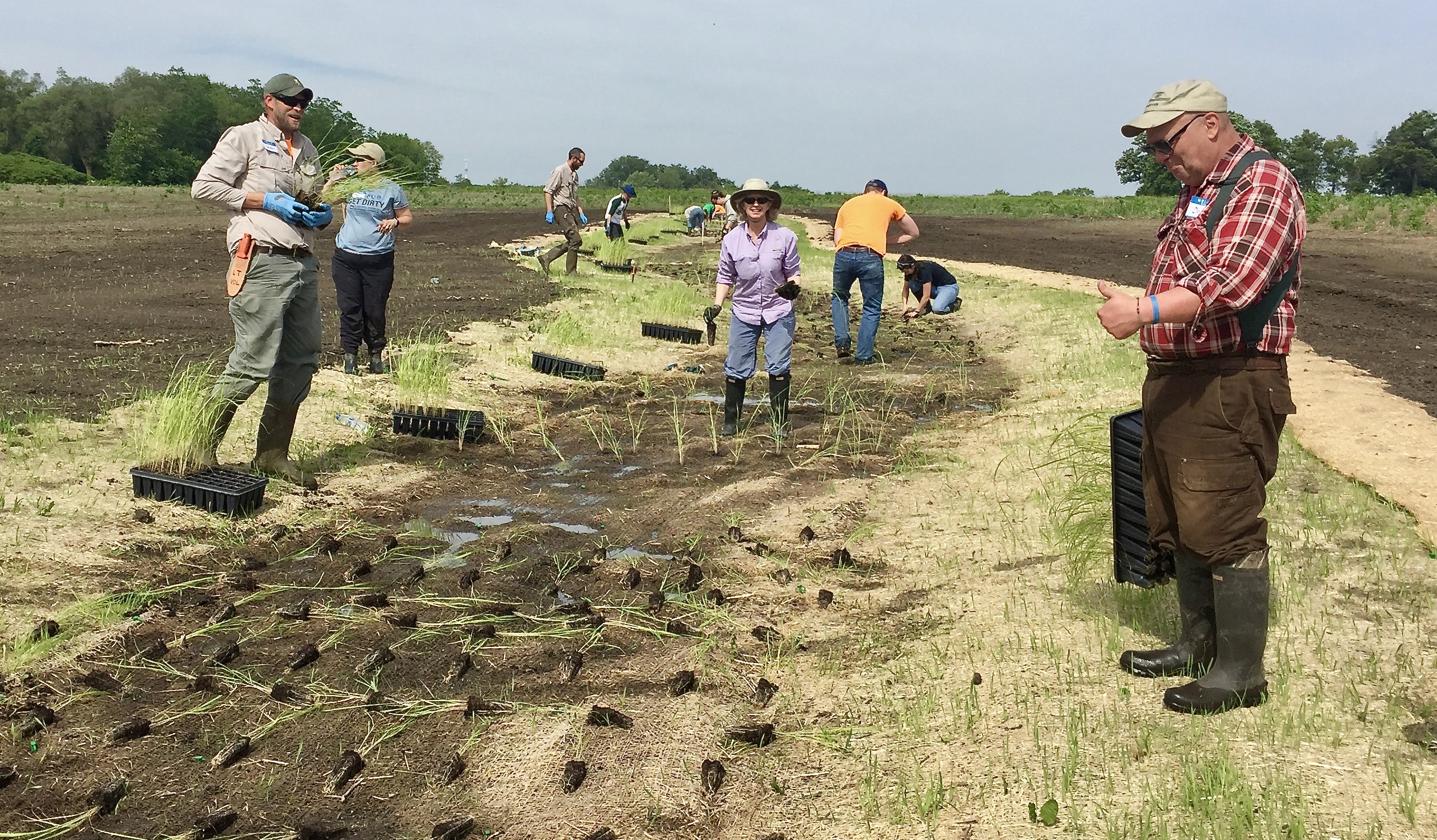
People standing and planting in former farm field

Over the weekend I joined about 20 other volunteers in helping one small corner of God’s earth make progress towards renewal. I want to encourage you to seek out opportunities like this in your own life. They’re out there.

In the photo above, you can see what we were doing – planting thousands of young prairie grasses where corn and soy beans used to be grown.

The Libertyville Township Open Space District has long owned this 44-acre parcel of land. For the last number of decades a farmer farmed it. Soil eroded, harming local waterways. Wildlife, including butterflies, found no food or sanctuary there.

The Open Space Disrict has begun restoring this field to prairie and oak savanna. In the first step, contractors removed 5,500 linear feet of drain tile from the field to allow water to more naturally infiltrate the land. But until diverse prairie vegetation can be established, preventing erosion is critical. This is why you see the erosion-preventing, bio-degradable mesh blankets in the photo.

And into that fabric volunteers are planting 10,000 young prairie grasses over two weekends. Specifically, we are planting prairie cord grass.

This is a favorite prairie plant of mine. Prairie cord grass likes its “feet” a bit wet. It also spreads quickly through energetic rhizomes. Pretty soon you have a thick, beautiful stand of green waving and undulating in the wind. Below the ground you have a thick, anchoring root system. This makes it perfect for erosion control.

For nearly three straight hours, we used hand-spades and even just our hands to create small gaps in the fabric. Once we had access to the soil, which was usually somewhere between being moist and water-covered muck, we dug a thin hole. Into that hole, we inserted the prairie cord grass plant. We then pressed the soil close around it.

If you don’t like sun, breeze, dirt on your hands, living things around you, and the chance to talk and even banter with people around you, then you should definitely avoid this kind of thing.

But I’m guessing you’re someone who would enjoy the experience. And, like it did for me, it would do your heart good. By the end, I felt tired and yet very alive and satisfied.

Being part of these kinds of projects is a way to honor and serve our Creator God. This is a natural part of a whole Christian faith. We should do what we can on as large a scale as we can to enable God’s earth to be as alive as possible and to recover from the wounds we have inflicted on it.

And doing so is a spiritual growth experience.

Look for opportunities like these. Non-profit land trusts and nature conservation organizations near you are a good place to start. Agencies like conservation districts, park disricts, and departments of natural resources are also well connected.

Dig in!