Some time ago I wrote about the 10 ways in which being committed to shepherding God’s earth deepens your faith.
I now feel compelled to explore the ways in which living as if Creation mattered to God tests us and challenges us.
There is an obvious but oft-overlooked reason why some Christians are averse to seriously shepherding God’s earth.
It’s because it can be just plain hard.
I believe, however, that when you know what’s coming, you can brace yourself. You can, at least to some degree, gird yourself mentally and emotionally for the challenge. I hope this is useful as you grow in determination to take on the challenges of Creation shepherding..
#1: Living in a World of Wounds
As human beings, it is fairly easy for you and me to imagine the pain that other human beings experience due to violence, poverty, and even emotional blows. At least it is if you had a childhood in which empathy was modeled for you and God’s Spirit has helped you be other-centered. It helps, too, if you have protected your heart as Proverbs 4:23 urges us to do. That can be radically hard to do today.
If we allow the Spirit to shape our hearts so they are open, pure, and child-like, we can have that same kind of empathetic imagination for Creation.
When we do, we will pay attention to Creation and eagerly learn more about it. We’ll carefully pay attention to trees, birds, bobcats, dolphins, soil microbiomes, and even the ecology of whole landscapes. We will actively restore life to Creation, tapping the regenerative ecological capacity God gave to it. When we use Creation, as we inevitably must, we will do the best we can to be respectful and reciprocally beneficial to God’s earth in ways that express love for God and our neighbor.
The expansion of your empathy beyond yourself and beyond humanity brings both profound kinship and vulnerability. This is because the more expansive your empathy the more easily you can imagine the pain and fear that beings in Creation experience. When you become convinced that the land, water, and living things around you are precious to God and when you know how beautiful Creation can be when fully healthy and complete, then you will begin to grasp how challenging we have made life for our Creation kin. Your heart will be wounded by the wounding of Creation.
You will also be aware of what you should see and hear but do not. There is a silence that is not the silence of peace but the silence of missing life. Being aware of that will cut your heart. You will feel pain at what is missing in Creation because of human sin.
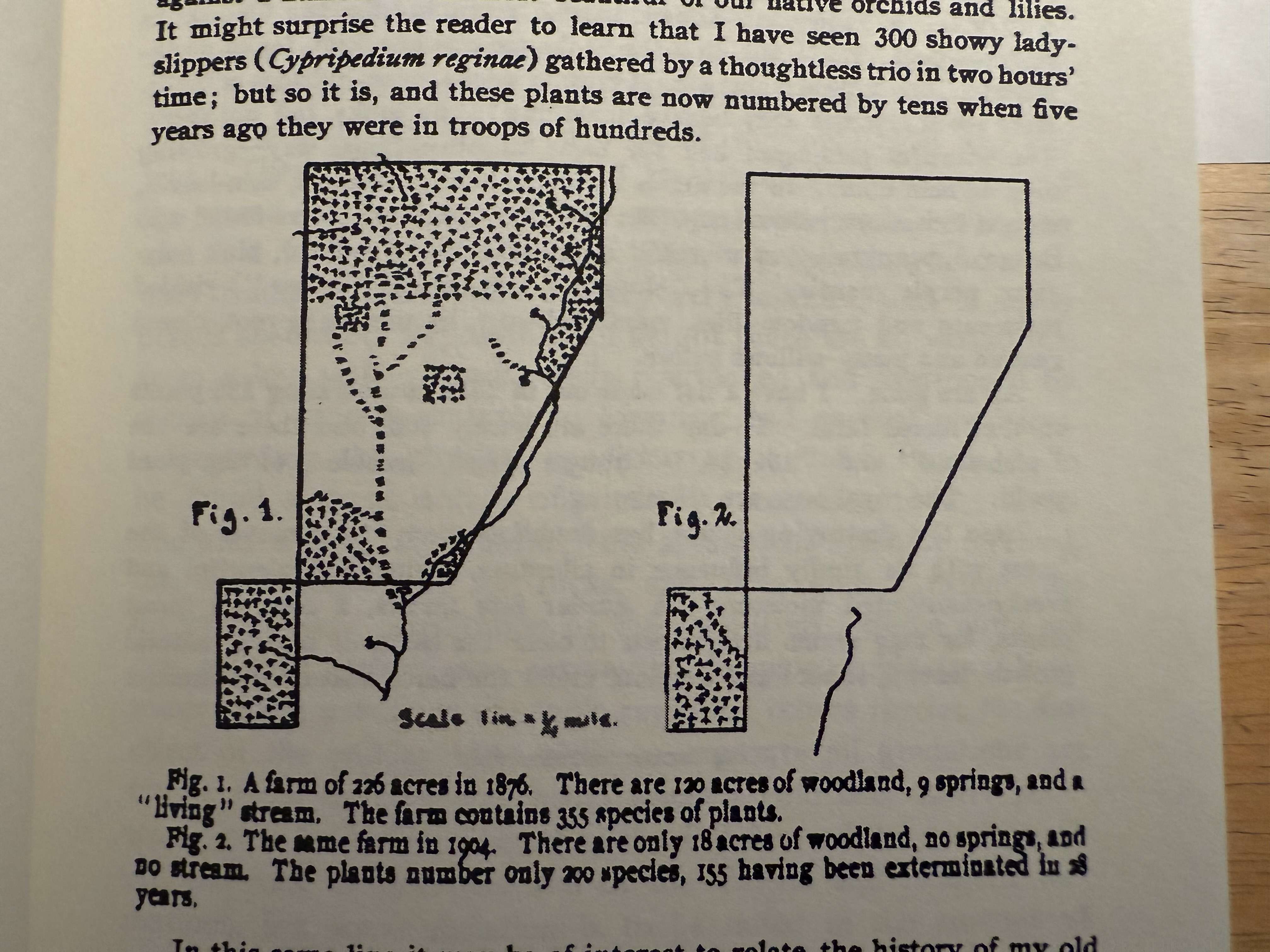
I have been reading some essays and papers by H.S. Pepoon, a biologist who documented the flora and fauna of Jo Daviess County, Illinois, (where we now live) more thoroughly than anyone else ever has post-settlement. In one short report, he documents the decline of life on his 226-acre family farm. In 1876, there were 355 species of plants. In 1904, there were just 200. One hundred fifty-five species were, as Pepoon writes, “exterminated in 28 years.” What, I wonder, is the state of that farm today? From what I’ve seen and what I know, I’m guessing the number is less than 50.
The decline of life on the Pepoon farm is a smaller version of what the whole world is experiencing on a much vaster scale.
When you take the blue whole faith pill of seeing what is happening to what our Creator God created, your heart can be broken..
#2: Living Alone in That World of Wounds
Ecologist and writer Aldo Leopold wrote: “One of the penalties of an ecological education is to live alone in a world of wounds.”
There are two pain points to which Leopold calls our attention. Seeing, thanks to one’s ecological education, the way humanity breaks the individual pieces and systems of nature is one “penalty” (what a euphemism, by the way). The other is experiencing the pain of that awareness largely alone.
Leopold was speaking largely of the loneliness experienced in American society as a whole.
I would argue, however, that there is a particular species of loneliness that Leopold probably did not understand. That is the loneliness of being among Christians who praise God for creating this world but who seemingly believe that God does not take personally how we treat it. Worse yet, some Christians will even criticize other Jesus followers who act compassionately and respectfully towards Creation do for being political, liberal, woke, or just plain unchristian. Facing that kind of critique and its accompanying personal castigation is no easy place to be.
Of course, being mindful of God’s earth does not represent a falling away from the roots of Christian understanding. The true situation is that mainstream Christian culture and theology have, in this area, fallen away from the roots of the Bible, the love of God, and God’s second scripture – Creation.
When you and I show concern for God’s living earth and question how it is used, we are actually bringing up uncomfortable truths. We are reminding others that the vineyard we are using is not actually ours. The criteria for what is right and wrong about our use of the vineyard is not what grows our power and wealth. The criteria for right and wrong is whether the vineyard owner will be pleased with the condition of the vineyard when the owner comes to reclaim it.
This all can complicate your experience of being in a local faith community. Do you compromise your principles? Or be a persistent voice in your community for Creation shepherding? Or take some kind of third path?
#3: Resetting Your Life Habits and Mission Overload
A Christian serious about a whole faith will, among many things, seek to create habits that daily reduce negative impacts on Creation and contribute to its regeneration. You wil, for example, think about what you eat. What you give to. How you treat your piece of God’s earth. How simply you live. It can be all-encompassing.
Between making a living, caring for family, maintaining a dwelling, and being involved in activities of one’s church, where does one make room for a real commitment to protecting and renewing God’s earth? All that needs changing can be overwhelming.
Creating new habits can be challenging. And when our lives are busy already, adding another layer of consciousness can seem like just too much to handle. This is especially true when a place we live in makes it hard to do good for God’s earth.
I can tell you, however, that you will eventually find that striving to be faithful and thoughtful in your life actions, including how your actions impact God’s earth, will grow your faith and increase your awareness of all of the world mattering to God. New choices will become new habits. Gradual yet tenacious effort will bear fruit over time. You will ultimately feel good, even as you realize we can never live perfectly.
#4: Between Faithful Response and Zealotry
The awareness of how frequently we interact with God’s earth and how marred Creation often is by our individual and collective actions can prompt a number of different responses.
One is overwhelm. This leads us to try to avoid thinking about it.
Another is a life of intense effort to be environmentally pure in every single act or habit of living. Because so many people don’t pay any attention to their life habits, this approach could actually seem extreme. Choose not to eat meat from an inhumanely treated pig? The average person might consider you a zealot.
A zealot, however, is not someone who builds habits so that they are as faithful as possible in a particular area of life, like the shepherding of Creation.
Zealotry, in my mind, is something different. Zealotry is when your passion for purity in one area of life overwhelms faithfulness in other areas of life. It is when purity in one area of life becomes the sole measure of your life’s morality.
Let’s consider the example of being invited to a new neighbor’s houses for a party. The food is not food that is healthy nor raised and produced in ways good for Creation, one’s farmer neighbors, nor their communities. Do you reject it all?
That might be pure, but how would your new neighbors understand your reaction? And what would your rejection or abstaining do? The food is already produced and purchased. Your new neighbors might have no frame of reference for understanding why you are acting the way you are. If they’re not Christian and they know you are, that might impact their impression of you and your family. Are you loving your neighbor in that situation?
Living out a whole faith with intentionality and consistency while avoiding zealotry requires God’s help and wisdom. It means paying attention to all of the facets of our life and all of the facets of what it means to love God and love our neighbor and follow Jesus.
It’s hard, but not impossible, to do this.
#5: Caught in Tsunami-Scale Systems
Almost all that we do every day is a form of interaction with God’s earth. The food you and I eat (even the food that is not really food) comes from God’s earth and the work of our neighbors.
Our furniture comes from God’s earth, whether it be from trees or petroleum by way of plastic. Our clothes come from the earth. So do our cars and homes. Plastics are a sadly good example of how our wizard-like powers to transform petroleum into everything from plastic bags to plastic bottles have the unintended consequences of poisoning Creation and ourselves. The growth of artificial intelligence technology is taking our energy and water consumption for virtual activities to a whole new and disturbing level.
Yet, how does one live without being part of the depletion of Creation? How could one change global systems?
Abstaining from eating factory farmed meat, although it is a good and righteous thing to do and sends a virtuous economic signal, does not change the system of factory farming that dominates places like Iowa.
Walking and biking as much as possible, as good and righteous as that they are, does not change our world’s consumption of fossil fuels on a system’s level.
Individual good deeds are not enough to turn us around from systems that degrade the life out of the earth on a massive scale.
This is one of the biggest challenges I experience in caring about the fate of God’s earth.
I believe in building habits of faithfulness in our everyday lives towards other people and Creation. I want to believe that if enough people do good things that that will contribute to a better world.
But it is clear that there is a tsunami of larger forces and trends at work. It is also clear we live in a world in which laws (or a lack of laws) and systems often enable the strong and powerful to take advantage of the weak, whether the weak are the poor or vulnerable beings of Creation.
Can better systems be built on local scales? Absolutely. There are example all around the world. But will those examples replace the systems degrading God’s people and world? It’s not clear to me that will happen before God brings a new heave and new earth. And that is, at least for me, a heavy thing to live with.
#6 Running Upstream Against Economic Nationalism
The power of a country, including its military power, depends in large part on economic power. Economic power is derived, in large part, by the extraction of wealth from Creation.. It logically follows that if you and I speak up for restraining humanity from extractive and violent uses of Creation in our community or country, then we could be seen as obstacles to success, wealth, and power.
And calling for restraint and restrictions on how individuals, businesses, and national institutions will use Creation also puts us at risk for being seen as unpatriotic. Nationalists, even Christian nationalists, will castigate us. Or worse.
A recent article from Inside Climate News shared this:
Since Global Witness began tracking annual deaths in 2012, more than 2,253 environmental defenders have been murdered or disappeared. Many of the victims opposed extractive industries, such as mining, logging and industrial agriculture, or had challenged systemic issues like organized crime and land theft.
These sad and tragic statistics mostly come from countries like Colombia and Guatemala. Someday, if we extrapolate from current trends, there could well be similar violence done in the United States, as our country becomes increasingly ruled by power rather than by law.
Being faithful isn’t so hard when your version of being faithful fits neatly within the value system of the dominant ruling class of the country you live in. But if your country’s actions and systems are counter to actual Christian values, like the shepherding of Creation, then being faithful will put you at personal risk.
Nevertheless, we are first and foremost patriots for God’s Kingdom.
#7 Torn Between Present Anguish and the Joyous Certainty of Renewal
Seriously shepherding Creation compels you to wrestle with the one of the paradoxes of the Christian faith. On one hand, violence done to the fabric of God’s people and world is a clear and present sin that should provoke outrage in us. On the other hand, we have confidence that people and all of Creation will someday have an eternal, joyful existence with God.
This is difficult to live with and process.
One of the reasons I’ve not released a blog since August is that I’ve been struggling with this post for months now. It has been hard to get it to a point that feels complete, authentic, and clear. And this paradox in particular twists my heart and mind into a knot.
I don’t know what face to show the world. Or how to organize my own attitudes.
There are Christian leaders in the Creation care field who seem to only show a positive, upbeat face to the world. I believe this is, in part, because they believe the voice of lament and grim anger is not winsome. I also believe this is because the Gospel’s message of hope and future world renovation fills their hearts so much there is no room for sadness and doubt. I admire their work, but the one-dimensional tone of optimism doesn’t land for me.
I also find that I don’t feel at home in faith communities where every service is 100% full of optimism and happiness.
And with that statement, I’m sure there are some readers who will feel I have gone completely off of the deep end. How, you might ask, can the Christian faith be anything but positive, hopeful, and reassuring?
Let me be clear – worshiping in hope and joyous faithfulness is a powerful centering force for my heart and mind.
But wouldn’t there be good that came from reminders, both in content and tone, that the reason the Good News is such good news is that Jesus came because God hates to see all of Creation so dysfunctional, so warped, so full of pain and frustration?
And isn’t it Good News that our salvation, our being turned by God towards Him and filled with God’s Spirit, equips us for good works in this world so darkness is pushed back, even just a little?
We are meant for being God’s active and good presence in this world. We are called to address the pain and dysfunction of the world.
There is a line of Christian theology that says the conviction that all will be put right does not have to reduce the energy of the conviction that we must step forward to address the world’s sickness from sin. It makes some sense in theory. But it feels like the practical default application is for Christians to feel that injustice towards people and Creation is unfortunate but acceptable collateral damage. There can be easy rationalization for minor responses or just plain inaction.
Life would be easier for me if I accepted pat theological answers and focused only on the happy ending Christian theology tell us is coming. But I can tell when I’m not yet fully convinced in the deepest depths of my soul.
I find the mixture of emotional chords in the Bible resonates with me in a way that I have a hard time finding in church.
I am, for example, challenged by the prophets. There is so much strident, unsettling, harsh emotion there. Yet, simultaneously, there is also hope and faith in the compassion of God. I find Isaiah 11 to be one of the most moving and inspirational chapters in the Bible, especially the ninth verse:
They will neither harm nor destroy
on all my holy mountain,
for the earth will be filled with the knowledge of the Lord
as the waters cover the sea.
The prophets did not believe the exile of the people of Israel was the final word, but their words expressed deep outrage at the idolatry and injustice that caused God’s judgment. They lamented the fall and captivity of Israel, even as they had faith that there would be a return. That is the kind of paradox I believe we need to lean into.
When was the last time your liturgy dived deep into the prophets on a regular basis?
Interestingly enough, Jesus brought those same paradoxical chords of tone and message. He was full of both love and sharp outrage. I am convinced, even though I don’t know exactly how to apply the conclusion in my life, that we need to be Christ-like in this way. Getting the balance right is no easy thing.
My hope is that these reflections strengthen your faith and prepared you for the challenges of doing what you and I are meant to do – love God, love our neighbor, confront injustice, and be the image of God for all of Creation. May you and I do so with 100% commitment that comes from a whole life-faith centered on Jesus. Jesus offers us both an easy yoke and a life purpose that will stretch us and grow us beyond what we might have expected.
Let’s lean into that.