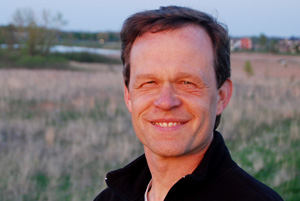
In late June I began a new job. I am the president & CEO of the Jo Daviess Conservation Foundation, a non-profit land trust working in Jo Daviess County and surrounding areas in northwest Illinois. It also operates the Casper Creek Natural Cemetery that offers green burials that are profoundly meaningful and generous to God’s earth.
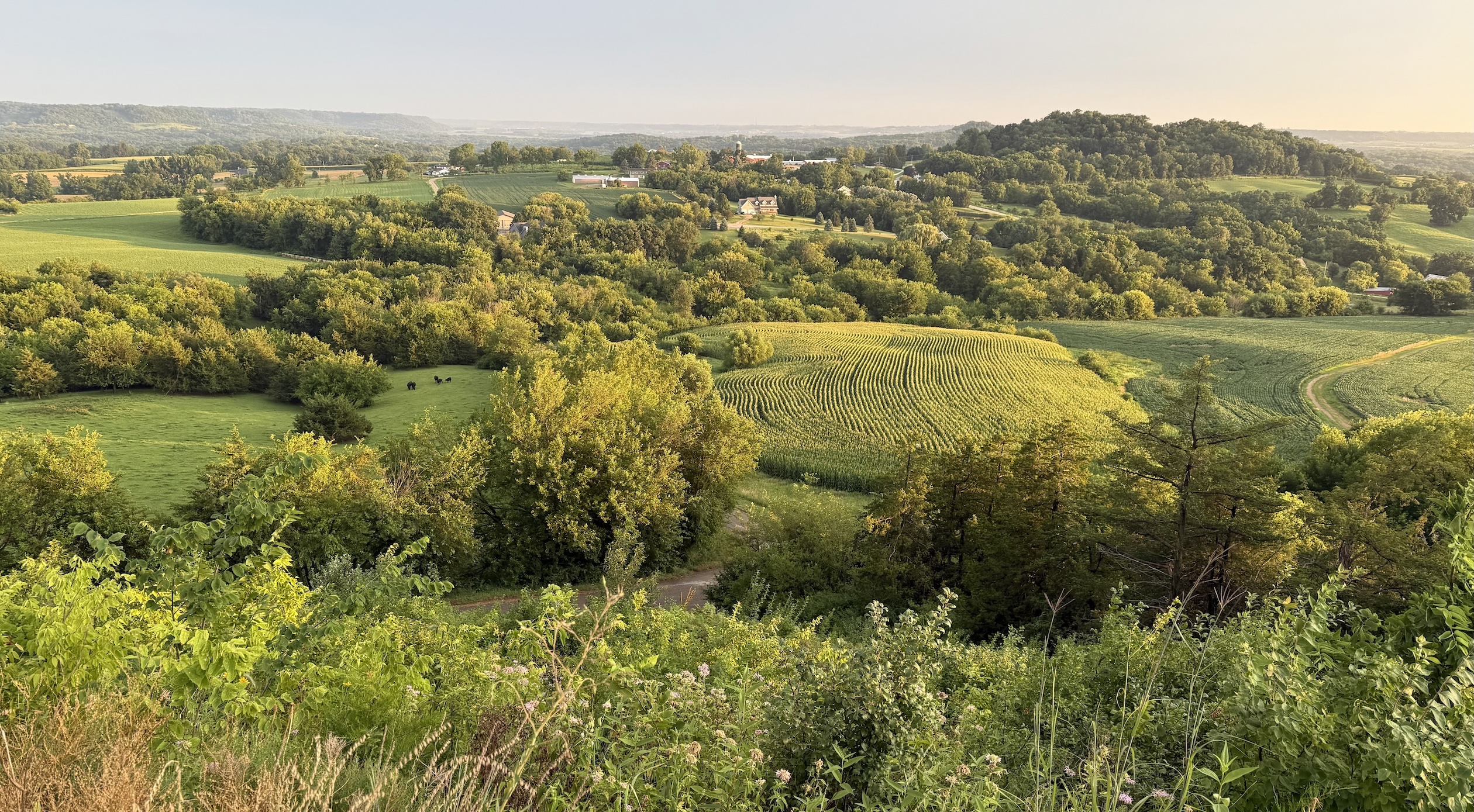
It’s a wonderful place to be. Jo Daviess County is part of the Driftless region, a geographic area in the Upper Midwest that glaciers never blanketed. As a result, it offers a rolling topography that creates striking landscape vistas that your eyes eagerly drink in.
Taking its natural beauty and habitat value to another level is its western border – the vast Mississippi River. (In the photo it is just slightly visible far in background to the right of the bluffs.)
What I am also encountering is a community of people who have deep ties to the land and water of this particular place. Some are transplants, like Mayumi and me, who felt drawn here. Some are the latest generation of families with multi-generational continuity who couldn’t imagine living anywhere else. And, more recently, I am meeting indigenous people that our organization is partnering with so they can again walk the lands where their ancestors lived and died.
Just recently, I had the chance to talk with a man who stewards a property in the region. We talked about wildlife he’s seen.
That led to a conversation about timber rattlesnakes. This part of Illinois, with its forests and rocky bluffs, supplemented by interspersed prairies, was prime habitat for them. But the destruction of habitat and relentless persecution have pretty much eliminated this remarkable animal from this area.
Amazingly enough, the gentleman had encountered a few of those creatures in the county over the years.
One he saw was coiled up on a gravel road that sees a decent amount of vehicle traffic. Fearing for the snake’s safety, he stopped his vehicle and began trying to figure out how to persuade the reptile to get off of the road. Before he could get that done, he noticed a car approaching. He moved toward the car waving his hands.
The vehicle stopped. He walked up and explained to the driver what he was doing – trying to rescue the rattlesnake from being injured or killed.
The driver looked at him and asked, quite seriously, “Are you crazy??”
I’m not sure how the land manager answered that question, but the driver did wait. The Good Samaritan did get the snake to move off of the road.
Why go to that trouble and take some risk in the process?
It can take a little or alot of craziness to respect and protect God’s Creation.
But that craziness is in the same chord of values as loving your neighbor or forgiving people who hurt you. And that craziness feels in tune with loving this world so much that you, the Creator, would send your only son so that people would have the option of having abundant life now and forever.
I came away from hearing that story from the land steward with my heart a little lighter.
Here in Jo Daviess County, I am happy to say I have met many other people similar to that land steward. Their warm and energetic personalities are generally matched with dedication to doing what they can for the prosperity of God’s earth. This doesn’t mean what they have done has been easy. They have faced challenges and obstacles. People around them have not always understood.
If I have to choose between being considered normal for doing things that take away the life of God’s earth and being considered crazy for doing the opposite, I’ll take the crazy. I am convinced it is a good and faithful crazy.
P.S. After I wrote this, I found an interesting essay by Sean Peter Michael. It articulates, from a Catholic perspective, why Christians should readily accept being considered odd by the rest of the world. Sadly, Michael never comes close to suggesting that living thoughtfully and compassionately with God’s world is also a pillar of loving God.