Archives For Agitations

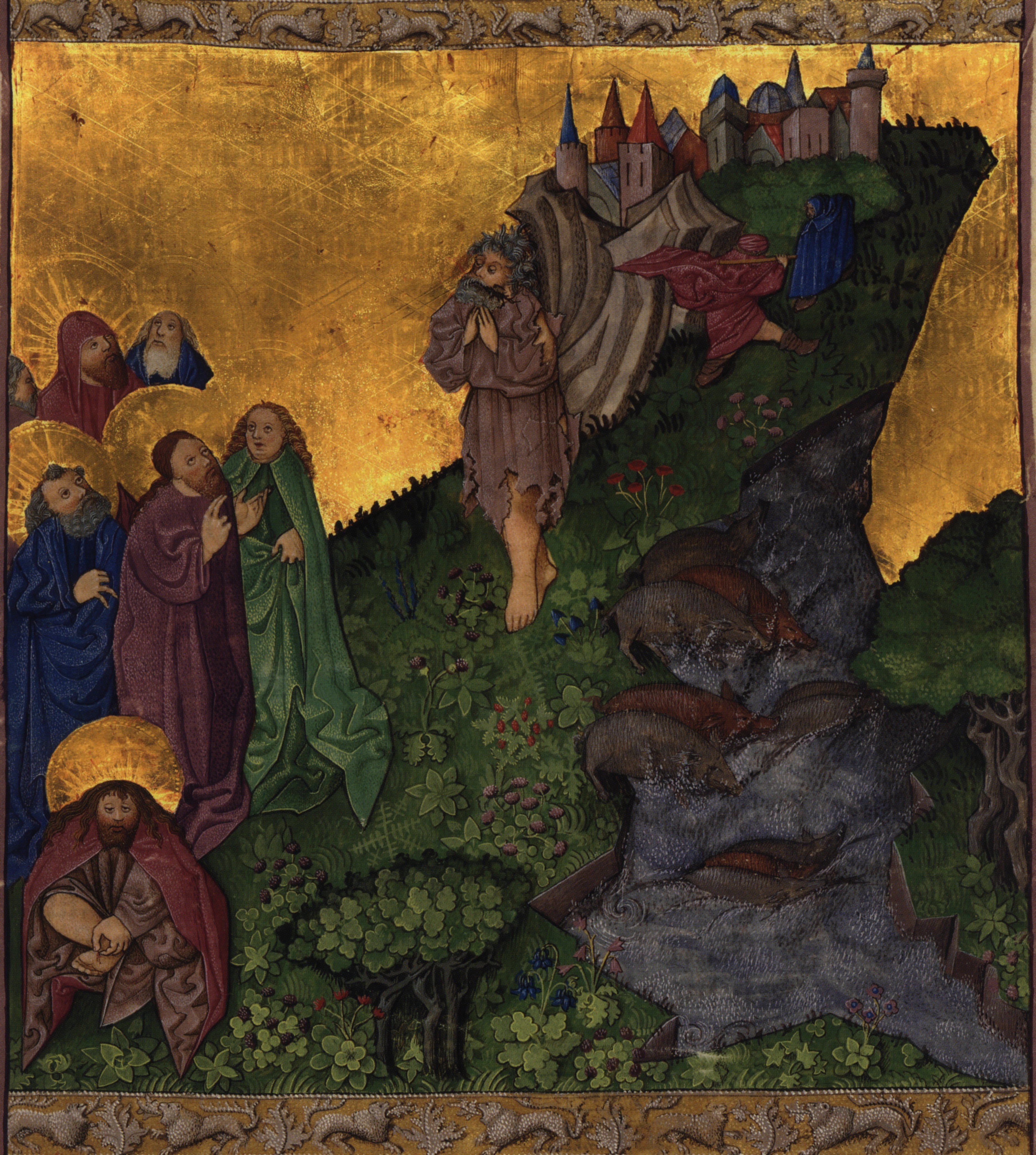
Medieval illumination of Jesus casting out demons and into pigs

A medieval illumination of Jesus exorcizing the Gerasene demoniac from the Ottheinrich Folio. You need to look carefully to see the pigs.

Almost exactly one year ago, I wrote this blog on the story we find in Mark 5:1-20 about Jesus, demons, and the pigs. The standard interpretations assume the pigs are mere dumb animals whose deaths are meaingingless. I explored a different way of reading it.

I thought I was balanced in what I presented and liked what I wrote. Other people have found it interesting as well. Only my post about Solomon has been read more. This suggests that the Bible story of the demon and the pigs is troubling for many people. They are looking for a way to reconcile the story with a loving Savior and Creator God.

Very recently, another blogger – Raymond Hermann – also wrote a piece about the same story and referenced my piece. You can find his thinking – “Demons, Jesus, and the Pigs” – here. It’s worth reading.

You’ll find that Hermann disagrees with me that there is a possibility that the pigs committed suicide rather than live in possession by the demons.

Here’s what Hermann writes:

I’m sorry, but I can’t buy that answer; pigs can’t think and reason like humans. It makes a lot more sense that, considering what the demons did to the two men, the pigs were just overwhelmed and went berserk (another word for being possessed by a demon), therefore causing their own death. Or maybe Jesus directed them to do so, as part of a lesson.

There is certainly no scientific consensus that animals can intentionally commit suicide.And I realize my proposition that the pigs might actually have done so is highly speculative. The insanity-by-berserkness approach seems possible.

Further Thinking

Hermann’s piece, however, compels me to make several points.

First, I encourage you to read Pig Tales: An Omnivore’s Quest for Sustainable Meat by Barry Estabrook. If you are open-minded, the book will expand your estimation of pigs and their intelligence. You’ll even read of pigs beating young children in video games.

What’s more, I’ve come to realize the real question at hand is not the reasoning intelligence of pigs. It is whether they, like us, have heart in the Biblical sense of the word.

If we have open minds, we will find that a surprising number of animals seem to have something that I would call heart. In an early blog post I shared the story of a group of elephants who traveled for up to 12 hours to stand outside of the home of Lawrence Anthony who had just passed away. He had helped them, protected them, and rehabilitated them over many years.

Or check out this story from San Francisco in 2005. It tells how a humpback whale showed appreciation to each of the six divers that had helped to free it from crab pot lines that had become wrapped around its body and threatened to drown it.

Second, while there is no definitive scientific consensus, that doesn’t mean that animal suicide does not happen.

By chance I’ve just finished reading Giants of the Monsoon Forest by Jacob Shell. It’s a fascinating book about the centuries-long use of Asian elephants for forestry and transporation in northern Burma. The relationship between the elephants and their riders (mahouts) is far more complex and nuanced than I had realized.

Shell shares this disturbing incident:

I heard of an awful story of another elephant, a mother, found dead one morning. She was still standing, her forefeet crushing her own trunk. Evidently she had committed suicide. I didn’t understand how this was possible. Surely, as she lost consciousness from lack of oxygen, she would voluntarily breathe through her mouth, or the trunk would jerk free.

Science, as we know, is a powerful human tool for understanding the world. But it has limits. It assumes that if something does not act in ways that provide consistent evidence through our senses, then it does not exist. This assumption causes Science to tend to dismiss explanations of animal behavior that suggest complex volition. It also causes Science to dismiss the idea of a Creator God who interacts in complex ways with people and the rest of Creation.

In fact, Science would tell us the idea of believing in the possibility of demons, much less Jesus interacting with supernatural creatures, is absurd.

So we need to carefully consider the judgments of Science regarding animal volition and will.

Shell relates a moving incident during World War II. A convoy of elephants ridden by mahouts were making their way with rice and other food supplies to British and American soldiers in a remote area of Burma. After a tragic miscommunication, a number of mahouts and elephants were killed. Shell writes:

While the surviving mahouts regrouped and debated what to do, some of the surviving elephants picked up their dead mahouts and carried them all the way back to the mahouts’ families in Chowkham, some sixty miles away.

Third, Hermann offers another explanation for why the pigs didn’t swim. He writes, “Or maybe Jesus directed them to do so, as part of a lesson.”

The text does not suggest this at all.

Fourth, referencing a commentary, Hermann shares another interpretation:

Or perhaps this is another possible example of a miracle that has a visible lesson—the point being that the deliverance of one man (or two) is worth the destruction of many pigs.

That conclusion reflects a self-focused way of looking at how God works. Clearly, within the story’s logic, Jesus didn’t need to grant the demons’ wish. Jesus could have destroyed the demons without using the pigs. So the deliverance of the man wasn’t dependent on the demons moving to another host.

Fifth, our tendency, and one that Hermann seems to go along with, is to intently look for distinctions between us and Creation. That informs how we understand what Jesus meant when he said we are worth more than sparrows in God’s eyes, it doesn’t register at all that Jesus was also saying that sparrows are worth something to God.

We seemingly can’t help but see things in a binary way. If we matter, we wrongly think, then the rest of Creation does not. We think, also wrongly, that if Creation matters then somehow our standing is diminished.

In fact, in this story, God’s living creatures and humanity clearly share something significant in common. Dark forces can possess both of us. And that possession causes us both misery and suffering.

Pigs and the Restoration of All Things

In Acts 3:21, we read of Peter saying of Jesus, “For he must remain in heaven until the time for the final restoration of all things, as God promised long ago through his holy prophets.”

I’m convinced “all things” means “all things.” And “all things” will include pigs.

It will also include the restoration of our respect and right relationship with all of God’s Creation. That is very good news indeed.

Have you had the experience where dealing with a problem couldn’t just be one of a million things on your to-do list?

Perhaps it was a loved one getting seriously sick. Perhaps it was a crisis at work. Perhaps a rising river threatened to flood your community. You joined in with others building walls with sandbags for hours on end. You had to do something about it above all else. The rest of your normal routines had to fall away. Bills and sleep could wait.

When an issue is urgent, tangible and very specific, we respond to that issue with all that we have. We put everything else aside.

It’s much harder for us to respond that way when the causes of the challenge are broad and hard to see and when the impacts are incremental. This sums up the general human experience with things like national debt, education system dysfunction, cultural decline, and crumbling infrastructure.

This is even more true of problems for the rest of Creation. Our civilization dams up rivers, creates dead zones, depletes fisheries, degrades soils, and destroys and fragments habitat. Where God’s living things once lived there is only silence and stillness. If we’re aware at all, we may feel bad, but our lives carry us along.

Greta Thunberg, a 16-year old girl from Sweden, is challenging all of us in this regard. She is a rare person who won’t accept the collapse of the commons.

She has stopped going to school in order to protest at the Swedish Parliament and to bring attention to the dire threat that is global climate chaos. She is now speaking around the world. The world is paying close attention.

Like a prophet, Greta speaks powerfully and directly. Diagnosed with Aspergers, her intense focus and directness are sometimes disconcerting. She believes, in fact, that her Aspergers has driven her to become an activist. It has been a gift.

“The politics that’s needed to prevent the climate catastrophe—it doesn’t exist today,” said Greta in a New Yorker article about her. “We need to change the system, as if we were in crisis, as if there were a war going on.”

You should watch her speech to the United Nations. Her example is prompting other students around the world to start school strikes and protests as well.

So where are the Christian Greta Thunbergs?

Climate change chaos is causing tremendous disruption and harm for people around the globe, especially the poor. Farmers around the world are becoming increasingly desperate. It is also accelerating the extinction crisis to a new level.

Greta learned of all this and couldn’t believe people weren’t in crisis mode and acting at all levels of life. She stopped speaking. Eventually, she began a new path of life.

How do we as Christians not raise the alarm and jettison our normal routines as well?

Why aren’t there new Christian prophets completely devoted to urging commitment to God that will translate into better ways of living at the individual level and at the community and national level? What is wrong with Christian culture that many Christians don’t care or worse? Are we not paying attention? Or have our hearts not been changed by our faith? Can we love God and love our neighbor and yet pretend all of this is not happening?

Three things come to mind as I consider those questions.

First, my impression is that Christians don’t have a good track record of taking care of God’s earth. We have tended to go along with the dominant culture in which we find ourselves. If Christian Greta Thunbergs emerged and Christians responded to them, it would be the first time in history Christians stepped forward as a whole body of Christ based on the conviction that God’s earth mattered.

Why is this? I’m going to be writing occasional blogs as a way to dive further into this topic. There are, I believe, multiple reasons.

Second, two verses from the Bible come to mind. In Luke 14:5 we read this: “Then he asked them, “If one of you has a child or an ox that falls into a well on the Sabbath day, will you not immediately pull it out?””

Being deeply devoted to keeping the Sabbath was one of the central features of the Jewish faith-culture. Jesus was making clear that nothing should stand in the way of compassion for people and non-human life we have responsibility for. Ignoring the cries of one’s child and the moaning of an ox while going to worship God would be completely contrary to who God is. It would also be an indication that the state of our heart is rotten. Following the routine, even the routine of holy worship, would be wrong.

Consider, too, Proverbs 21:3: “To do what is right and just is more acceptable to the LORD than sacrifice.”

Today, through communications, we better understand what is happening around the world then ever before. Our economies are more interdependent than ever before. In some ways, due to the development of technology, the condition of the earth is collectively ours more than ever before. The systems we are part of shape and reshape other places around the world. So when we hear of pain and destruction to people and life beyond our family, I would suggest the core principles at hand are the same as what Jesus asked in Luke and what we read in Proverbs.

Third, I can’t help noticing that, despite my convictions, I’ve largely gone along with my normal routine.

If I’m aware of all of these issues and have these convictions, why haven’t I done more of what Greta Thunberg has done?

The excuses and rationalizations have loud voices in my head. I have a family. My parents are failing. Someone else will surely do something. This is when I realize I sound alot like the people in the Gospels who wouldn’t follow Jesus because they had obligations to life as usual.

The whole Chrisitan faith-life includes putting your faith into action and your life on the line in pursuit of what God desires.

So do I really believe? Am I really committed to following Jesus? What would I do if I was?

And why do I feel alone struggling with these questions?


I’ve decided to fast and pray on Earth Day.

This is a step in a continuing odyssey for me.

Listening to a podcast recently lit the kindling of my awareness that fasting has a long history of being a powerful Christian spiritual practice. I have also long believed that a Christian faith that does not spiritual transform ones’ faith-life is not really faith at all. I will be trying my first focused fast on Good Friday with that same motivation.

My intense spiritual struggle over the condition of God’s earth also motivates me. My heart alternates between breaking at the condiition of God’s earth and intense anger. For reasons not entirely clear to me, I am acutely aware of the wounds of God’s earth. Sometimes I wish I could turn off that sensitivity. I am also painfully aware that few people of faith seem to care with any urgency. And the ones who do, including me, struggle to find meaningful traction and direction in taking meaningful, large-scale action that will alter the course our world is on (Gabe Brown is one exception).

My faith struggles mightily with all this.

So I am going to see where this leads. I recognize many Christians do not associate Earth Day nor God’s earth with their faith. Likewise, many of the people who are acting energetically and sacrificially to defend and restore Gods’ earth do not associate Christians with Earth Day either. Over time, I would like to change this. But I must start with myself.


Motivations

I seek the following from my Earth Day fast.

Open My Heart to God

Here is a great quote from Cistercian monk Charles Cummings in The Sacred Art of Fasting by Thomas Ryan. “The more I try to make Christ the center of my life and thoughts and actions, the more I feel every pull and tug that draws me back from the radical, loving surrender of myself.

YouTube, sports, and a host of small matters distract me. These cause me to be deaf to God and his callings as they relate to family, neighbors, and Creation.

I am hopeful that I wil experience a closer connection to God through this fast. I desire the Holy Spirit to fill me so what is uniquely me is creatively directed towards God’s ways. I want to give God’s will highest priority. Even as I write that, part of me is afraid of allowing that to happen. May this fast reduce or eliminate that fear.

Full Mourning

I sometimes retreat from allowing myself to feel the full grief of how much we have defaced the beauty and goodness of the natural world. I want my grief “circuit breaker” removed. I need to dive into that grief.

The grief over the empty forests of Vietnam. Poaching wars over the last great animals of Africa. More thatn 750 impaired (meaning chronically sick and depleted) streams and rivers in Iowa, largely due to the way we farm and raise animals. The decimation of Haiti’s forests. Emerging dead zones (like the one in the Gulf of Mexico. The list goes on and on. People and Creation suffer from all of this.

David mourned by fasting after the deaths of Saul and Jonathan (2 Samuel 1:12) and the death of his son Abner (2 Samuel 3:32-35).  Nehemiah fasted in grief over the state of the Jewish people who had returned to Jerusalem and the condition of Jerusalem itself – the wall broken down, gates burned by fire (Nehemiah 1:4). Mourning and grief for God’s earth through fasting and prayer seems wholly appropriate.

Deep Repentance

I want to express deep penance for what we have done to God’s oceans and lands and for the part I have played in it.

I also want to express regret for the fact that Christianity has largely been AWOL from the struggle to cherish God’s earth. And, in fact, too often economic philosophies and political ideologies have used a misrepresented Christianity as religious legimitization for advocating degrading uses of God’s earth.

But repentance is much more than feeling sorry and feeling regret. I’ve recently learned that the Greek word metanoia that we translate as “repent” has a deeper meaning. It means a transformation of our hearts and minds. Father Gregory Boyle of Homeboy Industries articulates it like this: “to go beyond the mind we have.” I will pray that I and many other Christians will go beyond the hearts and minds we have to a loving spirit that cherishes all that is God’s. What isn’t God’s?

Visceral kinship

I believe the fast will help me better appreciate the plight of the poor harmed by climate change and the plight of birds, mammals, insects, fish and other life who find it ever harder to survive in the world we are unraveling.

Seeking direction for action

In Esther 4:16, we read of Esther asking the Jewish people to fast before she visits King Ahasuerus uninvited. She will do so to seek save the Jewish  people from destruction and at the risk of her life. Moses and Jesus both fasted for 40 days before key points in their missions on earth.

I need further wisdom and discernment about where I should focus my energies in trying to defend and renew God’s earth. I hope to gain it while fasting.

Intensify my prayers for Creation and its defenders

Are you praying for Creation along with your prayers for family, friends, and yourself? I do, but I feel compelled to do more. We should also pray for the scientists (like Katharine Hayhoe), advocates, and regular people who are putting their hearts and minds to the service of Gods’ Creation and the people who depend on it. They struggle against the powers and dominions of this world. Their hearts are broken by what they see unfolding. They are trolled viciously. Sometimes they are killed because their words and actions would stop powerful people from making money.

Learn to LIve with Limits

Our appetites tend to be our masters. This is true of our individual lives. This is true of our economic-political systems. Adam and Eve’s sin was ultimately about not accepting a limit on their desire. I struggle with limits on my appetites. And when my appetites for distraction and security fill up our lives then we have little life and love left to give to God’s purposes. I seek God’s help in loving limits and loving God’s ways.

Seek Joy and Hope

This year Earth Day is the day after Easter. That proximity is unusual, and it calls attention to the fact that Christ’s life, death, and resurrection are good news for all of Creation.

I desperately need to remember that good news and to fully experience the joy it contains even in the midst of this crazy, broken world. And by remember I mean a confidence that fills my bones and heart, not just a doctrinal assent.

I believe It is fully understandable and acceptable to be outraged and full of despair at the injustices of the world that harm people and Creation. The Bible gives us many resources for expressing outrage, doubt, and misery. We are not fully human if we can look at injustice in any form, shrug it off, and go on to a Netflix binge.

Yet, our faith also calls us to hold joy in our hearts even as we struggle with brokenness and evil. God loves us and the whole world and has expressed grace and love to us through Jesus. God’s mercy does endure forever. God will make everything right some day. I need direction for action and light in my heart.


How exactly this will work

I will begin with a sunrise-to-sunset fast on Good Friday to deepen my experience of remembering the crucifixion of Jesus. Then, on Easter evening, I intend to eat dinner with my family before going on a water-only fast until after sunset on Monday (Earth Day) when I will have dinner again with my family. I will still be working during the day.

In The Sacred Art of Fasting, I read that it is really not a spiritual fast if one does life completely as one would normally would. So I plan to take a walk and pray during the time I would normally eat lunch. I also plan to pray whenever I feel hunger pains and between tasks.

Since fasting is typically combined with almsgiving in Christian tradition, I plan to honor that tradition but will do so in a different way. I will make a contribution to a conservation organization that is protecting habit so that God’s living things have places to live and food to eat.


I Welcome Fast Companions

I originally thought I would make a big push to encourage you and others I know who share deep concern for God’s earth to join me in this fast. Having friends to communicate with during the day for mutual encouragement would certainly be wonderful. But I’ve decided to focus this first attempt on my own exploration of this practice. This will enable me to speak from experience for Earth Day 2020.

If you do decide you want to join me, please email me at wholefaithlivingearth@gmail.com. We can arrange to share phone numbers so we can create a text group during the day.

I strongly encourage you to do some research on fasting before you do it. If you have any health issues that would make a food fast a risk for you, please consider a fast from something else.  And if you haven’t fasted before, please consider starting slow – perhaps skipping just lunch or doing a juice fast.

Your prayers would also be welcome.

Yes to Natural Burials

Nathan Aaberg —  November 30, 2018 — Leave a comment
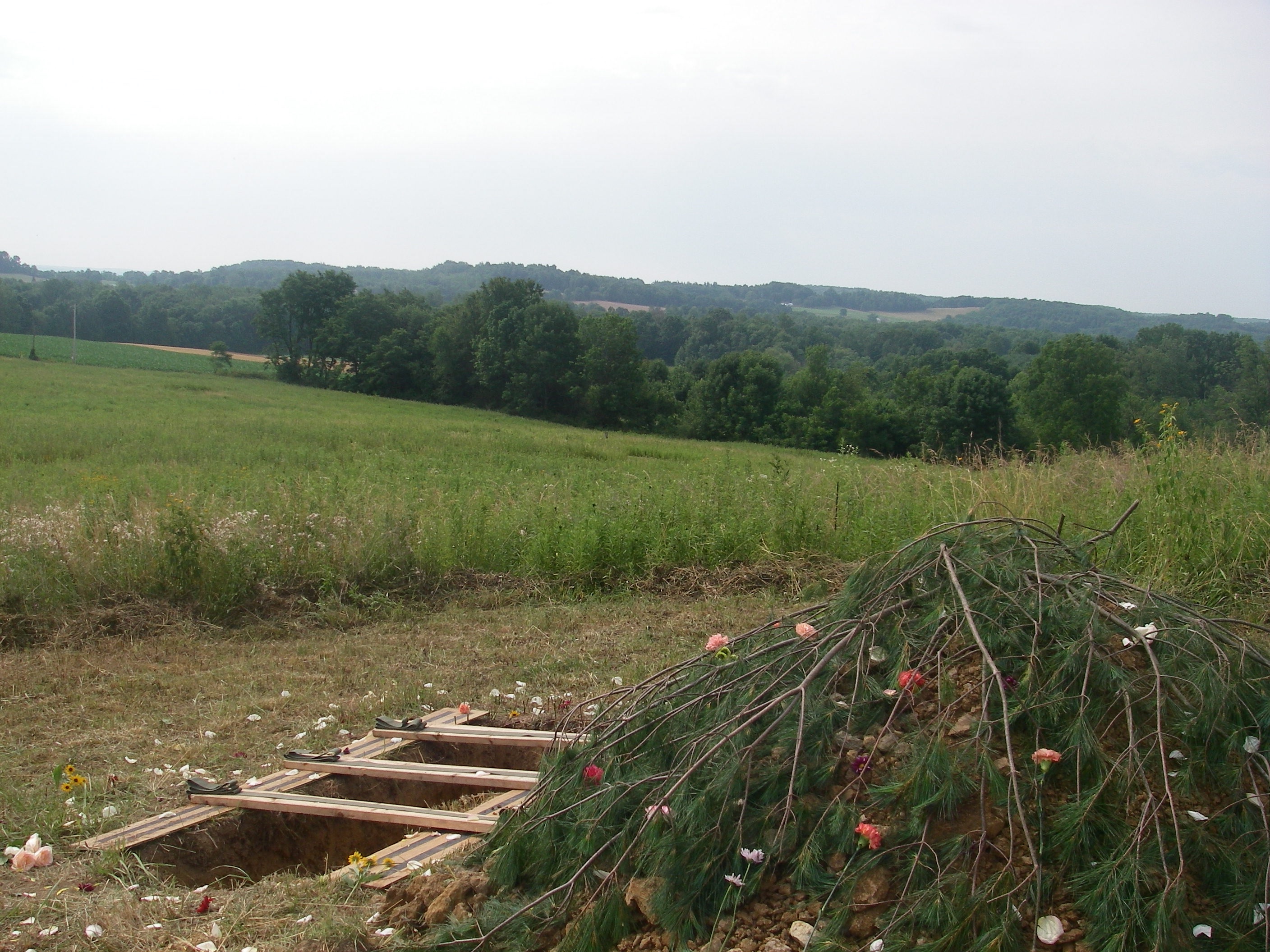
In rolling Ohio landscape hole for burial has been opened in meadow with pine branches nearby for covering after burial.

A site prepared for a natural burial at the Foxfield Preserve in Wilmot, Ohio. (Photo courtesy of Foxfield Preserve)

Interest is growing in natural burials. That’s good news for people interested in living (and dying) in the ways of a whole Christian faith.

I experienced this firsthand when I attended a session entitled “Dying for Conservation” recently at the Land Trust Alliance’s annual conference in Pittsburgh. The session featured representatives from a number of organizations that are operating conservation-oriented natural burial cemeteries in several eastern states.

One of the speakers was Jeff Corney, executive director of The Wilderness Center in Ohio. He spoke about his motivations to more widely promote the organization’s natural burial ground (Foxfield Preserve) and its conservation benefits. When his father died, their family had proceeded with a conventional burial. By the end of the whole experience, he was convinced the whole process was wrong. It was all wrong because it was not in keeping at all with his father’s life or their family’s values. His heart sank.

Foxfield Preserve is one of a growing number of conservation burial cemeteries around the country. In these places people are buried naturally as part of a larger effort to restore and manage natural habitats in those places. A portion of the fees paid for the burial often funds those restoration and management activities. In this way a person’s death contributes to the life of God’s earth.

This is an encouraging trend. Christians should embrace this with enthusiasm and support. In fact, as I wrote in this earlier blog, whole faith churches should make this the new normal.

Because it’s so much a part of our culture, we often overlook a defining moment of disconnection in the usual burial ritual we attend. At the graveside service a pastor will often use the phrase “dust to dust” in reference to Ecclesiastes 3:20. Yet, everything in the way the body has been treated and the way in which it will be buried is intended to prevent our dust from returning to the dust.

There are at least two reasons why this profound dissonance between the worldview of the Bible and how we actually bury our dead matters.

First, if you believe the earth is God’s, then damaging and diminishing God’s earth is something you will want to avoid at all costs,  This should especially be true when it comes to a spiritual-cultural moment of profound meaning.

Yet, we allow the river of culture and tradition to carry us away from our actual values.

Here’s a concise rundown of the cost to God’s Creation that comes from an article in Forbes by Laura Moss in 2011:

Embalming bodies requires cancer-causing chemicals like formaldehyde, glutaraldehyde and phenol — in fact, every year in the U.S. we bury 827,060 gallons of embalming fluid. Plus, caskets are often made from mined metals, toxic plastic or endangered wood. U.S. cemeteries use 30 million board feet of hardwoods, 180,544,000 pounds of steel and 5,400,000 pounds of copper and bronze annually. Casket burials also prevent a corpse from decomposing efficiently, and this slow rotting process favors sulfur-loving bacteria, which can harm nearby water sources.

Obviously, the exact numbers have likely shifted, but the general consequences remain the same.

All of that chemical and industrial activity is designed to prevent the vessel that is our body from naturally being recycled back into God’s earth. Yet, we are compostable!

This is not even to mention the fact that the conventional cemetery itself is a largely sterile and dead landscape. Vast areas of lawn are doused with weed-killing chemicals and mowed regularly by lawnmowers with internal combustion engines.

If your loved one loved God and cherished God’s Creation, you’d have to conclude that the whole process fundamentally contradicts your loved one’s values.

And there’s another reason why our burial rituals matter.

My son and I are reading the Bible together in lieu of confirmation classes. We just finished up Numbers. One of the things we came to better appreciate, especially with the help of the writings of Rabbi Jonathan Sacks, was the way God integrated extensive rituals and laws into the everyday life of the people of Israel.

In his essay “Neuroscience and Ritual,” Rabbi Sacks notes that:

…much of our behavior is driven by instincts that lie beneath conscious awareness and the rational, reflective part of the brain, the prefrontal cortex. The question then arises: How, if our instincts are largely unconscious, can we change them? The short answer is ritual: Ritual is behavior that bypasses the prefrontal cortex. It is action based not on a ritual decision that this is how we should act. Rather, it is behavior that follows a precise set of rules, a fixed choreography. Doing certain acts repeatedly, we form new “habits of the heart” that work at an unconscious level to form new patterns of instinctual behavior.

In other words, rituals shape the hearts of the people carrying them out. And from those shaped hearts come habits of behavior.

As Jesus said in Luke 6:45: “Good people bring good things out of the good stored up in their heart, and evil people bring evil things out of the evil stored up in their heart…”

Unfortunately, our death and burial rituals form wrong habits of the heart as they relate to Creation. Our unconscious comes to understand that death and mortality are things to be afraid of and to deny. At a heart level we understand that we are separate from the life of God’s earth. We absorb the understanding that our eternal destinies and Creation’s eternal destiny are completely different. We deny a Biblical and scientific truth – we are made of dust.

Above all, our burials and our burial places assert a selfish dominion that is the oppostie of what we see in God. They reflect in their tangible details an odd hybrid of Greek philosophy and American industrial culture.

When our core rituals reflect ways in opposition to God’s ways is it any wonder that the rest of our lives do as well?

In that context, the trend towards narual burials and especially those that contribute to conservation of God’s earth is doubly positive. The trend offers hope for particular patches of land and water where people are buried. We can renew the life of what we have been charged to tend and mend.

What’s more, choosing to bury naturally offers hope for renewing the ground that shapes everything else – the landscape of our hearts and souls.

I plan to post some links to related articles on my Twitter feed. I hope you’ll follow it.


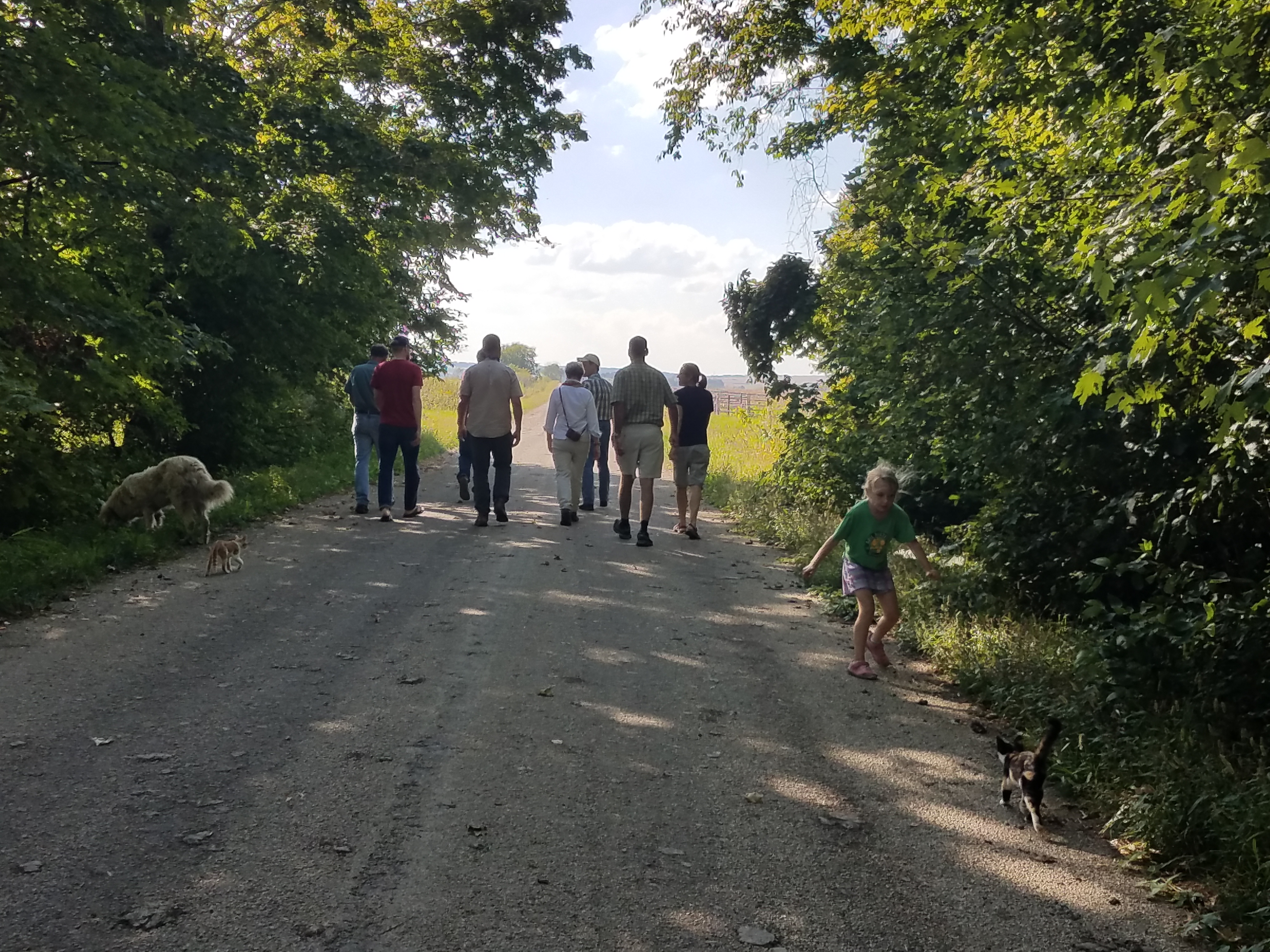
Group of people from the gathering walk down Riemer Road

I’ve known for some time that I needed to take a step beyond this blog. Intentions became actions when I organized a gathering of fellow Christians who care deeply about God’s earth on a Sunday late in September. I thought you’d like to read about it.

Thanks to the hospitality of Jen and Bryce Riemer, we gathered at the Riemer Family Farm in Brodhead, Wisconsin. Our potluck featured delicious food: fresh salads, Indian lentils, meatballs made from the pasture-raised animals of the Riemers’ farm, Asian pears, zucchini bread, and chocolate chocolate chip cookies made by the Riemers’ daughters.

While we ate and for awhile after, we shared our faith journeys and how our lives have been shaped by the conviction that God’s earth is of great value and importance. All of us were hungry to do this. All of us also shared the rewards and challenges of living out this conviction.

The attendees included a couple who have been running an ecologically-minded tree care company for decades, the director of community relations from the Au Sable Institute, an artist who is also the volunteer steward of two natural areas in Lake County, a land manager for a forest preserve district, a non-profit staff member working to promote sustainable farming (me), an occupational therapist who also gardens organically and teaches tai chi, and an organic grain farmer.

Later, I shared ideas I have on what collective action we could take going forward. In the discussion that followed, there was general consensus that we need to start with gathering together as a network. Through this network we can find ways to inspire each other, support each other, and even take action together. We closed this portion of the event with heartfelt prayer.

Jen and Bryce then led us on a tour of their farm fields where land long farmed in corn and beans is being converted to perennial pasture for rotational grazing of livestock. Rotational grazing on well-managed pasture has a multitude of benefits. It is good for the land and water, for habitat, for the health of the animals, and for the quality of the meat.

About 400 yards away, we could see a massive dairy factory farm’s new metal structures and barren earth. As this industrial farm facility gears up to full operating capacity, it will eventually house 6,000 cows. These living creatures of God will be kept inside 24/7 365 days a week to maximize efficiency and productivity. The contrast with the Riemer’s farm could not have been more stark.

For three years, the Riemers had led the local fight against the startup of this dairy Confined Animal Feeding Operation (CAFO) to try to prevent the damage to community and environment that they bring. This fight was ultimately unsuccessful. Its operations, which are not even at full scale yet, have already forced a neighboring family to move because their their children couldn’t breathe.

Yet, the Riemers have shown amazing grace and are seeing other opportunities to grow sustainable, humane, God-honoring farming out of the situation.

A highlight of our touring was when we passed the trees on the edges of the Riemers’ fields. Clouds of monarch butterflies flew up from the branches of the trees and all around us. The trees offered shelter for the monarchs as they rested together during their long southward migration. This was a fitting benediction to the day.

Thoughts and Insights

Several thoughts and realizations emerged from the gathering and from our conversations:

* The vast majority of people (and not just Christians) are profoundly disconnected from Creation and how it works.

* A feeling of isolation is common for Christians like us. The Au Sable director shared how many of the friends of Au Sable that he had been visiting have started crying when asked why they supported the Institute. They cried because Au Sable is one of the few outlets they have for being part of a Christian community that values Creation.

• We have felt the judgment of other Christians. Stories were told of other Christians suspiciously assuming that if one cared about God’s earth and acted to protect it then one was almost certainly on the road to becoming an earth worshipper and abortion rights supporter.

* Why is it that secular scientists and advocates are the ones mobilizing people to address the destruction being done to God’s earth on an epic scale and not churches and Christians?

* Sharing the message that God’s earth matters to God should be done with patient grace. Zealous judgmentalism will not help.

* Despite the many challenges, we were also reminded of the power of God to change hearts and transform lives. We heard of a Christian farmer who is now in the process of transitioning his 2,200-acre operation to organic methods. He chose to do this, in part, because of his children’s interest and desire to see Creation treated well.

*Our time of fellowship was deeply meaningful. One participant said, “I don’t want to leave and never see you all again.”

Another gathering is in the works. If you are in the Midwest and would like to be invited to the next one, please email me at naaberg19 at gmail.com. If you’re not in the Midwest, know that we hope to share what we learn from these gatherings. We would hope, too, that other groups of Christians will organize similarly elsewhere.

I don’t know where this is going exactly. But, with God’s help, it will keep going.