I’m currently working on two blog posts. One is the transcription of a great conversation I had with a Wisconsin farm family about how their faith has led them to a form of livestock raising that rejuvenates the land, produces healthy food, and is good for the animals. The other examines Revelation 5:13 and what that means for our understanding of the whole arc of the Bible and of time itself. I’m also planning to partner on some future posts with Ryan O’Connor to share reviews of documentaries and other environment-focused resources that individuals and churches would find helpful.

I can’t, however, ignore these turbulent times and the election. So I am going to dive in with some observations in the form of a letter to a fictitious cousin. I present him as someone becoming curious about Jesus and the God of the whole Bible but confused and even unsettled by our current times.

Dear Wyatt;

I want to say how much I have enjoyed our renewed relationship. We’ll need to get together sometime some place in the middle with our wives and children. I know we’d have a great time. It’s a heartwarming to not only connect with family but then to find one shares many similar outlooks on the world.

I’ve welcomed the fact that we’ve begun discussing the Bible, Jesus, and how everything all fits together. Our common ancestors had some very deep religious roots, didn’t they? But those have not carried into the modern generation very well. Many of our extended family no longer believe in the God their ancestors did. Why that is the case would make for another good conversation.

But I write because in our last converation you expressed confusion and even cynicism about the veracity of what is in the Bible because of the state of our country and the upcoming election. Specifically, you did not understand how so many people calling themselves Christians can be strong supporters of President Trump and the Republican Party.

I didn’t have good answers, but I felt I should. This letter is my attempt to do that.

When I need to wrestle with hard questions, I turn to writing. Good writing can only come from clear thinking. So forcing myself to write coherrently on an issue forces my mind to think about the issue squarely. When I find a line of insight that hangs together well, I take it, even if it takes me in a surprising and unorthodox direction.

I’ll be honest. I am having a difficult time making sense of our country and the role many Christians are playing in its direction. I feel anger, frustration, fear, and sometimes pure hopelessness. But every morning I pray, and I try to hold on to faith. In Jesus I know that God also understands our suffering even as God also calls for us to live with the love and courage of Jesus.

So I offer my own opinions to the questions that seem to be at the heart of what you are struggling with. These are my opinions based on what I read in the Bible and what I believe I have learned about God and Jesus over the years.

What would a truly Christian approach to politics look like?

Every Single Thing: All of life would be lived out in ways that reflect God’s wishes and God’s ways. And that includes politics.

Even Words: Words are the fundamental foundation of politics. Our use of words is an ethical and spiritual act. The words of Christians must be full of truth and show love of neighbor, even in the world of politics. Politicians, of course, lie and misrepresent so often that we are calloused to it. But God is not. And it’s time for us to stop being calloused about it, too. Christian politicians, and the politicians Christians support, would be at a level of truth and integrity above all others.

Cautious About Power: Politics is largely about how power is used in and outside of a country. Governments have power to make rules, to enforce rules, and to exercise in our international relations. True Christian politics would be cautious about the use of power and would be concerned for the vulnerable and the poor. You cannot escape the concern in the Bible for the vulnerable and those who do not have power. Both oppressive governments and overly dominant business interests run counter to the grain of the Bible. This never means that power is to be avoided. Government can play a wise role in directing society’s common interests. Private entrepreneurial creativity can bring great benefits. But a Christian politics would continually push for the right balance.

God’s Kingdom and Values Above All: The loyalty of the Christian should always be first to God and God’s Kingdom. When the values of God’s Kingdom clash with our country’s interests or our party’s fortunes, God’s Kingdom must come first.

Rules and Laws: Christians and the people they allow to lead them should have the highest character. They should follow laws and rules zealously and be as fair as possible. Corruption and exploiting the system for personal or party gain are, again, grievous sins against God. Christians can’t accept these kinds of actions.

Humility and Openness to Rebuke: Christian politics are inherently humble. True Christians reocgnize that they are fallen and that they need God’s grace just as their neighors have fallen and also need God’s grace. True Christians are open to correction and rebuke and are ready to change their own ways.

How can we make sense of strong Christian support for Donald Trump and the modern day Republican Party?

I agree with everything you have said about the current president. He breaks all of the Christian norms of life and the principles of Christian politics I’ve just listed. That church-going Christians can vote for Trump reflects an approach to Christianity and life untethered from the Bible, Jesus, and the Spirit of God.

A vote for Trump, it appears to me, is part of a reaction among conservative Christians against a growing secular and atheistic culture. That culture appears openly hostile and dismissive of people of faith. This is a real thing. But that is no excuse for voting for Trump and the Republican Party he is making in his image.

How to explain it?

Start with the marriage between the Church and national power. When Chrisitanity first appeared, it was seen as a radical, strange, subversive movement that was antithetical to Roman values and Roman power. When Emperor Constantine made Christianity the Roman Empire’s religion, Roman interests and Christian interests were brought together in ways that resulted in a less pure practice of the Christian faith. When Christianity became married to nation states, the interests of the nation state and its dominant culture then tempted churches to compromise the values of Jesus. Vice President Pence epitomizes the moral compromises conservative Christianity is willing to make for national power to serve its interests.

It is not just American national power that conservative Christianity has become very comfortable with. Conservative Christianity tends to favor the corporate and individual’s freedom to use power almost without limit. It worships freedom without any hint that freedom must be balanced with responsibility and ethical concern for others and other life that God loves. It is also comfortable with the political system today that is lubricated largely by funding from business interests. Republican Christians look the other way when power is cunningly used to suppress voting and gerrymander voting districts.

You must still ask why does this cruel and unbiblical approach to power find a home in the hearts of some Christians? When you feel you are in a spiritual war, then I think it is easier to go along with harsh measures and to look away from the worst things your allies do. The dominant narrative of the End Times, which is not the only interpretation of Revelation possible, gives conservative Christians license to feel that we are in a take-no-prisoners struggle against evil. The ethics of Jesus no longer apply.

Finally, we need to be honest about race. President Trump has made the Republican Party the comfortable home for white power and white racism. Christian Republicans go along with this. Could this reflect the comfort that many churches had with cruel slavery for centuries?

But what about abortion?

Wyatt, I can read your thoughts. I know you and your wife have deep emotions and convictions around abortion, especially because of your experience with having difficultty conceiving. You and wife also know the intricacies of the life and development of a child in the womb.

It is this issue that causes many Christians to vote Republican. The concern of many Republican Christians for unborn babies is sincere, real, and full of true Christian compassion.

But there is something very wrong in how myopic Republicans apply their pro-life principles. I’ve already written about this. Use laws to limit abortions? Of course. The more the better. Use laws to limit polluition and chemicals that cause cancers and harm God’s life? No. That will harm our economy and limit our freedoms. Use laws and government bodies to protect vulnerable consumers? No. Too much government interference. Use laws to protect coverage for existing conditions and offer a public health care option? No. That might nudge us into the orbit of something that smells a little like socialism.

In short, the pro-life position of Republicans is, it seems to me, in direct contradiction to the Repubican Party’s larger fealty to a completely unfettered free market economy and culture that supports commercial interests over people and God’s earth. The cynic in me sees the Republican Party’s pro-life platform as a deal that doesn’t harm business interests but gives the party’s Darwinian approach to the economy a sheen of religious goodness.

Why do I not feel enthusiasm for Democrats?

A second term of president by Donald Trump would be a disaster for many true Christain values and for the ability of the faith to appeal to people like you for decades to come.

But the Democratic Party is also a hard place in which to find a home.

Here are just a few reasons why I say that.

Joe Biden, from all indications, is a fundamentally decent person. Our government under Joe Biden would work again and not be corrupt. His administration would adopt many specific policy measures that are more compassionate.

However, one of his deficiiencies, which is a Democratic deficiency, is an inability to speak of positive values that hold together the Democratic Party and would hold together America. The Democratic Party is too often a loose coalition of interest and identity groups. The Party doesn’t seem to have binding principles that would resonate with most Americans of good will.

What will hold our country together as one? What standards does everyone need to live by? I have not heard anything like that from Democrats. And the fact that the pro-lifers are largely unwelcome in Democratic circles indicates that Democrats are not fully committed to holding people accountable to protecting vulnerable life

It has also been stunning that Joe Biden and Kamala Harris have not been able to speak against China what is doing internally  and externally. This is a ruthless empire within its own borders (see Hong Kong and with the Uighurs for examples) and beyond. Freedom and fairness mean nothing to its leaders. When Democratics go soft on China out of fear of loss of trade, one cannot help but think the Democratic Party’s concerns about justice are very selective.

And, of course, there is a tendency in some progessive circles to dismiss and ridicule people of faith, especially the Christian faith. Is some of it a reaction to the trends we’ve seen in conservative Christianity? Probably. But there is something more there as well. The ideas that there might be a God who holds people accountable for certain standards of life and there might be mysterious power in the universe that does not fit with orthodox science are profoundly threatening to the most progressive Democrats. And the most progressive Democrats tend to be comfortable with shutting down ideas and thoughts that don’t fit their own orthodoxies.

As a whole faith Christian, I’m sad to say I cannot truly be at home in either party. And our two party system freezes out true potlical diversity that could actually give us a party of integrity and coherent values.

If Christians can differ so much about American politics, what does it say about the Christian Faith?

My wife recently received an email from another church member strongly encouraging church members on the email chain to vote Republican. In a follow-up exchange with my wife, the church member called President Trump “a God-fearing man.”

If President Trump is considered a “God-fearing man” then the Scriptures and two thousand years of the Christian faith and thousands more of Jewish traditions are meaningless.

In short, we’ve crossed a line. The term “Christian” no longer means anything.

There is no commonly accepted definition for what the Christian faith-life really looks like.

There are some who will point to confessions and doctrines as giving us those distinctions. But doctrinal correctness matched with consistent patterns of behavior  and philosophy that are the opposite of virtue in the Bible is meaningless. In fact, it is worse than meaningless. It mars the goodness and truth of God and God’s wishes for the world.

A transformed life in communion with God is the point of giving one’s life to God, not an optional amenity.

Is there any reason to continue to look for a church or some other faith gathering?

The Bible is full of people living in communities of God-following people. So it is ideal to be with other people of faith. If you can find a church where God is worshipped and you feel comfortable and challenged, that is a beauiful thing. There are millions of sincere, loving Christians around the world, and many are in churches.

But I’ve concluded that you and I should not feel guilty if we find that our reading of the whole Bible makes us feel comfortable neither with conservative churches nor more liberal ones.

Remember, conventional church is not the only option. Prophets and prophetic communities can be needed when mainline religion is no longer a good fit. The early Christian gatherings were largely in people’s homes. Remember, the first monastic orders were in reaction to the excesses of the Roman Empire. It is also said that every 500 years or so the Judaic-Christian tradition goes through dramatic change and revision. I feel we are due for that.

There are stirrings of people longing for a diferent experience of faith and life in the service of Jesus and in communion with God. We may well be on the path to a new way of following Jesus with others in a whole faith way. They may offer a better way to reach people turned off by conventional Christianity or who have never really encountered a loving relationship around God.

I meet and communicate with many people like this. They are out there.

How does God’s earth fit into all this?

We’ve already had some good conversations about this as both of our families share love of hiking and growing healthy food. So I wanted to end this letter on this topic. The earth is not a disposable trifle. How any body of faith thinks and acts together towards Creation is a pretty good indicator of how whole its approach to faith is. It’s a bad sign when the fruits of a body faith are the ongoing destruction of God’s earth and an unwillingness to even try to deal with growing climate chaos. You are not alone in not understanding how you could follow a faith whose members support what President Trump has done to weaken protections for the health of God’s earth.

What I most want to say to you, Wyatt, is this – don’t give up on engaging with the Jesus and God of the Bible and being open to God’s Spirit in your family’s life. If you cannot find a church where you find a deep reverence for God, a willingness to be accountable to each other, and common commitment to learning together and transforming one’s character together, then be willing to be a spiritual nomad for awhile until new expressions emerge.

This is a world that is holy and full of meaning and that God needs us to engage in. Whatever the new forms of Jesus-centered communities and ministries will be, they will need good and creative and humble people like you and your family.

But be sure to find even one other family, one person, who can take that path with you. We would love to do that with you.

Fondly,

Nathan

P.S. To read a more hopeful and very insightful piece about divisions within Christianity during this election, check out this article in Christianity Today.


I’ve noted before that some of the most innovative, regenerative farmers and agriculturalists in the world are Christian.

Joel Salatin. Gabe Brown. Allen Williams. Ray Archuelata. John Kempf. The list goes on. It’s incredibly inspiring to see people of faith who are dynamic, inventive, entrepreneurial, generous, and full of passion for the beauty and complexity of God’s earth.

So why are they the exception?

I’ve decided there are three primary commonalities that lead Christians to live out faith-lives that include God’s earth as something that matters to God.

First, the theology people have includes the life of God’s earth in its story and fabric.

Second, people are committed to applying their faith principles to how they live individually or collectively in every single way.

The culture around us often makes it more comfortable for us to apply some values and to let other values gather dust in the “Sounds Good in Theory” room. We don’t differentiate enough between the values of the culture we’re in and the set of values that come from our faith.

Third, people’s hearts have been transformed by God’s Spirit.

This can be through the impact of other people, prayer, direct spiritual encounters, and encounters with Creation. However it happens, people’s hearts are filled and reshaped by God’s love.

The second and third factors tend derive in part from the first – theology.

I’ve highlighted (as have others) elements of the Bible narrative (like the first rule God gave, the cross, and what eschatology is all about) that clearly highlight that God’s earth is part of the whole story of God’s whole relationship with all God has created.

So why don’t more Christian theologies make God’s earth more than just a setting, more than just a treasure chest of resources for us to use, and more than just a setting from which to escape?

I believe it’s because we have failed to be ecological in the theological.

And we can actually learn something about reading the Bible from ecology, the study of the relationship between the parts of a whole and how the whole can be greater than the sum of the parts.

A great example in the natural world is fire. For a long time conservation orthodoxy taught that fires are bad. That was a simple, compelling message.

The reality is far more complex. Many ecosystems have been managed in highly nuanced ways by native peoples for centuries or more, creating vibrant, beautiful natural systems. Stopping fires out of a simplistic understanding has resulted in huge fuel loads that now erupt into horrible fires. Stopping fires has also harmed the wildlife who depended on fire-dependent vegetation.

What did it take for people to see the ecological truth?

It took humility. Lots of humility.

It also too a willingness to question dominant assumptions about how nature worked and look at things fresh.

It took listening to other people.

It took close observation.

It took attentiveness to the whole over time and space.

And it took an openness to paradox. Could a seemingly destructive force actually be positive?

Our approach to theology, the way we make sense of the Bible and God, needs those same qualities.

Our theology would be more whole and vibrant if we did.

More thoughts to come.

I first connected with Ryan O’Connor through farmers Jen and Bryce Riemer. They are friends of both Ryan and I, and they introduced Ryan to this blog. When I read a sample of his writing and talked with him by phone, I quickly realized I had found a kindred spirit. What struck me most was how filled with a whole, Spirit-led faith he and his family were. The way they live, think, and orient themselves towards God in all they do is beautiful.

Ryan has put down deep roots in his church and has worked to help his fellow believers to integrate their common life with the commons of God’s Creation. I’m very grateful that Ryan has taken the time to share lessons and insights he has gained from this experience. I know you’ll be inspired.

Ryan O'Connor in the outdoors

Ryan O’Connor

I often get asked “How can I start a Creation care group at my church?” or “What can I do to expand our small team into something larger and more vibrant?”

Each situation is unique, but the following are a few lessons I’ve picked up along the way. I have led and participated in faith-based Creation care activities for 20 years, combining my professional training as an ecologist with my personal passion for others to see God in His Creation and care for what He has made.

I’ve also learned many lessons from other people. Others I’ve learned by accident. But wherever you are in your efforts, I hope they will encourage and perhaps inspire you to try something new.

1. Don’t be afraid to approach your pastor.

When I wanted to start the Creation care team at my church, I wasn’t sure what my pastor would think. I’d never heard him talk about Creation care, and it was hard to imagine him seeing it as a priority. However, I arranged for a meeting and pitched the idea of forming a team. I was surprised to hear how enthusiastic he was. He shared how he had experienced first-hand the environmental degradation and water pollution in coastal cities around the world during his time with the Navy.

Never assume your pastor is a barrier. He or she might be your strongest advocate.

2. Find common ground

Katherine Hayhoe, a climate scientist, Christian and one of Time Magazine’s top 100 most influential “people of the year” (2014), points out that every human person—and certainly every Christian—already has the values they need to care for the earth. We just need to connect through shared values – whether those are saving money through increased energy efficiency or rooftop solar; beautifying our homes, towns, and churchscapes with native plants or community gardens; or reducing the effect of pollution on the unborn and most vulnerable in our society.

This principle applies to your congregation as a whole and to your conversations with your pastor and elders. They might take some convincing, but if you can highlight the common ground of your shared values, you’ll likely have success.

3. Involve and empower others

Our goal should be to strengthen relationships with people in addition to our relationship with Creation. That means being a facilitator rather than a dictator. Find out what excites other people and help them do it.

In my church, I recently tried two approaches to forming a team, almost by accident. The first was oriented around a specific goal of exploring the possibility of installing solar panels on the church grounds. With the support of the pastor we recruited team members and got a dream team including several experts in renewable energy. After several months of progress, we ran into a snag: the roof was aging and was scheduled for replacement in a few years. It made no sense to put panels with a 30-year lifespan on a roof that would be torn off in three. Our team needed to pivot to other projects, but it was full of solar enthusiasts. Participation fizzled.

Later that year, with a skeleton crew, we managed to host a movie and discussion and used it in part as a recruiting tool. Several new people joined the group. When we met again as a reinvigorated team, I presented a range of options for our next projects. I then asked people what they were interested in. I followed that up by asking what they would be willing to lead.

The response was tremendous. We went from planning one initiative per year to five. More importantly, people felt empowered and recognized the critical role they could play.

4. Start with an event

Plan a one-time event that is educational and fun and use it to launch your group and recruit new members, as described above. Hosting a screening of a documentary and discussion is a low-barrier option that you can pull off with just a couple of people. Numerous popular titles are available. Some are even free from the producers.

Another option is hosting a presentation given by a local expert on your topic of choice from the church, community, or local university. You might even consider a screening of a TED Talk available on the Internet.

Remember that your choice of topic will influence who attends, so orient your event around a subject you want your group to tackle. Be sure to screen your movie, TED Talk or presentation slides beforehand and plan thoughtful discussion questions.

Finally, keep in mind your own objectives for the event. Since a key objective is to attract ongoing engagement, pass around a sign-up sheet with a checkbox for participants to indicate if they are interested in joining your team. Orient your discussion questions around your objectives, too. If you want to know what issues members of your church are concerned about, make that a question during the discussion and find someone to take notes on their responses.

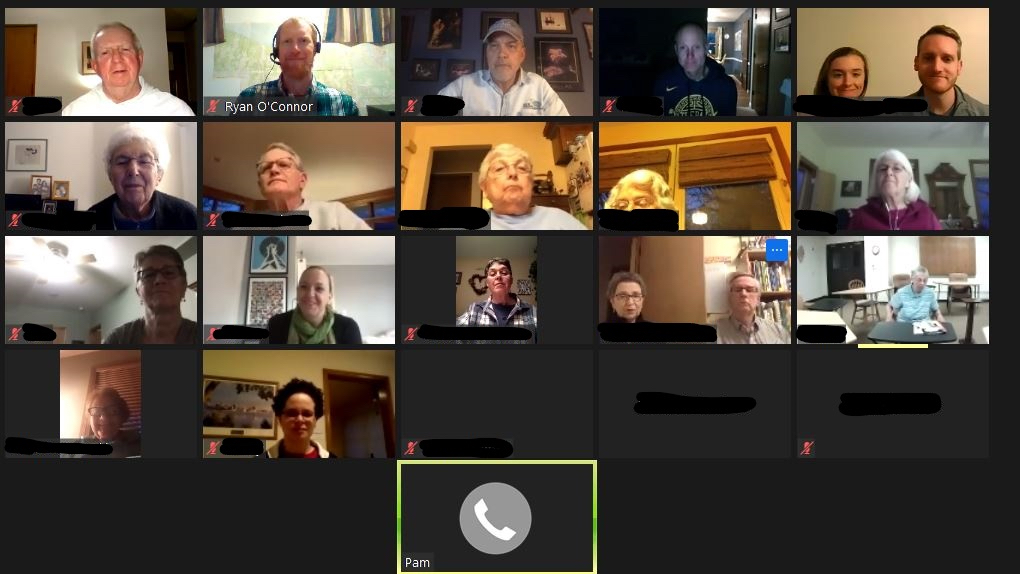
Gallery View of Zoom Meeting Organized by Ryan O'Connor for his church

Gallery view of a study event Ryan recently organized via Zoom for his church.

5. Approach others from a place of great enthusiasm and great need

Nothing is more attractive than hopeful, passionate enthusiasm. But people sometimes can feel that help isn’t wanted or needed if someone looks like they already have all the answers or there isn’t room for their ideas. A pitch that’s grounded in both your passion as well as why others have a critical role to play creates a more inviting space for others. Articulating why “now” is an important moment of opportunity also creates a positive energy that draws people in to your cause.

Remember to pitch a positive, hopeful message. Fear, anger, and frustration don’t motivate. They usually drive people away.

6. Inspire and encourage personal action

During the COVID-19 pandemic, my team needed to quickly change gears from an in-person study we had planned. Instead we went virtual, and the response was overwhelming. We had more people from outside the church than current members. These new participants included eight enthusiastic women from a rural parish an hour away, a leader from Texas, and a woman in Canada.

At the end of the four-week study, we asked people to make a commitment on at least one thing they would change about their habits, or take a step toward something they had been putting off. The response from participants was incredible. Commitments included looking into electric vehicles, calling contractors about roof-top solar, eating more vegetarian meals, buying only sustainably-raised meat, and engaging friends and family in conversations about Creation care.

Gently asking people to make a verbal or written commitment is a simple but powerful way of encouraging action. When done in the presence of others in a supportive community, such as at the end of a group study, you leverage social norms (i.e., everyone else is doing it too). There is also an implied sense of accountability. When I was first asked do to this in a study, I felt deep inside that I needed to follow through, because I made a commitment to others.

7. Educate, serve, AND advocate

Most church groups focus either on either educational or service events, but mature, effective groups also advocate for systemic change as a component of their mission. We are called to be salt and light to the world, not just to our church. We are to go into all the world and proclaim the Good News. This could be either working within your faith denomination or working with local, state, and national leaders to promote policies that are more just for vulnerable people and better for creation.

Bob Lindmeier, longtime meteorologist in the Madison, Wisconsin area, has been an outspoken advocate for common ground action on climate change. He’s also been active in getting not only his Lutheran church to go green by installing solar panels, but was also instrumental in getting the ELCA South-Central Synod of Wisconsin to endorse a specific policy to address climate change, something organizers call a “grasstops” effort.

This type of advocacy involves working with church, civic, and business community leaders. While it takes a bit of work, it can lead to bigger and more systemic change. Getting local leaders on board with your cause can also carry more weight with agencies and politicians if laws or policies need to be changed.

Whenever you engage in advocacy, it can be helpful to work with other groups who are already organized, have developed effective messaging, and whose mission and approach aligns with your values. I’ve volunteered for a number of years with Citizens Climate Lobby, a bipartisan grassroots group with hundreds of chapters around the nation and world. I like them because they are highly strategic in both their solution and approaches and are fully committed to respectful dialog. Their main objective is to solve the climate crisis. But their secondary objective, and one of their main strategies, is to build positive long-term relationships with everyone they talk to, whether a prospective member or a skeptical member of Congress.

8. Include Food

Never underestimate the power of the plate in bringing people together! Incorporating a meal or snacks into your group gathering builds a sense of community among your creation care team and participants at an event.

Making different food choices is also one of the most tangible and accessible steps most people can take to reduce their environmental footprint. Your group can model putting faith into action by using fair-trade coffee, local produce, grass-fed meat or a vegetarian entrée, for example.

Whether you’re in the early stages of starting a Creation care group or part of a well-oiled team looking for fresh ideas, we all have room to grow. While these are a few things I’ve learned, your wisdom is welcome, too. Feel free to share your own tips and lessons learned in the comments below. Finally, all of us would do well to continually ask for a fresh outpouring from the Holy Spirit of the knowledge and wisdom of what we’re being called to next and for the courage to take the first steps.


Ryan O’Connor works as an ecologist in the Great Lakes region, combining faith and science to help serve, protect, and restore God’s earth. He has been involved in Creation care in churches for over 20 years. He currently leads the Creation care team at Blessed Sacrament Catholic Church in Madison, Wisconsin, where he attends with his wife and daughter. His written work has appeared in the online and print journal, EcoTheoReview, including a reflection on The Beautiful, the Good, and the True: Through the Eyes of Lapland Azalea, about climate change, the fate of a rare cliff-dwelling plant, and the theological virtues of sharing a small closet.

We live in such turbulent times. Unfolding climate chaos. The worldwide pandemic. And now, with the murder of George Floyd, boiling outrage over racist policing and other manifestations of the centuries-old racist stain that continues to mar the ideals of the United States.

What else can be said that others haven’t already said very eloquently?

I just have one humble thought. As we try to heal, we will sometimes need to do positive things together. And by positive things I mean tangible, limb-moving, calorie-burning, body-engaging things that are not self-conscious moments of conversation and reflection.

Talking and reflecting in heartfelt ways are, of course, incredibly important things. But actually doing things together is just as essential. Actions taken together can imbed new ways of thinking and feeling even deeper into our hearts, minds, and the very fiber of our being.

And what are things we can do that make us feel whole and just human together? I’d suggest any engagement with God’s earth in positive ways.

Birding. Making and enjoying food. Gardening. Farming. Restoration of natural areas.

Creation takes us out of our distinction-making mindset between people and reminds us we are one set of beings and we enjoy and depend on one world. Creation takes us beyond words and our head space.

And, ideally, in that activity in Creation there is an encounter wtih God, consciously or unconsciously, that leads to deep humility.

A Novel Idea

I want to give you fair warning – I have begun writing a novel. In it I plan to further explore the ideas I’ve been exploring in this blog.

While I’m moved by the power of story, I have almost no experience writing fiction. So, to get over paralzying hangups about doing this well, I have made my goal just this – complete the first draft of a very bad novel. I am happy to report that I am indeed on pace (a very slow pace) to write one of the worst novels ever written. I’m guessing in fact that the secret guardians of literary quality are already planning to treat this work the way Russian authorities treated Chernobyl – entomb it forever in concrete.

Am I being excessively humble?

Not really. My characters, for example, all speak like they were clones of each other. Actually, and what is even worse, I think they all speak like they were clones of me.

Despite all that, I’m doing my best to accept where I am and to just plug away. Over time I hope to build some craft. I have other story ideas, too, all of which grow out of my passion for the topic of the abundant life Jesus offers, including a new relationship with God’s earth.

We only grow when we are out beyond what feels comfortable and easy. What new things are you trying this year?

Water Scorpions

A friend and farmer here at the Prairie Crossing Farm in Grayslake recently saw an unusual insect while he was working in a vegetable field. The insect was nothing like he had ever seen. It was about four inches in length, including a long tube-like structure coming out of its back end. It flew away later with wings that emerged from under armored covering.

A water scorpion!

Water scorpions are not even closely related to real scorpions. Real scorpions are arachnids with eight legs, while water scorpions are insects with not a bit of venom. The tube-like structure is actually a breathing device that allows the water scorpion to hunt in its favorite hunting grounds – underwater. In fact, it can pack bubbles of air on its abdomen’s specialized breathing holes and then use the bubbles later like handy oxygen tanks.

There is so much more that is fascinating about these insect. I encourage you to read more about them here. This world is truly amazing.

Water scorpion on hand

Water scorpion (photo by Wim Rubers)


Over the last four years, the following two questions have become pressing to me.

First, how have many Christians become so comfortable resenting reasonable* laws and rules designed to restrain the use of power to harm others and God’s earth?

And second, how do Christians continue to make up such a large percentage of President Trump’s supporters when his value system seems to be based more on Ayn Rand than Jesus Christ?

One example of President Trump’s bridling at restrictions is his firing of four inspector generals in short order. He also has a long history of working to weaken laws designed to protect people and God’s earth.

All of these actions echo the larger, unmistakable pattern of his presidency – the despising and resenting of restrictions and rebuke. The free exercise of personal and corporate power, even at the expense of justice and compassion, is clearly his highest good.

Fattori painting showing St. John the Baptist pointing at Herod and Herodias

St. John the Baptist rebuking Herod by Giovanni Fattori.  Herod imprisoned and ultimately beheaded John the Baptist because John rebuked Herod and Herodias for breaking laws.

This is not a Biblical approach to life. It is the celebration of power and the pursuit of individual prosperity over love, of valuing money over God. And prominent Christians, like Vice President Mike Pence, are going along.

How did we get to this point?

I believe part of the answer is that American Christianity tends to be incomplete.

The underlying assumption of this blog is my conviction that the Christian faith-life is both simple – life-changing faith in Jesus – and multi-faceted. Our goal is to have a whole faith-life that, over time, transforms how we think, how we feel, and how we act. Missing key ingredients of that whole faith-life is comparable to the impact on our body of not getting the right levels of iron or vitamin C. It causes our faith-life to be weak and sick. And that causes us to fall short of what God desires from us. It also causes us to mar the attractiveness of the Christian faith for others.

Here are three ways in which the faith-life of American Christians tends to lack key “nutrients:”

Christians tend to associate salvation only with the promise of life after death. 

In Acts 5:17-20, we read of the apostles being arrested for spreading the Good News of Jesus Christ, and an then angel releasing them. Read the passage below and consider the instructions the angel gives them:

Then the high priest and all his associates, who were members of the party of the Sadducees, were filled with jealousy. They arrested the apostles and put them in the public jail. But during the night an angel of the Lord opened the doors of the jail and brought them out. “Go, stand in the temple courts,” he said, “and tell the people all about this new life.”

Christian faith and discipleship leads to new life. Now.

Check out the meaning of “eternal life” in John 3:16 here.

Second, Christians generally don’t read the Bible.

And it is my sense that we tend to particularly avoid the Old Testament, despite the value of doing so. The Old Testament provides important “nutrients’ and “vitamins” for our our faith-lives.

One of the unmistakable messages of the prophets, for example, is that a symptom of a nation’s turning away from God is cruelty and injustice towards the poor and vulnerable.

Third, churches don’t comprehensively train people to go from believers to disciples.

In Beginning Well: Christian Conversion and Authentic Transformation, Gordon T. Smith rights:

The work of Christ makes conversion possible; even more, the actual focus and dynamic of conversion is that an individual comes to faith in Christ Jesus. Conversion is the act of believing in Jesus, choosing to follow Jesus and being united with Jesus as Lord and Savior. To be converted is to become a Christ-ian. And the purpose of conversion is that we may ultimately be transformed into the image of Christ Jesus.

Conversion is about justification and sanctification. But with a focus only on justification bringing the promise of heaven, Christians can be Christian without being transformed over time. They can have a Christian gloss even as they live as they’ve always lived. They can feel good about being “saved” even as they otherwise are carried along by values and culture that are incompatible with Jesus Christ.

Churches should instead train Christians in the Christian life. Some have.

God intends for every element of our life and being to be made whole and holy.

This is not easy. It means restraining ourselves for the sake of Jesus. It means having a heart that actually welcomes restraint and rebuke when they come out of good motivations. And it will put us on a collision course with princes and principalities motivated by different values and who, above all, hate the idea of restrictions on their use of power.

Early Christianity found itself at odds with the Roman Empire, which was built on a culture of power. Yet, the early church grew exponentially. What does that tell us?


* I want to be clear that not all laws are well-designed and reasonable. Governments can have a tendency to overextend their own power so that creativity and local autonomy are overly limited. The powerful can also craft laws that protect their interests.