When you think about farmers, you probably assume they own the land they farm. And you may well assume the farmers are the only ones who can decide how farming is done on the land.

In fact, there are many farmland owners who do not do the farming. And, in fact, those farmland owners can decide what kind of farming they want done on their land.

According to an insightful report from The Nature Conservancy, 41 percent of all U.S farmland is owned by a non-farming landowner and that figure is 62 percent in Midwest. In McHenry County (just east of Lake County, Illinois, where we live), that figure is over 80 percent!

The news that Bill and Melinda Gates had become the largest private farmland owners in the country highlighted this phenomenon.

If someone uses your property in a way that you agreed they could, the logic is clear. You are responsible in part for what they do and the impacts of what they do. This means that farmland owners who don’t farm are still important decision-makers in our country’s food and agriculture system.

And that means they have a whole lot to do with the stewarding of God’s earth.

After all, fifty-two percent of America’s land mass is used for agriculture.

But do farmland owners apply stewardship values to the management of their farmland to the degree they could and should?

The answer is generally not.

That same report from The Nature Conservancy I quoted from earlier revealed that 80 percent of the landowners surveyed relied more on their farmers for information about conservation than any other source.

It is true that many farmers do take conservation seriously. They do so, however, within the paradigm of farming as they know it. That paradigm is a production-oriented, industrial approach. That paradigm, even if tweaked and refined, generally results in declining soil life, erosion, a dead zone in the Gulf of Mexico, and miles and miles of land where a monarch butterfly cannot find a single milkweed.

But thanks to pioneers in regenerative agriculture (which is rediscovering principles of food production indigenous peoples have known for millennia), we now know there is a very different paradigm for agricullture that is better for God’s earth and good for the farmer, too. Gabe Brown, a Christian farmer, exemplifies what that kind of farming can look like. Check out his book, this podcast, and this video to learn more.
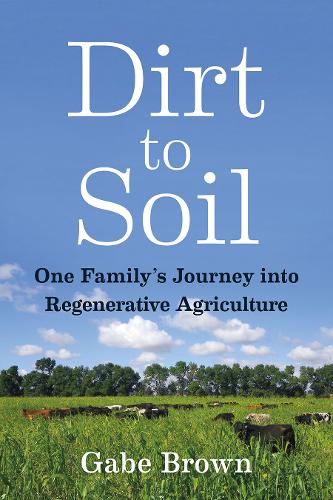
If you are a farmland owner who doesn’t farm, I urge you to apply your Christian faith to how you manage your farmland.

Ask yourself these questions. How well that does the farming on my land reflect the values I find in the Bible? How well does the farming on my land reflect what I know of God and God’s Creation through the Bible and my own experiences in Creation?

Our faith is clear that we do not own this earth.

As Dr. Allen Williams puts it, God put us here to be both servants and masters of that earth. We are not here just to use the earth and then escape to heaven.

It is clear, especially from the Old Testament, that we are to have limits to how we use Creation. Remember that for the Israelites even the land was to have its sabbath every seventh year. This was likely, in part, a wise systeming for maintaining the fertility of the soil. But the command was also teaching the Israelites that the land, too, had its own needs that mattered to God.

That priniciple has not expired. Efficiency and economic production are not the greatest good for God.

It is also clear, especially from the New Testament, that our hearts are remade by faith in Jesus. When they are, we will reflect the fruits of the Spirit (Galations 5:22-23) – love, joy, peace, patience, kindness, goodness, faithfulness, gentleness, self-control –  in all we do. I believe those principles apply to how to we treat people and how we treat God’s earth.

From the Bible, we see, too, that the living things of this earth have their own relationship with God and are sustained by God. In fact, from Psalm 148 and Revelation 5:13 we can conclude that the living things of this earth are part of the choir of Creation that we are also members of.

In other words, the land a Christian owns, whether it is a suburban lot or a 500-acre farm, is not just a financial asset. It is not “real estate.”

The land you own is a unique portion of the living earth that is part of the overall world that God so loves. It is alive. It supports other life in complex ecological relationships. What is done to the portion of God’s earth that you temporarily steward impacts land and water and living things far beyond it.

I don’t mean to suggest that being a fully engaged steward of your farmland with the goal of prospering Creation is easy.

You may rely on the income from the land for a significant portion of your yearly budget.

Agriculture and the ecology of soil, land, and water are complex. Farming has its own language, its own tools and equipment.

And the status quo approach to agriculture is a powerful status quo. It takes energy and tenacity and conviction to persist in a different approach. What’s more, you likely have an existing relationship with the farming renter who is likely a family member or friend in your community.

Complexity, however, is not a justification for inaction or procrastination.

Through its wisdom literature, the Bible prepares us for applying God’s values in a complicated world that is not always black and white.

Jewish and Christian thinkers have also produced wonderful writings and bodies of wisdom guidance. Use those resources to grow your wisdom and apply what you learn to your farmland management.

Wisdom also requires you to learn more about soil life, the realities of conventional farming, regenerative agriculture, farmland ownership, and the situation of your current farmer in your county. Being responsible for your farmland requires that you know enough to judge whether the farming is contributign to the life of God’s earth or depleting it. Loving your neighbor means being as fair as you can be to the farmer you lease to.

Then apply your faith-based wisdom to how you manage your farmland in your particular situation.

For example, if you are asking the farmer to invest in new, complex practices that will have long-term benefits for your land, then you should give the farmer long-term lease so he or she can also enjoy some of those benefits they are making possilbe.

You can also learn wisdom from other farmland owners. An Illinois landowner I know made clear to her renter (who happened to be here nephew) that she intended to move the farming of her land in an organic, sustainble direction. When the nephew showed no willingness or interest in learning more and adjusting to her values, even in an incremental way, the landowner had no choice but to not renew the lease when it expired. Sometimes, making those hard decisions are the only way to be true to God’s values. I’m happy to report, by the way, that the landowner eventually found a farmer completely in synch with her values.

In a different case, a landowner with land in Iowa planned to move that property to organic as a better way of caring for it. The farmer was uneasy because organic farming approach is quite different and requires much more documentation. But both the farmer and the landowner wanted to maintain their relationship. The farmer was open to changing his ways.

The landowner applied wisdom and love of neighobr. She is paying for an organic farming agronomist to advise and help the farmer during the transition process whenever the farmer  needs it. This is enabling the farmer to feel more comfortable and be more successful. Its a gesture, too, that shows the landowner is willing to share the risks of the change.
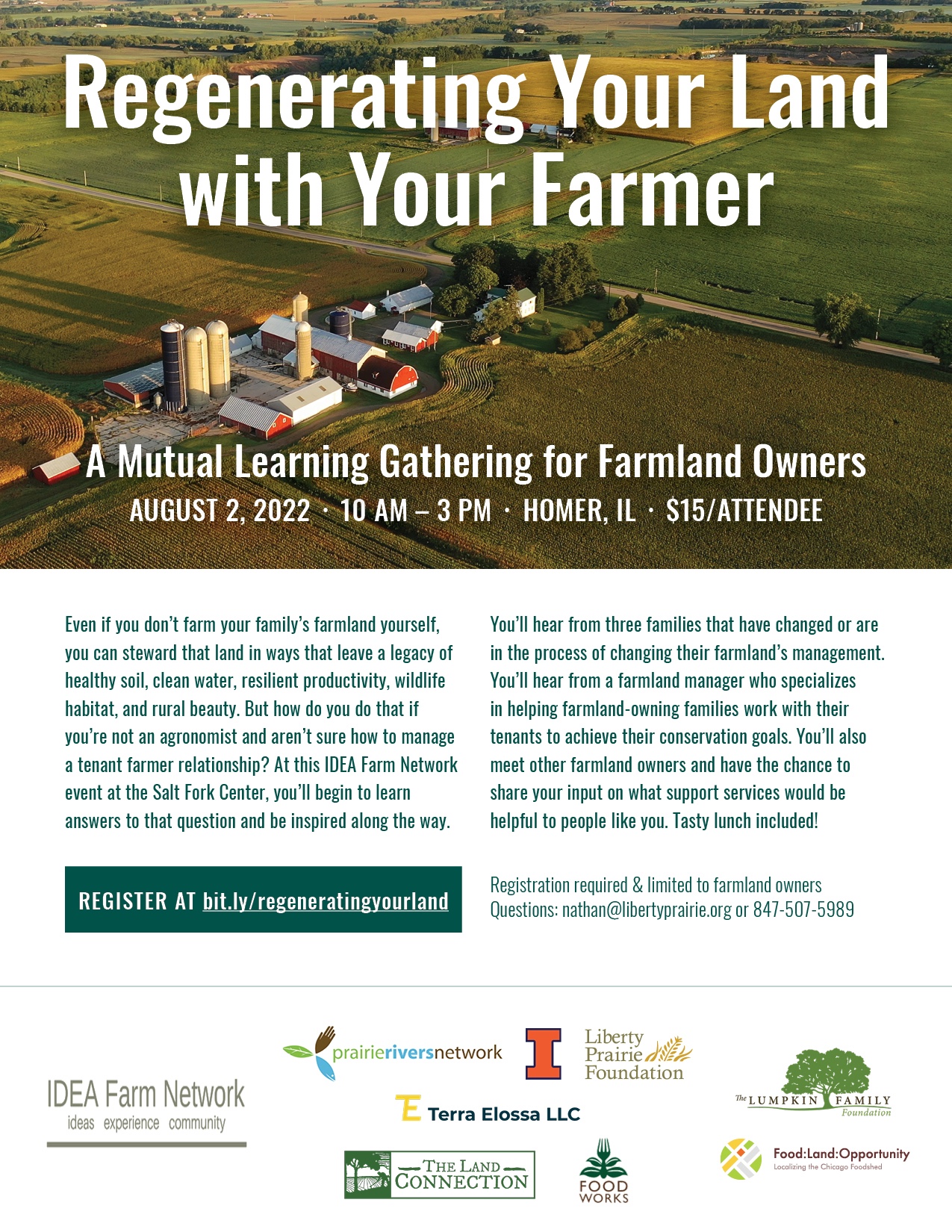
As part of my work that I mentioned earlier, I am helping to organize an event on Tuesday, August, 2nd for non-farming farmland owners. The event will feature three farmland owners who will share their experiences and lessons from moving towards better stewardship of their farmland. It’s extremely helpful to learn from other farmland owners.


I’m happy to report that more and more private and public farmland owners are working to improve their farmland stewardship. If you own farmland, I hope you will be bravely take full ownership of the responsibility and opportunity you have to prosper God’s earth. If you know a farmland owner on the journey of improving the stewardship of that land, please help them and encourage them and pray for them.

Don’t hesitate to reach out to me if I can I help you connect to the resources that would help you.

 

On Sunday, April 24th, I gave another sermon to the good people of North Suburban Mennonite Church. They asked me to do so with an Earth Sunday theme but otherwise gave me no direction. I had complete freedom.

So I considered ideas and thoughts I had had in the past but had not presented about or written about.

I ultimately chose to call their attention to a number of ways in which a Christian faith-life that includes a deep commitment to shepherding Creation contributes to a whole, loving, God-honoring faith-life. This is something I’ve been intrigued by for some time. In this blog post, I’m going to share ten.

Isn’t it enough, you might ask, to just be 100% committed to the truth that Creation matters to God? In other words, do we really need to justify a commitment to God’s earth as one of the fundamental ways people of the Christian Way should live?

No.

And yet yes.

The reality is that the culture of Christianity in America and in the world is very diverse. And it’s safe to say that most Christian culture still either recoils at the idea that Creation matters or gives it some half-hearted adherence in theology but not in everyday habits and choices.

In the spirit of 1 Peter 3:15, I believe it’s useful to be able to offer a defense, with gentleness and respect, to the non-believer and to the believer, for why we follow Jesus and why our following includes loving Creation. I also believe that a whole faith necessarily holds together better and with more resilience than a partial faith. We should, as I have written, have an ecology of theology.

So let’s dive into the list. A whole faith that includes God’s Earth as a fundamental element of it will bear the following good fruit:

#1 Transformed Hearts

We know from Proverbs 27:19 and from many words of Jesus that our lives reflect the state of our hearts. In fact, the state of our heart is a major point of concern for much of the Bible. Being in God’s earth and understanding it and working to restore it all help to shape our hearts in salutary ways.

This can be the peace we feel and experience when we are on the water of a stream or lake or hiking through beautiful mountain forests. This can also be humility and wonder at the blessings of God’s goodness and creativity.

It can also be what the Old Testament labels “fear,” as in Deutoronomy 10:12 or Proverbs 9:10. From these verses, it is clear that this fear is something we need to have. Fear, of course, doesn’t feel like a 21st century notion of how we relate to God. But this is another example of interpretation that hides the original nuance. The Hebrew word we translate as fear is “yirah,” and it actually doesn’t have a simple equivalent in English. It actually conveys fear, awe, and reverence. All at once. Simultaneously.

Where is the best place to experience awe, reverence, and fear simultaneously? Can there be any doubt? It’s being in Creation, whether it’s observing a jumping spider in a backyard garden or encountering a grizzly in Denali National Park. And that awe, reverence, and fear is what our hearts often desperately need to be opened to the deeper realities of this world and to be open to a fuller conception of God in our hearts and minds.


#2 Pervasive Awareness of the Reality of Sin

When life is going well for us in our modern, technological world, it’s actually easy for the reality of sin to seem rather quaint and naggingly troublesome, like a small chronic pain in your knee that won’t quite go away.

The whole equation changes if we believe God holds us accountable for how we individually and as societies treat God’s Creation (and, I would add, the most vulnerable people of our world). If you believe that and pay attention to what we actually do to God’s Creation, then the wounds of sin become powerfully evident.

Consider that fifty percent of the coral reefs have died since the 1950s. And that matters because they are said to provide habitat for 25% of marine life. Factory farms house hundreds of thousands of animals in horrible conditions. Many of the wild animals mentioned in the Bible, like lion and bear and antelope, no longer live in that area because of hunting and human expansion. The existence of some animals on this planet has simpley winked out forever. The list goes on.

The tragedy and loss are clear when we consider that our number one human job is to serve and keep God’s earth. An art museum night guard who took part in the vandalization of some paintings in the museum and allowed others to be stolen and then burned would not be a guard for long  Sin, both individual and collective, is real. Its prevalence in the light of the destruction of Creation is unmistakable and heartbreaking.

This hearbreak illuminates human sin in flashing neon lights. It makes clear to us that we need God’s help and deliverance.


#3 Sharpened Wisdom

Immersing yourself in the systems and interdependencies of God’s Creation will grow the nuances of your thinking and perceptions. You will better be able to understand whole systems work. You will become more observant. You will grow the abiltiy to weigh principles and values in particular specific circumstances and choose the best practical course going forward.

That is wisdom. The Bible celebrates wisdom. Being wise in understanding and applying the whole Bible to one’s life uses exacty the same mental and heart muscles that figuring out how to sustainable use and restore God’s earth does. Being an active steward of God’s earth compels us to grow in wisdom. In the process, you can build your ability to be wise in other aspects of your faith-life.


# 4 Good Saltiness

We are called to be the salt of the earth. We are called to love our neighbors as ourselves.

Enabling Creation to thrive is a way of loving your neighbors near and far. And the neighbors who most benefit from a thriving Creation are often the poor and disadvantaged.

Struggling to prevent wells from being poisoned by agriultural inputs is a way of being the salt of the earth. Designing cities and rural areas in ways that don’t require every family to own many cars is a way to love the poor and build more community. Preventing overfishing so that future generations of coastal communities will be able to live off of the sea as their ancestors did is a way to love one’s neighbor while also cherishing the amazing life God declared to be good.


#5 Awareness of the Tempter

When Satan tempted Jesus and offered him the principalities of the world, Jesus resisted. Using and exploiting the resources of this world for unbridled power is the same temptation we, our communities, and our nations face. There are many ways to rationalize taking from God’s earth beyond what earth and the life of God’s earth can bear. But rationalization for our selfish, God-ignoring motives is the way of the Tempter. And one can, as Satan showed in the story, use Bible verses to rationalize things that are against God’s will.

Being alert to the rationalizations all around us in our Christian culture for going along with the harm to Creation will awaken your heart and mind to the efforts of the Tempter in many areas of life.


#6 Restraint and Simplicity

We live in a world full of conveniences and a myriad of recreation options, all there to meet every wish and need and hunger. Creating habits to protect God’s earth through our daily life choices requires us to limit ourselves, both individually and collectively.

There’s a strong thread of limits and restraints in the Bible that American Christians often want to ignore or categorize as no longer applicable because of the work of Jesus. The Sabbath, one of the core commandments, calls upon us, as Abraham Joshua Heschel wrote, to be part of a ‘palace in time,’ to rest not only ourselves but also give rest to the land and livestock.

The practice of tithing causes us to live with less and have faith that God will provide.

Jesus fasted. Fasting is about restraint.

Restraints and limits are actually, in other words, blessed things.

The only way we individually and socially will protect and restore Creation effectively is if we restrain ourselves and adopt simpler lives. As a society, that will mean leaving some areas forever wild and even pulling back our human presence in other places. That will mean reducing reliance on fossil fuels. Acting and caring for creation help build our capacity to live simply and with restraint and with generous interdependence. That capacity will bear fruit in other parts of our lives.


#7 Resonant Lives and Faith

In the book Simply Christian, N.T. Wright calls the reader’s attention to the fact that around the world people, regardless of whether they are Christian or not, share common dreams of justice and goodness and peace, of what should be. These dream, these yearnings, N.T. Wright says, come from God and from what used to be.

When followers of Jesus ignore Creation and contribute to its destruction and justify its diminishment, we not only harm life that matters we also play a horribly out of tune note that ruins the whole song and the whole chord of what the Christian Way is.

Why would a young person or any person who knows in their heart that prairies and forests and oceans and the teeming life of the soil are all amazing and good, accept the other convictions of the Christian Way if the people following that way foul the world and don’t care that they do so?

On the contrary, when we defend and protect and restore God’s earth, we point to a unifying and compelling whole Way that is beautiful and challenging at the same time. This is a faith and a life that calls out to the heart without any false notes.


#8 Strengthened Agape

Attention and devotion to living in ways that provide for Creation grows selflessness in one’s heart. Animals and plants and fish and the vast universe of the soil rhizosphere cannot vote. They generally speaking can’t speak. To be sensitive to their welfare and to act on that sensitivity is to be selfless and loving at a very high level. It is to think and have empathy beyond oneself and even beyond one’s human neighors. This is taking the story of the Good Samaritan to a whole different level.

God calls us to selflessness throughout the Bible. Jesus, of course, is an obvious example. But I am also reminded of the 42nd chapter of Job: Job’s fortunes are not reversed and restored when he repents and acknowledges to God that God’s wisdom and ways are beyond his comprehension. Instead, God calls upon Job to pray for his three friends who had advanced wrong arguments against him and who God required to show repentance. And that is what happens, despite all that Job had already experienced and despite the further grief his friends had caused. Job prays for them. And then his fortunes are restored.

Caring for habitats or rivers or just a small woodlot or our pet all grow that same selflessness that God desires.


#9 Missional Impulse

Being convinced that we must keep and protect God’s Creation necessarily drives us to be missional and to have an outward focus. Protecting and restoring God’s earth requires us to go out! If we only change how we live as an individual or family or even a church, we will not have done all we need to. You and I, especially in a democracy, are part of collective systems – employers, local municipalities, state government, even a mighty nation. How they act is partly our responsibility.

By going out and speaking up and bringing about change in ways that stretch our comfort zones, we find that our missional and prophetic muscles also grow. Christ-like also means bold. Strong. Tenacious. Radically candid.

In Alan Hirsch’s provocative book The Forgotten Ways: Reactivating the Missional Church, he writes, “We are a message tribe.” By this he means we are meant to be a sent and missional people. We can’t expect to have people seek us out. We must reach out to them. Organizing and advocating for God and God’s earth takes us out of our homes and our church buildings and into the world. This is where we are supposed to be. This is where we are supposed to share God’s Way.


#10 Faith

Anytime we live out the values of the whole faith Way, we will be aware of the necessity of faith.

When we do something that makes us stand out and perhaps endure ridicule, then our faith will grow.

When we work to restore a forest or protect a river, we will not know whether our efforts will ultimately lead to success. But when we do it anyway because it is the right thing to do, then we are acting on faith and building faith at the same time.


I pray you will continue to pray and act for the life of God’s earth.

My tendency, as you’ve seen from my past blog posts, is to think big picture. I learn towards theology, ideas, trends, analysis of verses,patterns of people marring God’s Creation, and patterns of people regenerating God’s Creation through ingenuity and commitment and faith.

In this post, I go in a different direction. I share some moments in my life in the month of April that relate in some way to God’s earth.

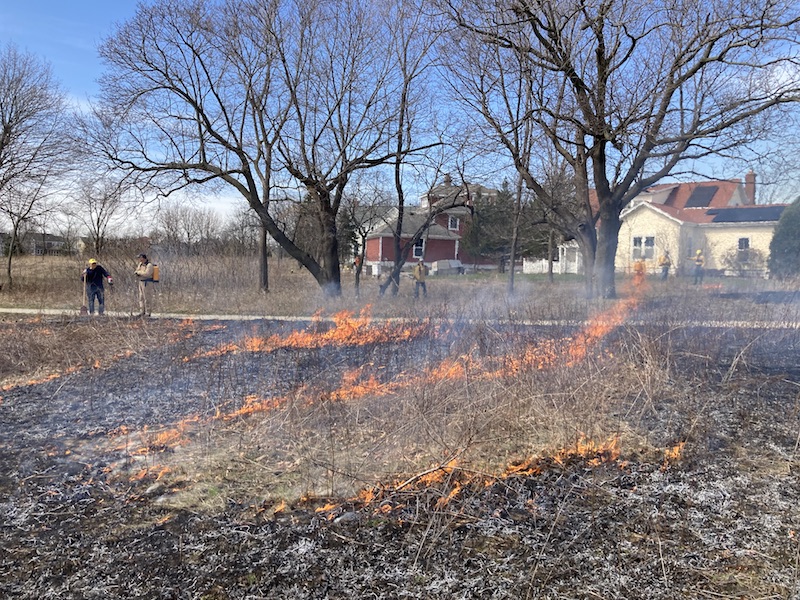
April 10 – I volunteer along with other residents here in the Prairie Crossing conservation community to burn several sections of the prairies and other habitats of our community’s common areas. Our burn leader – Jim O’Connor – takes extreme care in the planning of the burns so that homes are never in danger. Jim also keeps track of when areas are burnt. It’s not good to burn at the same time of the year every time. Prescribed burns are essential to keep prairies healthy.


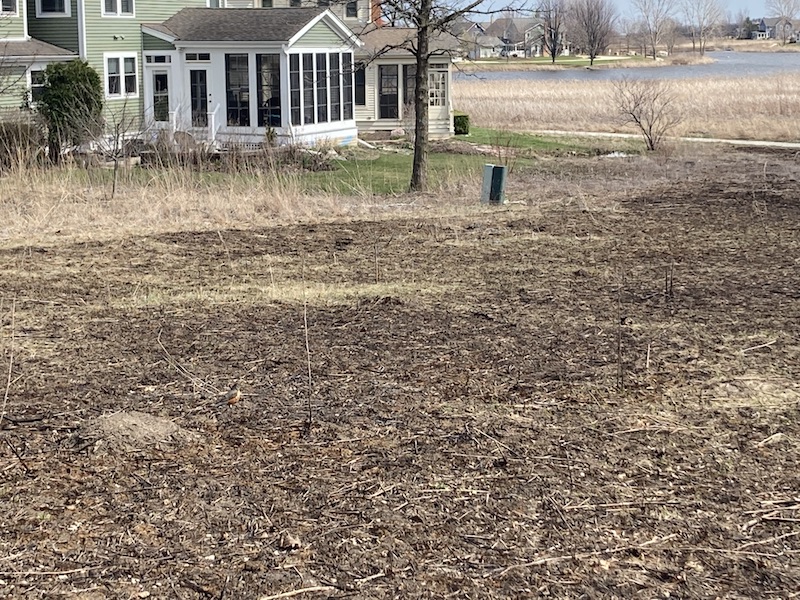
April 16 – This is the same area six days after the burns on April 10. Look carefully in the bottom left corner of the image. Can you see the mound that has a different texture than everything around it? And can you see the robin just to the right of the mound? The mound is that of a colony of prairie ants (likely Formica montana). With the weather warming, the ants had begun to appear on the surface. And that had drawn the robin which had been scarfing them down like a famished guest consuming a tray of hors d’oeuvres. Prairie ants play an important role in prairie ecology and provided a useful, high-protein, high-fiber diet supplement for the robin early this cold spring. I wonder what King Solomon would make of this.


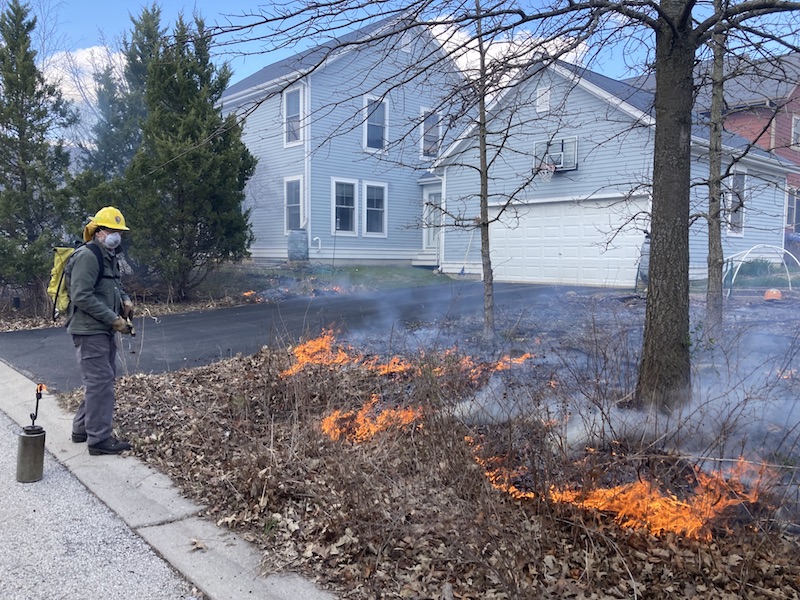
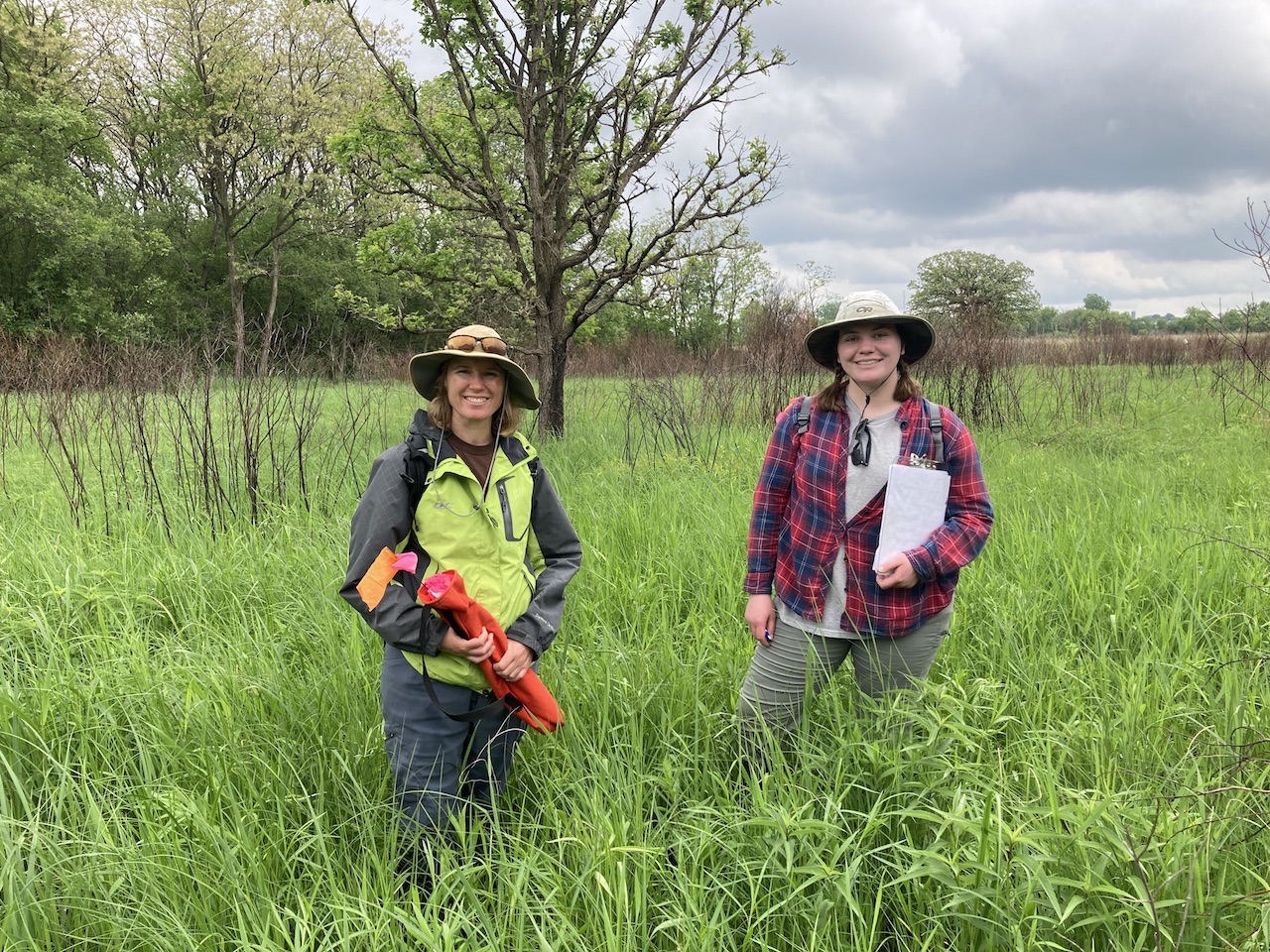
April 19 – Many residents in Prairie Crossing have native habitats on their own properties as well. Here Jim O’Connor (yes, he is everywhere) and Bill Pogson (not in the picture) are helping me burn the natural habitats of our yard. Further down the alley we have a small open prairie. Here we have three oaks whose leaves burn nicely, contributing the fire ecology of the habitat. Prairie Crossing HOA regulations require us to have at least 3 adults carry out any burn and to also make sure that the weather is suitable for a burn that day. Burning together with neighbors brings us together. After the burn was completed (and perhaps inspired by the beer), Jim expertly recited portions of a Robert Burns’ poem.


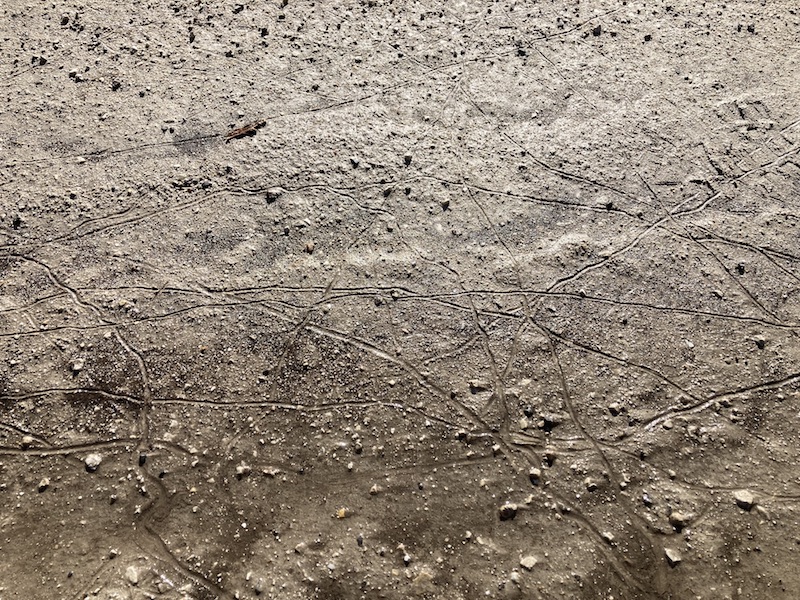
April 21 – Any ideas what this is? A lunar landscape perhaps? It’s been a wet month. Rain the previous day turned some eroded soil along the edge of Harris Road near our non-profit organization’s office into mud. These are worm trails visible early on a weekday morning. The ephemeral trails were ever so faint traces of creatures whose lives are usually invisible to us.


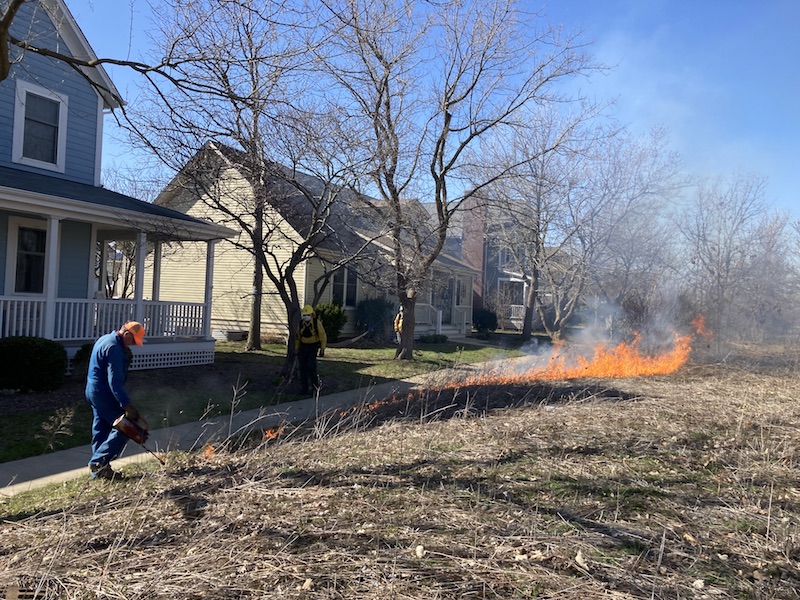
April 21 – Another burn in a Prairie Crossing common area. My friend and neighbor Bill Pogson uses a drip torch to spread the flame. Earlier we had burned to the right of the image so the flames you see that are being pushed by the wind will only go a short distance and then run out of fuel. I had more work to do at the office that Friday afternoon, but I felt I needed to help out as good burn weather can often be rare. Glad I did. The needs of people and nature don’t always fit in nicely with our plans for a day.


Stir fried basmati rice

April 25 – It’s a weekday night, and Mayumi and I need to figure out what to make for dinner in a hurry. We had leftover basmatic rice I had made over the weekend, so Mayumi created a quick stir-fried rice dish with organic peas, onions, carrots, and pasture-raised eggs.


April 25 – Gus, one of our two cats, enjoying a nap in covers we’ve pulled up around him. I believe our love of our pets and how our homes feel much better with plants in them remind us of something profound we see in Genesis – we are meant to be in a state of shalom with the rest of life.


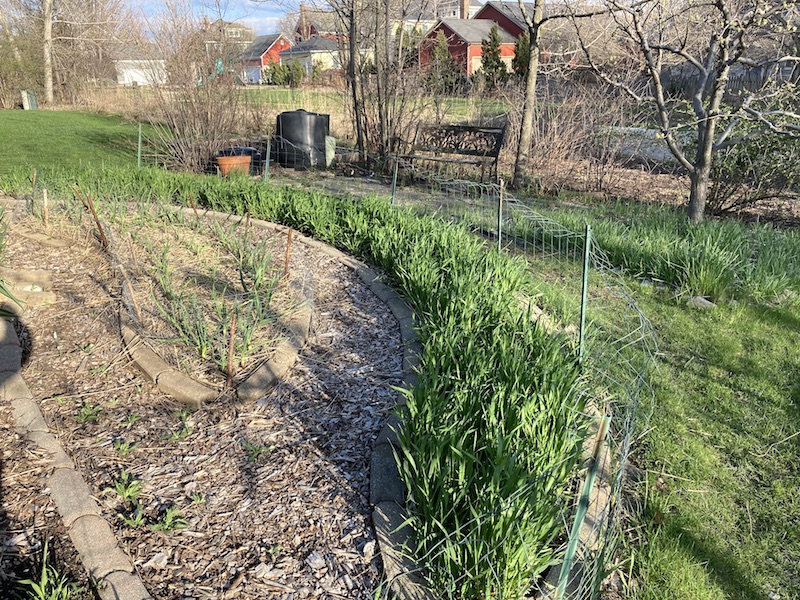
April 26 – Our small garden at the south end of our home. You can see the compost bins in the background. To the right of the bin is a choke cherry and a shagbark hickory, both native woody plants. And at the right edge of the image is an Asian pear tree. The abundance of vegetation you see in the garden itself is winter rye, a cover crop that my wife Mayumi planted last fall to build the soil. The winter rye stayed green all winter, and with all of the rain, it is now growing quickly, which means it is pumping dissolved sugars (liquid carbon) into the soil which feeds the microbes and fungi there. This is our first time using cover crops in these beds. We keep trying to learn.


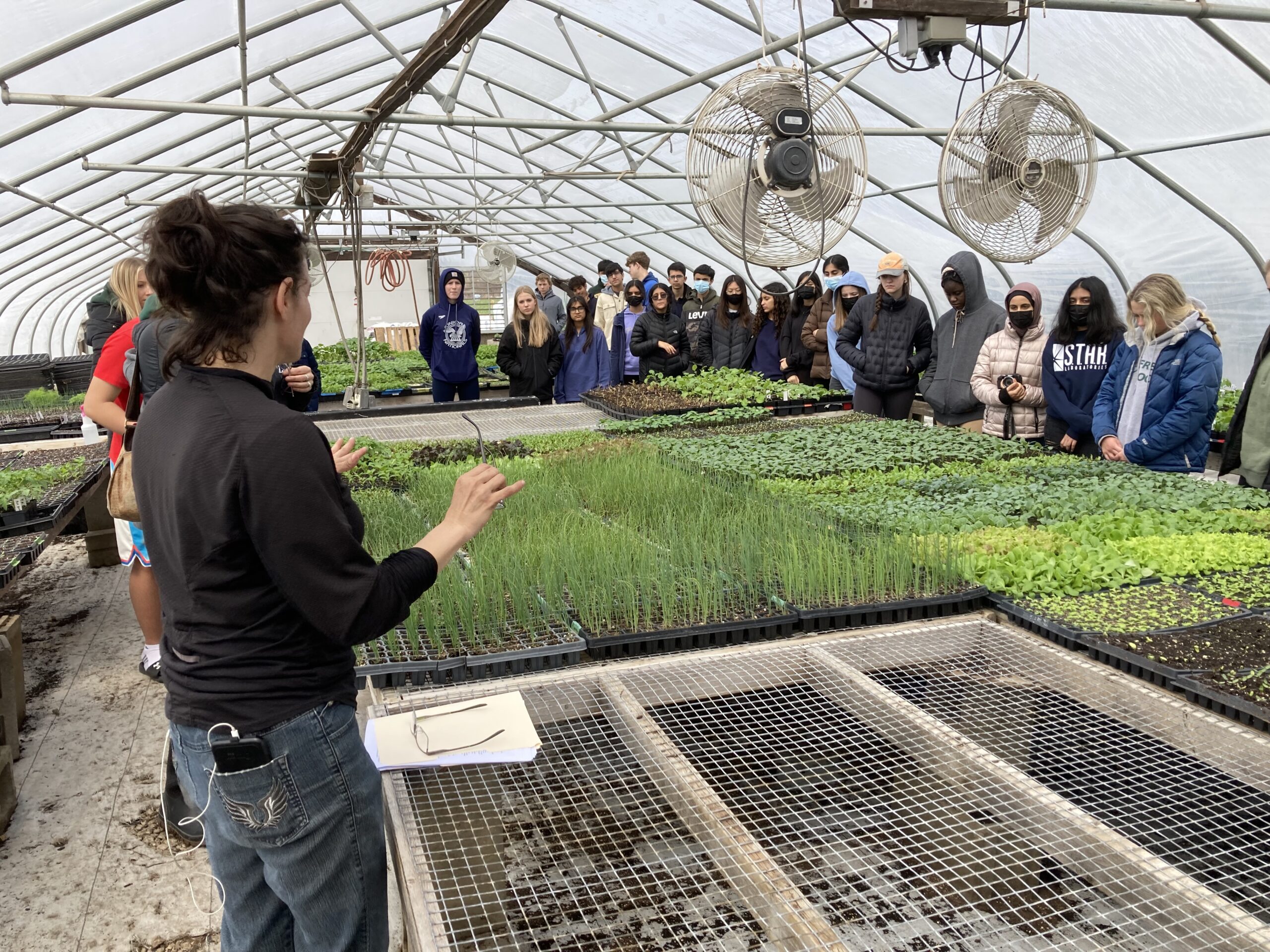
April 27 – It’s not exactly in my job description, but on this Wednesday I led a tour of our farm and Prairie Crossing for ~40 students of AP Human Geography classes from a local high school. Here my colleague Meg Runyan explains how she gets 8,000+ plants germinating and growing in our greenhouse for our annual organic plant sale. Earlier I had shared why it makes such a big difference to human health and nature how food is farmed. One of the teachers said at the end of the tour, almost as an aside, that just reading about sustainabilty has little impact and meaning. Youth need to experience what it actiually looks like.

I also gave a sermon to the North Suburban Mennonite Church and Christ Community Mennonite Church on the Sunday after Earth Day. In preparation for the sermon I reviewed my notes from a book I had found inspiring some years agao – The Forgotten Ways: Reactivating the Missional Church by Alan Hirsch. A quote I found that I couldn’t squeeze into the sermon that I still find compelling and want to share is:

“To say this more explicitly, there is no such thing as sacred and secular in biblical worldview. It can conceive of no part of the world that does not come under the claim of Yahweh’s lordship. All of life belongs to God, and true holiness means bringing all the spheres of our life under God.”

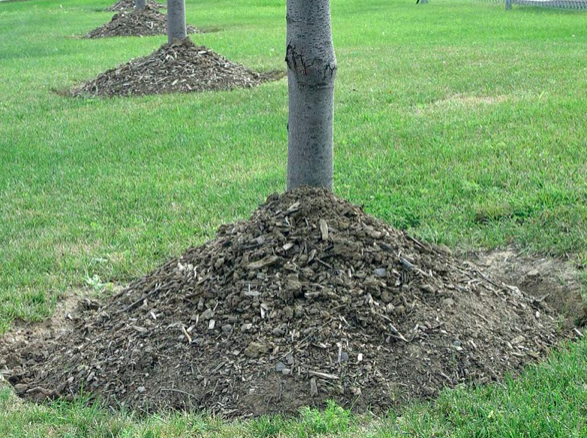
Trees in a row with mulch applied in mulch volcano way

Row of mulch volcanoes (photo: George Weigel)

My wife Mayumi recently learned about “mulch volcanoes” from the Master Gardener class she is taking through the University of Illinois Extension.

People create mulch volcanoes when they pile up mulch high against the trunk of a tree. This makes it appear that the tree trunk is erupting out of a sloping, volcano-like mound of mulch.

Mulch volcanoes look innocuous, but they’re actually harmful to trees for multiple reasons.

Just one reason is that the constant contact of wet organic material starts to break down the surface of the tree’s trunk. This eventually leads to damage to the phloem and xylem layers beneath the bark. These vascular tissues carry nutrients from the leaves to the roots and from the roots to the rest of the tree respectively. Rotting these tissues away is like applying a tourniquet too tightly to a human limb – it cuts off vital circulation. The tree will slowly die.

Ever since she learned about mulch volcanoes, my wife has been dismayed to see them seemingly everywhere.

They were, of course, there all of the time. But now she knows what to look for and knows the damage the practice does. And my wife, being who she is, wants to save every tree she sees in this condition. Her heart hurts to see these vulnerable plants suffering harm in slow motion.

This is a prime example of the truth of Aldo Leopold’s words: “The penalty of an ecological education is to live alone in a world of wounds.”

Once you understand the fascinating elements (plants, animals, microbes, etc.) of God’s earth and how those elements relate to each other ecologically, then the purposeful and unintended damage we do to Creation becomes painful to contemplate.

I know you know the truth of that statement.

I’m sure you’ve become aware of the wounds done to God’s earth nearby and around the world. Like a subdivision replacing a woods. Like a dam under construction that will drown villages and forests.

You may also have noticed that you are largely alone in seeing that harm and experiencing that ache in your heart. This is often the case in general American culture. It’s also usually the case in church culture.

When was the last time you were at a call for prayer and someone lifted up a concern related to Creation?

That combnation of being aware of the degradation of God’s Creation and of feeling alone in that awareness is something I often feel. And because the pain can be overwhelming, I sometimes begin to allow a callus to grow around my heart. Sometimes, too, I try not to see what I see or distract myself with (and I hate to admit this) YouTube videos.

But those attempts to avoid the wounds or keep them from my heart only work temporarily. I become aware of what I am doing. Or something comes onto the scene that just doesn’t allow me to escape.

The war in the Ukraine is the most recent example. The war is a disaster of epic proportions for the Ukranian people. It is also a tragedy for the many Russians who oppose it or who are simply powerless to stop it.

That’s just one level of pain.

If you remember your whole faith and do a simple Google search, then you can easily enter another level of anguish.  You will find that the Ukraine war, like any other war, is a disaster for the animals, plants, soil, and air that are all part of God’s miraculous world.

Here are revealing articles about the tragedy of the war for Ukranians, their pets, and the life of their country. The first. The second. And this is one about a young woman – Anastasia Yalanskaya – who was murdered by Russain troops while trying to deliver desperately needed food to a dog shelter.

God!

I desperately want to look away from all of this brokenness. I desperately want God to make it all all right. Right now.

As if that it isn’t hard enough, I then find myself aware that it feels wrong in America to be sad and heartbroken. That’s not what our culture wants or accepts.

And somehow it can also feel wrong as a Christian to be sad and heartbroken. I feel like a widower who frustrates his well-meaning friends calling for him to buck up and move on. Sure he lost his spouse, but she “was taken by the Lord” and is “in a better place.” There are countless ways Christian culture tries to deaden our hearts towards Creation and what we do to it.

This all leads me to two questions. The first – why could God allow such suffering for people and all of Creation? God has heard all of Creation groaning for millennia like God heard the Israelites groaning in Egypt. How can a father, the Father, not intervene? The second – how do I live in the presence of so much suffering? How can I persist in acting for God’s love of his people and His earth when the cycle of destruction keeps coming again and again? How can I persist when climate chaos threatens so much? How do I persist when the nature of today is a diminished form of what it used to be?

I know there are many complex theological ways of dealing with the first question. But here’s what I have found works for me. It is not an answer. It is more of a resonance.

The Bible makes clear that this suffering was not God’s intent. In John 3:16 and in the very sending of Jesus, we know that God loves this world. God loves this world dearly.

The Bible also makes clear that the brokenness of this world will not always persist. In some mysterious way, through Jesus the grip of evil and of the rule of destructive principalities over the world will be fully broken. There will be a new heaven and earth that is, I believe, somehow like the body of the resurrected Jesus.

And I believe that this new earth will have all of the goodness and diversity that this current earth has ever had and much, much more.

What helps me in a resonant sort of way is to know that God through Jesus experienced the suffering of the world from our sins. And isn’t it interesting that suffering and anguish are common elements of the Old and New Testaments? The majority of Psalms, for example, are laments of one kind or another. The prophets are full of sadness and anger. Jesus, who knew of God’s future for the world, wept.

I am helped, too, by the knowledge that the early Christians were able to be so revolutionary in their living and in their presence within the empire that had killed Jesus. They stood apart. They treated women differently. They welcomed people of all social strata. They offered hope, and they carried a message that changed people. The DNA of the movement must have been incredibly powerful. That also resonates and inspires.

As for how I live, I will follow the God I know through Jesus.

Jesus calls us to follow him. His path informs our path.

We must expect difficulties and be willing to sacrifice. The fact that such a way would lead Jesus to death tells me a great deal, makes it seem more authentic. In this world of wars, factory farms, and toxic agricultural chemicals being found in ambient air even on mountain tops in Europe, we must expect to face seemingly impossible odds. We must also expect to feel anguish at what cannot be stopped, like when Jesus shared his anguish at the coming destruction of Jerusalem in Matthew 23:37-39.

I find, too, a strange sort of comfort in the fact that the name – Israel – given to the people God chose to be a key part of his rescue mission for the world literally means “wrestles with God.”Moses wrestled with God at times.  So did Job and the prophets.

Faith does not mean absence of struggle. I will wrestle with God even as I follow Jesus. I will argue with God that enough is enough. I will pray for God to intervene for the sake of the whole world – people and Creation.

Mayumi and I will do what we can where we live and work to live out a whole faith with God’s help. We will seek to love God with all of our heart and soul and strength. We will seek to be good and loving to our neighors and to do what humans are meant to do – protect, keep and prosper God’s earth. Mayumi, for example, will use her Master Gardener education to help people care for their gardens and yards. I’ll keep giving all I have to my job. There I seek to expand regenerative agriculture and connect sustainable farmers with the farmland they need to farm. I will do my best to contribute my voice for this kind of whole faith. And, I have written an email to our Lake County Department of Transportation about the mulch volcanoes we saw recently in the median on a county road.

We will balance all of that with rejuvenating our hearts and spirits on a regular basis. We strive to use Sundays as Sabbaths. We enjoy good-for-God’s-world food and the company of our sons via Zoom calls. We read together. I’ll take breaks from time to time for enjoyment and relaxation, striving to have the faith to know that it is not all up to me. God is at work in the world.

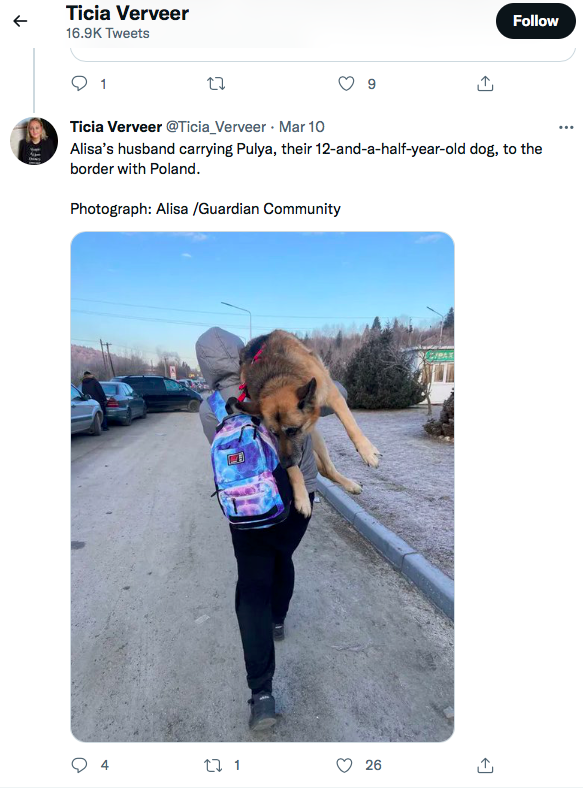
Even as the war in Ukraine has brought despair, it has also brought inspiration. I read of a Ukranian couple who, as they fled the Russian invasion, remained devoted to their German shepherd. They carried their aging pet to safety as you can see in the photo below.

They could not save all of the pets and wild animals from the horrors of a war. But they could be devoted to the dear animal in their care.


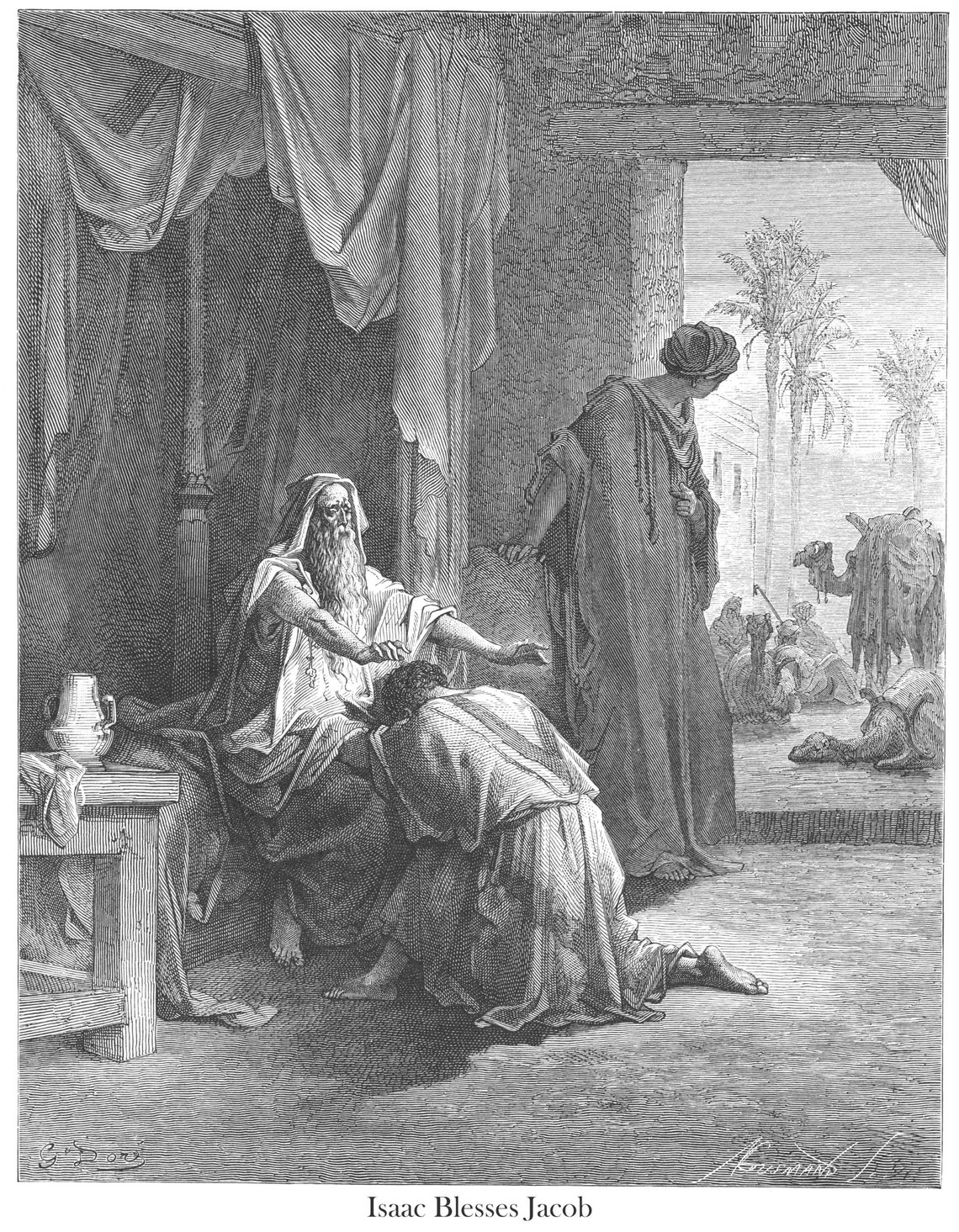
Shows moment of Isaac blessing Jacob

As I have been reading my way through Genesis, I came upon Genesis 27:27 in which, in the middle of a chapter focused on blessing, we read that God blesses fields.

The drama of the moment comes from Isaac blessing Jacob when he seemingly intends to be blessing Esau. This holds the reader’s mind and heart. It held mine. Then, in this verse which begins Isaac’s blessing of Jacob, Isaac says something remarkable. He says, “See, the smell of my son is as the smell of a field that the LORD has blessed!”

It’s so easy to just keep on reading because of the Jacob-Esau drama.

I’ve done so many times. It’s so easy to overlook.

But this time the phrase caught my eye. I saw it anew.

What does it mean? What would God’s blessing of a field look like? What would a blessed field smell like?

In the story, Jacob is wearing the best garments of Esau who was a skilled hunter and “a man of the field.” So, presumably, Esau’s clothing smelled of the outdoors. Of wind and sun. Soil. Flowers. Soil. Dung. Perhaps of animals he had caught and carried. Complex odors of the outdoors. Creation.

Our tendency here is to focus on the deception taking place and to think of the reference to the odors only in connection with the deception. In fact, in my online research, I could find no commentary or reference that actually focused on the concept of God blessing fields.

You could make the argument that Isaac’s words in this verse are a rhetorical flourish. They transtion us smoothly into the next verse in which Isaac declares that Jacob will receive the dew of heaven and the fatness of the earth and plenty of grain and wine. You could make the argument that that is all this phrase is.

But I can’t just flick the significance of this verse away so easily. I’ve meditated on this for awhile and come away with two simple conclusions.

First, landscapes are blessed by God. I don’t know exactly what that means. Does that mean there are landscapes that aren’t blessed or receive lesser blessings like Esau did in the end? I don’t know.

But what we do know is that humanity is not the only element of Creation that God cares about. This is another reminder of that. Interestingly enough, the first blessing of the Bible comes in Genesis 1:22. It is not God blessing humanity. It is God blessing the life of the waters and the birds. So the idea of God lavishing attention on the life of this world is not new.

And that leads to the second point – if we are paying attention, we see that the life of God’s earth is part of the thread of the Biblical narrative, even the crucifixion.

This is yet another. The whole 27th chapter of Genesis is centered on who Isaac will bless first and the drama that follows. In this chapter about blessing, verse 27 serves as a small but strategic reminder. It reminds us that Creation is, from Genesis to Revelation, part of the arc of the Story of God’s intentions and work. This, in my mind, is ultimately about the unity of all things through Jesus that is mentioned in Ephesians 1:7-10.

You may be saying to yourself – is this reading too much into this verse? Is Nathan reaching here?

I’ve asked myself that question.

This is where the BibleProject has helped me. This non-profit ed-tech organization and animation studio helps people understand the literary design and core themes of the Bible in creative, clear ways.

In one of their booklets, they state their thesis – “The Bible tells one expertly crafted story from beginning to end.” Later, in the same booklet, they explain what that story is. “It’s a beautiful story about God’s plan to restore humans to their lost calling through the life, death, and resurrection of Jesus.”

It’s pretty clear to me that Genesis 27:27 could so easily have been written without a reference to God blessing a field.

But it wasn’t.

And in light of the careful, artful writing and editing of the Bible, we can’t believe that was an accident. Or a throwaway line.

Genesis 27:27 is, I believe, yet another intentionally placed signpost in the Bible. It is a signpost that reminds us that the life of God’s earth matters to God. I have experienced, as I know you have, the awe, fear, and reverence of God through encounters with Creation. Those encounters are also signposts of truth.

All of those signposts point us towards one of our lost callings.

That lost calling is for us to live out our human exceptionalism in the way God intended. This means enabling Creation to foster, keeping God’s earth like we would keep our own family.


P.S. When was the last time you smelled a field or a forest or some other landscape full of God’s life? Make a point of making that happen in 2022.

P.P.S. The story of the Jacob and Esau is far more complex and interesting than I originally realized. This essay by David J. Zucker about whether Jacob’s deception of his father was really the main deception going on is very provocative. And this thesis by Il-Sueng Chung gave me a whole different understanding of Esau. How often the Bible rewards close and careful reading!