In a recent post I wrote that whole faith Christians will work to bring more life to the corners of God’s earth they hold, keep, and use. And they will do so even when the culture of land use around them creates pressure to do otherwise.

Whether that corner is an urban yard, a suburban lot, a rural property, or a farm, there are creative ways to bring more life to the parcels of land under our care. Figuring out those ways is one of the pleasures and challenges of being human.

I would even assert that taking on the challenge of bringing life to different places and at different scales is a path towards growth in our hearts and minds. It takes patience. It takes careful observation and nuance. You need to research and gain new knowledge while also using practical, down-to-earth skills. Anyone doing this will make mistakes. What works at one point may not work at another point. Love and faith will be needed. Sometimes discipline will have to be applied. Sometimes hard choices will have to be made.

Sounds a whole lot like parenting, doesn’t it?

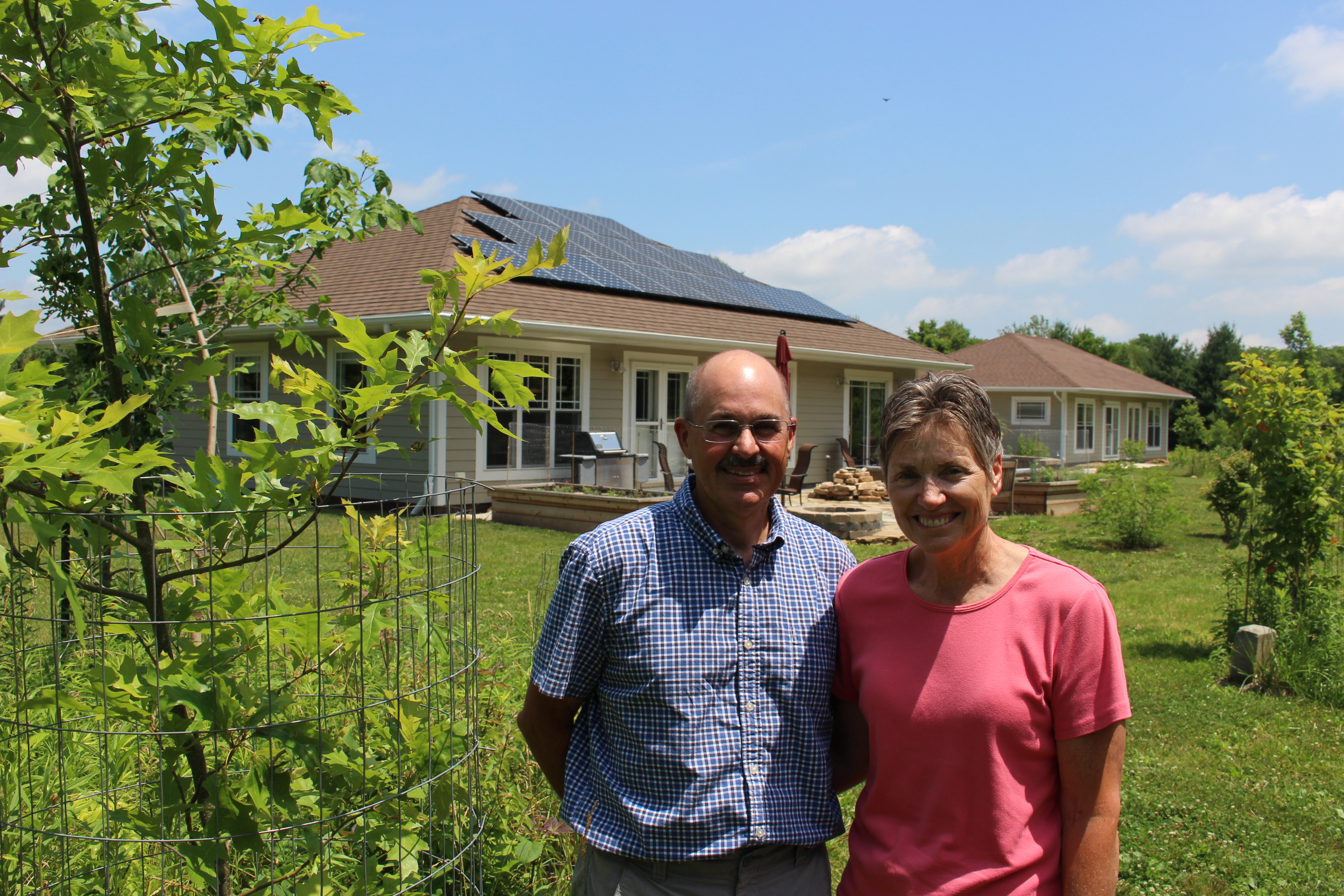
Over time I want to share profiles of what Christian land stewardship looks like in real life. And in this post, I share the land-to-life story of David and Dianda Easter.

In 2008, they acquired a 7.5-acre property near Urbana, Illinois after a search of over a year. They were living in Ohio at the time and had been working with a real estate agent for their search. David’s sister was eager to help. She drove back county roads looking for properties that might not be listed. Her efforts paid off when she found an abandoned Christmas tree farm.

Your average person might have seen only problems. The Scotch pines that were left on the property were succumbing to disease. The former owners had been harvesting the Christmas trees with a big digger but had not been replacing the missing trees or filling the holes that had been left behind. There were over 200 holes scattered about. Each was 3-5’ in diameter and 2-4’ in depth. What’s more, invasive non-native plants like Asian honeysuckle and autumn olive now dominated the undergrowth.
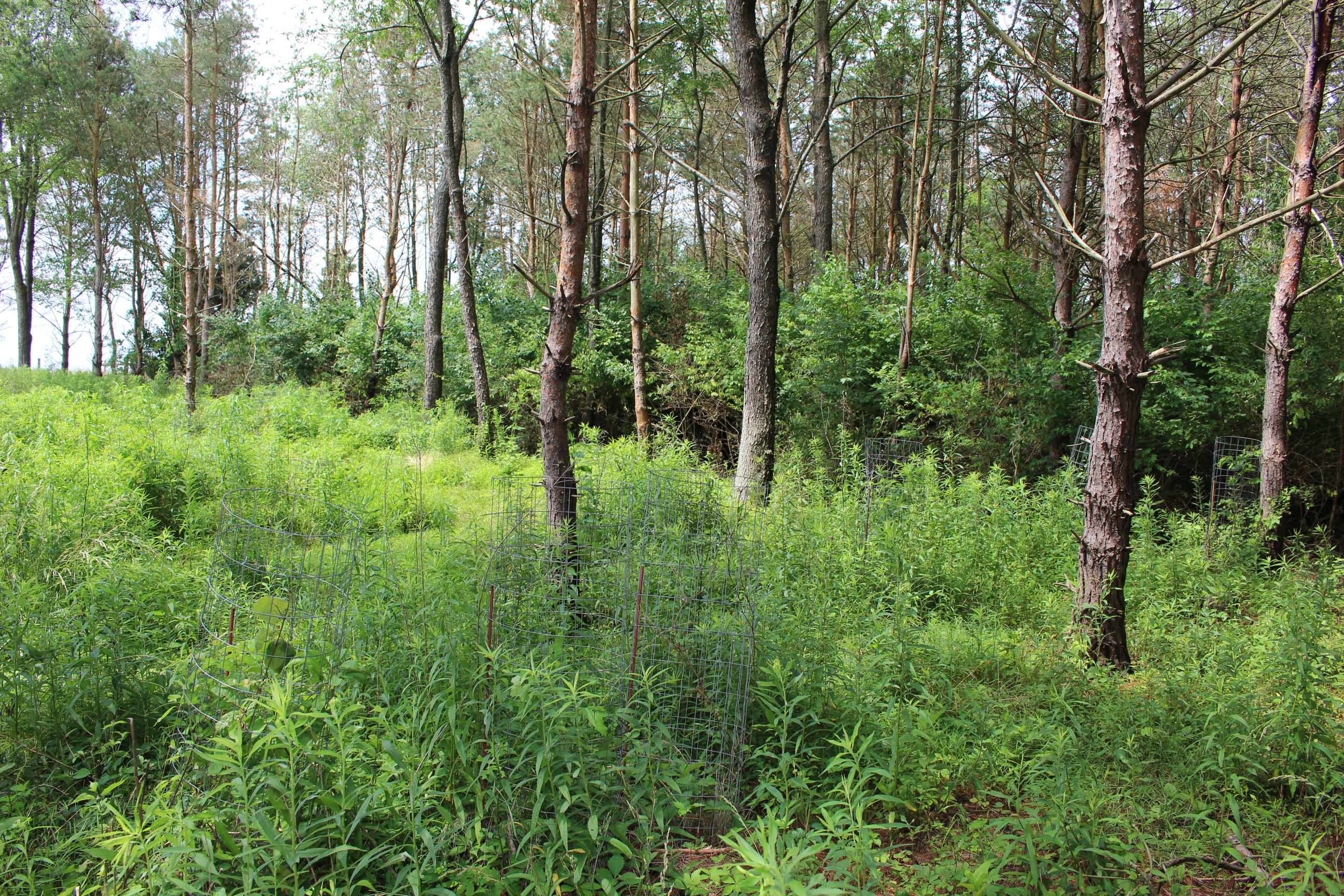
Open woods in the foreground without any invasive plants and in background, across the property line, is a wall of invasive shrubs.

The contrast is stark. Across the Easters’ property line in the background of this image, you can see their neighbors’ land is still dominated by a thick mass of invasive shrubbery that prevents light from reaching the ground. In the foreground you can see what the land looks like after the Easters have removed invasive shrubs and diseased trees over the last 10 years.

It was an aesthetic and ecological mess. The Easters saw a chance to restore and renew God’s creation.

Its context, which David’s sister had noticed, also gave the property latent potential to be ecologically valuable . The property, for instance, is next to a river. River corridors are especially important for wildlife. Their property is also across from a publicly-owned natural area. By restoring this degraded property, the Easters saw they could have a larger impact.

The Easters were motivated by their long-time Christian faith to take on this challenge.

“We’ve done organic gardening for thirty something years,” says David. “We’ve always felt that God created the earth, and the earth should be protected. We believe we need to protect and improve the world around us and leave it a better place, both spiritually and physically.”

The Easters were able to retire early to this piece of land because they had long committed themselves to living as simply as they could, which itself was a reflection of their Christian values. They chose not to buy into consumer culture, which compels people to keep consuming and buying.

“Early in our marriage we set a lifestyle, and we capped it, even when our incomes rose,” says David. “Instead, we saved, and we gave.”

In 2008, they weren’t quite ready to move, but were eager to begin improving their new land. So for the next four years, they would travel from Ohio and spend several weeks of their annual vacations filling in the holes, clearing the invasive plants, taking down the diseased pines, and planting native trees and shrubs.

“The first years we planted and went back to Ohio so we didn’t care for them well so we had to replant quite a few.”

In 2012, they moved to their property in Illinois, building their own passive solar house there with solar panels on the roof providing much of the energy they needed. They also planted a large garden so they could grow more of their food. Now that they were there year-round, their restoration of the land picked up in pace and intensity. To bring ecological life to their land, they’ve planted a wide variety of native trees and shrubs.
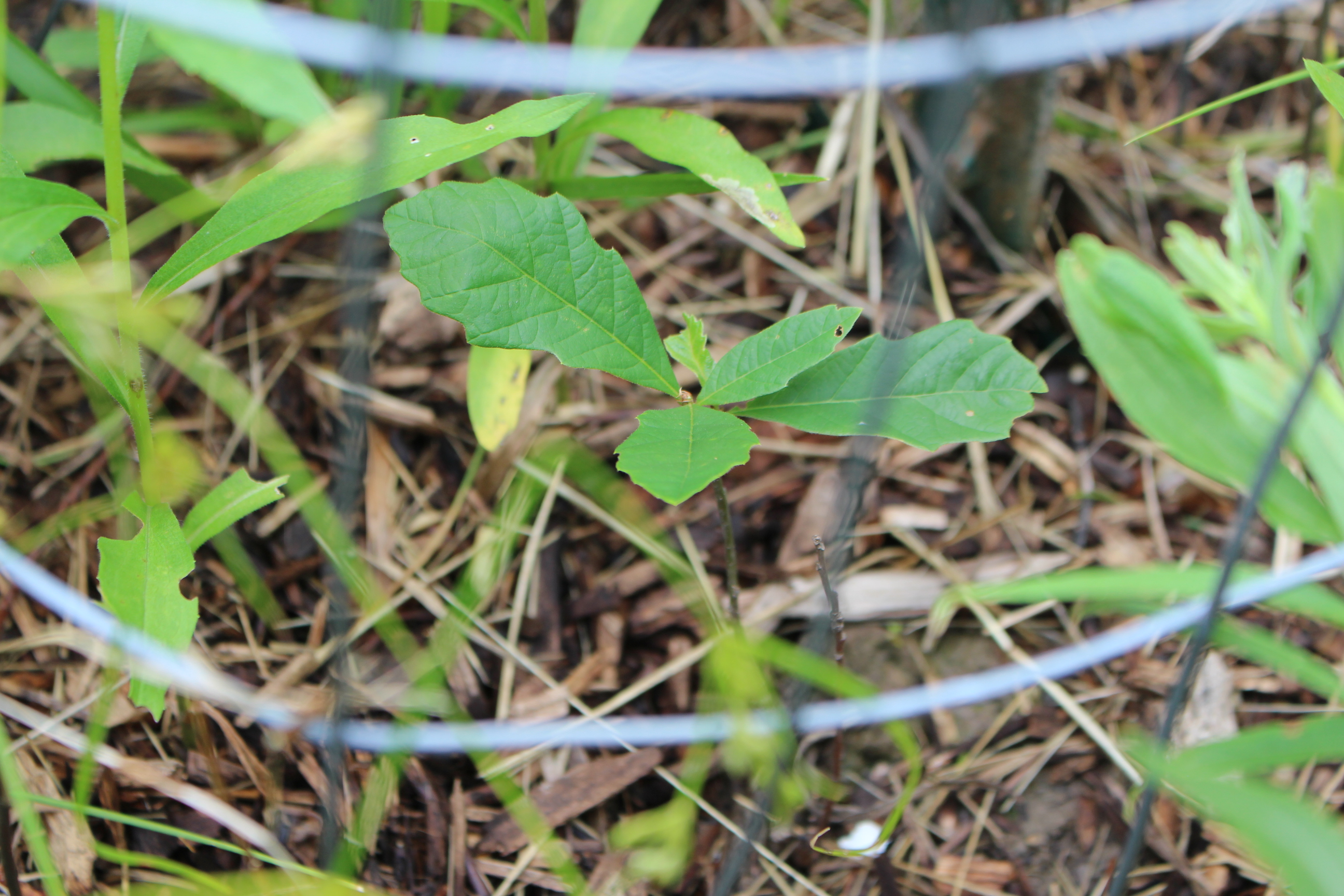
A young oak sapling protected by wiring.

The Easters have planted hundreds of native trees on their property since they bought it in 2008 and have also seen native trees and shrubs spring up even when not planted by them. Here is a young oak with protection from deer.

David is proud to recite the diverse native species of woody plants he and his wife have planted, both from seed and as live plants – 10 species of oaks, four species of hickory tree, two maple species, persimmons, sassafras, viburnums, pawpaws (a favorite of mine), hornbeam, Juneberry, wahoo, snowberry, coralberry, ninebark, hazelnut, witch hazel, and spirea. For their own sustenance, they’ve also planted fruit and nut trees and bushes. These include pecans, gooseberries, currants, blueberries, pears, peaches, and plums. In all, they’ve planted 82 different species of trees and shrubs on their property.

“We have a book called Trees of Central Illinois,” says David, “and we’ve planted everything in the book, I believe, except perhaps for the ones that would belong on the river bottoms. Based on the number of fenceposts we’ve purchased for marking the location of the woody plants we’ve planted, there at least 750 trees and shrubs growing right now.”
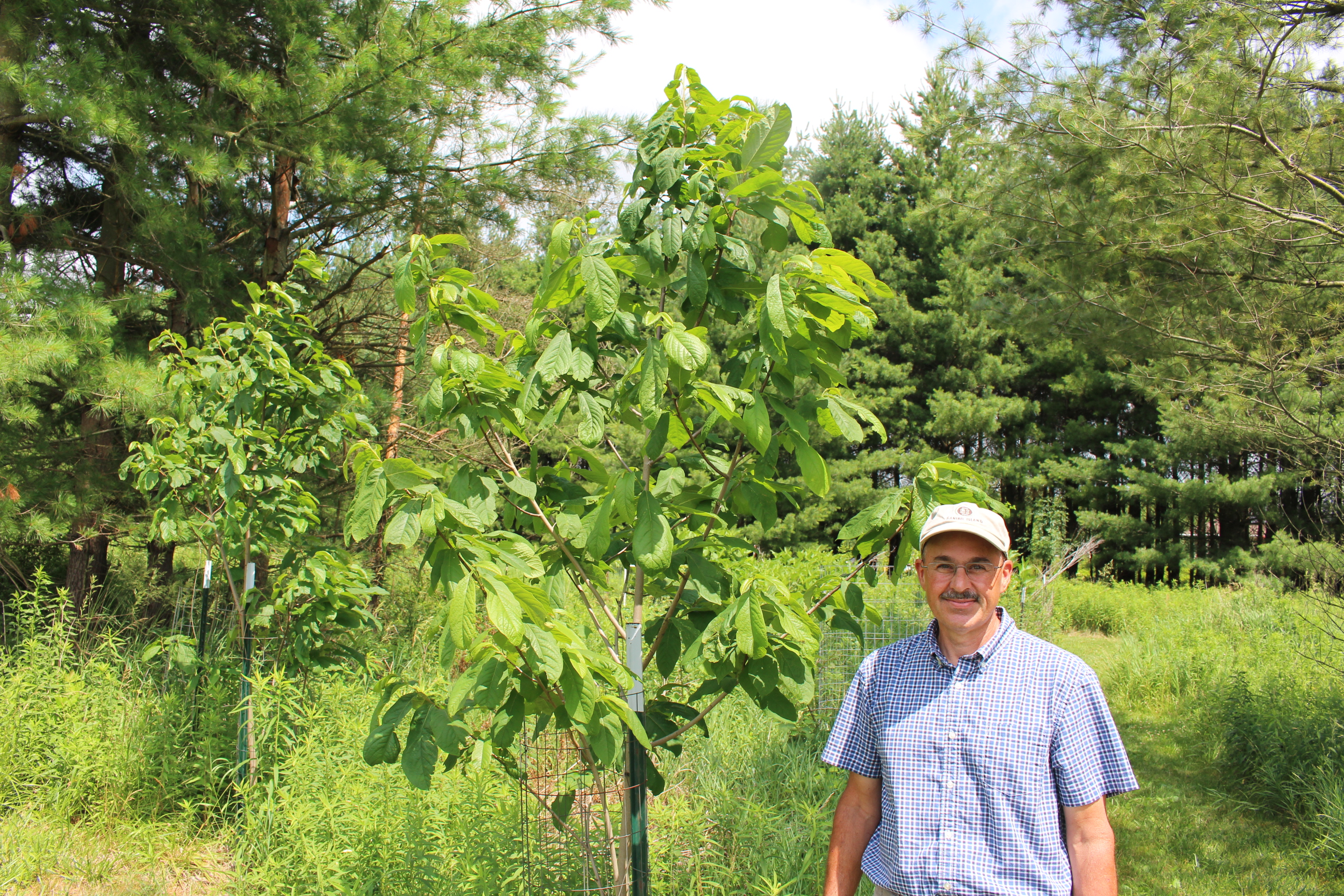
David Easter stands next to pawpaw tree.

David stands by one of the pawpaw trees he and Dianda had planted some time ago. Seeing what they planted grow and prosper over time has been a great pleasure for them.

They’ve had pleasant surprises as well. After they cleared out the invasive plants that had been dominating the land under the trees, native plants began springing up that the Easters hadn’t planted, including sassafras, oaks, and spicebush. “We’ve seen plants come up that we would not have expected and had not done so in 20 years,” says David. His guess is that birds were bringing in nuts and dropping berry seeds from other nearby properties.

The rich variety of native plants and the pollen, nectar, fruit, nuts, and cover they provide has attracted a variety of wildlife. They have seen turkey walking through, hawks and eagles flying over, and owls in the woods. Deer are actually overly abundant. They are happy to see coyotes using the land frequently. The red fox are a mixed blessing, as they are beautiful animals but have also absconded with several of the Easters’ chickens. Monarch butterflies, which face a difficult future as a species, often visit their land. Dave and Dianda enjoy watching bluebirds nesting in the next boxes they’ve installed on the property as well..

They’ve even had moments of discovery. “In the tallgrass area one day we saw hundreds of swallows and hundreds of dragonflies,” says Dianda. “Were swallows eating the dragonflies or were they both eating insects there?”

David and Dianda have advice for people who want to bring life to their properties:

1. Do research before you begin

2. Use native plants whenever possible

3. Start planting native plants (especially trees and shrubs) as early as possible in your ownership or stewardship of a piece of property so you can enjoy them as they grow

4. It’s never too late to start planting and restoring your land

5. Start small so you don’t become overwhelmed and can learn lessons that you can easily fix as you go

It was a pleasure to spend time with David and Dianda on their property when I took the photos you see. They were simultaneously at peace with who they were and energetic in their life purpose that is bound up with their Christian faith.

I first met David at a land conservation meeting we both attended in central Illinois. In addition to what he and Dianda are doing on their land, David also works to help God’s creation be protected and restored to life on a larger scale by serving on the board of Grand Prairie Friends. This is an organization that protects ecologically important lands from development by purchasing them and also by using legal tools like conservation easements. David and Dianda attend and are active in the life of Stone Creek Church in Urbana.


Back in January of 2015, I wrote an essay called Beautiful Game, Beautiful Kingdom. It explored the idea that soccer could give us insights about the kingdom of God.

As I’ve been intensely watching the World Cup the last month, the ideas in the essay came to mind a number of times.

Have you had the experience where you go back to read something you’ve written some years ago, and it hasn’t aged well. That’s happened to me many times. Well, it’s hard to say this without sounding immodest, but I did go back to read it, and to my surprise, I think the core ideas have actually aged quite well. (The only caveat – I need to figure out how to get my ideas across more concisely!)

So I’m wriitng this post in part to invite you to read it if you haven’t done so already. Here’s one section that gives you a taste of the main idea:

Soccer is often called the beautiful game. Its beauty comes in part from its simplicity. Its beauty also comes from how a well-knit group of players can move and create like a single organism that elegantly improvises within the general structure of a formation. But much of the beauty comes from how artistry and creativity have grown out of the boundaries and limits the game imposes on its players in terms of how they control the ball. It is a supremely enjoyable and always surprising thing to see powerful athletes using fine and careful movements with their feet, knees, thighs, and other parts of their body to move and control and even caress the ball…

God’s kingdom operates in a similar way. We are called to operate on love and selflessness, which run counter to the world’s drive for power and self-promotion. God’s kingdom is about freedom within limits. God’s kingdom is a state of being where we submit to God’s will and recognize that there are things we could do that we shouldn’t do because they would harm others and God’s world.

Living a Christian life is about God’s will being done even when we are sorely wanting our will to be done.

This translates into lives that are beautiful in ways counter to the mainstream. Christians at their best seek to serve others. They bear crosses and the burdens of others. They have integrity. They seek out challenges and work to mend brokenness in the world. They care for orphans and widows and the poor. They give generously and find ways to make ends meet while doing so. They try to create spiritual communities among diverse people. They submit to each other voluntarily. They take time for others and for God. They pursue peace.They love their enemies. They speak up for what is right even when that threatens their safety.

As I’ve watched this World Cup, which in the eyes of many has been one of the best ever, I’ve watched an interesting tension play out. There are teams that have been extremely defensive and conservative in their approach. Their first priority has been packing lots of players in their defensive zone. Their main strategy has been to keeping the other team from scoring while waiting for the other team to make a mistake on which they can capitalize.

There have been teams on the other side of the spectrum (like Peru and Morocco) that have been committed to playing attacking, flowing, creative soccer. They have been some of the most enjoyable to watch. And there have been many teams somewhere in between on that spectrum.

I’ve been trying to understand why I and some other observers find it so hard to watch conservative, defensive teams that put little effort into scoring, much less offensive creativity.

I think I now know the reason. Part of the global appeal of soccer is its potential to be the most beautiful and artful of sports. This sport, at its best, has a spirit that is part art. But when teams ignore that potential and seek only a practical outcome for their country, the spirit of the game is cynically lost. The higher the ideals of an enterprise the more that cunning, selfish, small-minded behaviors within it seem to taint and mar that enterprise.

Yet, soccer is still a sport. Teams are there to win. So it’s understandable that teams and players would balance skills and attacking flair with a desire to maximize the odds that they will win.

How teams, coaches, and even countries manage the tension between the spirit of the game and the rewards there are to taking practical steps that will increase one’s odds of victory is part of the appeal and vulnerablity of the game.

There are parallels, I believe, between this and the our everyday lives in the kingdom of God.

For starters, too often the Church and local churches are like defensive-minded teams that don’t get the beauty and life-changing energy and perspective of what Jesus and the kingdom of God are all about. The focus becomes defending fundamental doctrines and creeds and avoiding sin rather than living beautiful, challenging lives together that go against the grain of human-shaped culture and society that are counter to God’s values. Churches can give short shrift to cultivating dynamic, proactive, imaginative, kingdom-oriented lives of love and impact in their members. And this extends to how they treat God’s earth. Churches should be leaders in creating cultures where members creatively and beautifully figure out how to meet human needs while also prospering God’s earth.

Second, I humbly realize that I struggle with the ideals of the beautiful kingdom myself. I want to see myself in my Christian life as constantly looking for ways to show love to others, to pray, to read the Bible and related books, and to have God on my mind and heart at all times. In short, I want to be more Christ-like. And Jesus was not passive and defensive.

But instead, and all too often, I become overly practical and self-focused. I want to reserve a great deal of time for myself rather than giving it to people and causes who would benefit from them. I sometimes think too carefully about whether our budget can handle a particular donation or buying the food that best epitomizes a Christian care for God’s earth. I pay attention to what people would think of me if I spoke more clearly about my faith.

I need to ask myself this question – if I dislike soccer teams that place way too much priority on conservative, opportunistic, practical tactics, why do I find myself living out my life in the kingdom of God in the same way?

How about you?

How well are you stewarding that part of God’s earth that is under your care? Are you giving it any thought?

You and I can learn from Gabe Brown in that respect. Gabe Brown is a Christian farmer in North Dakota who is helping to change American agriculture for the better. He transitioned his family’s farm from conventional, chemical-dependent farming practices to a creative, Creation-friendly, profitable system. For years now, he has been tirelessly sharing his lessons with farmers around the country.

In his talks and interviews, Gabe recalls that before he made that transition in farming, his focus on most days was how to kill things. Weeds and bugs were his enemies. Now, in contrast, he wakes up each day trying to figure how to bring more life to his farm through cover crops, grazing, and other nature-mimicking approaches.

Gabe makes clear that creatively striving to bring more life to the land is rewarding, energizing, and just more fun.

I urge you, as part of your whole Christian faith, to make the commitment to bring more life to your corner of God’s earth. 

Photo of eastern tiger swallowtail on flower of Silphium

This is what life looks like on a landscape – plants providing what wildlife (in this case, an eastern tiger swallowtail butterfly) need. For this native butterfly to live and thrive, it needs both host plants and nectar plants. Your yard or your church property can provide both. (Photo courtesy of Joan Sayre)

I urge you to then choose how to best act on that commitment.

One excellent way is to grow food. There is much more to write on that. And I will!

But another way I want to bring your attention to is this – managing your landscape so it feeds and shelter birds, butterflies, and other wildlife. Speaking in general terms, this boils down to planting native plants on your landscape and minimizing the use of chemicals that are directly or indirectly harmful.

Just like Gabe Brown has gone against the flow of conventional farming culture, Creation-friendly landscaping goes against the flow of conventional American landscape culture.

Are you willing to go against mainstream culture for your faith?

Culture is the invisible voice that tells us what should be done and how for reasons that we really can’t explain. The lawn is the centerpiece of American landscape culture. For reasons we can’t explain a yard, cemetery, or church property without lawn just doesn’t feel right. This compulsion is invisible to us. It is just what we expect to see.

And we see a lot of it. According to this article, a NASA study estimates that there are over 63,000 square miles of the United States is devoted to turf. That is three times more than any other irrigated crop grown in our country. It is approximately the size of Texas.

We as Christians, however, should not blindly accept the culture around us. We’re called to consciously question every element of the culture we find ourselves in and determine whether it is consistent with the core threads and values of the Bible.

Israel was threatened by the lure of surrounding cultures and their gods. The story of the Good Samaritan is a story of God-honoring love triumphing over culturally formed dividing lines. Paul’s letters reveal early churches wrestling with questions of local cultures that were sometimes contrary to Christian values. One of the factors behind Christianity’s early spread was how its followers were willing to live out a charitable, loving culture in stark contrast to Roman culture.

It’s time Christians questioned the lawn culture.

When you do so, you will find that the pristine lawn as the default and unquestioned landscaping option is, in fact, contrary to a Christian perspective. This is not to say that there isn’t a place for lawn in our landscapes where there is abundant rainfall, especially when it isn’t dowsed with excessive chemicals and fertilizers. It does bring order.  It offers a place to play. There are places where vegetation close to a building is not a good thing.

But the lawn culture at its most extreme is inconsistent with a whole Christian faith.

It reflect a compulsive need to control nature to the extent that we damage and exterminate it. It is built on a culture of figuring out how to kill things. It deprives God’s wildlife of sustenance and shelter. It is a culture of selfishness at odds with what we see of God in Jesus and the rest of the Bible.


The number zero representing the wildlife value of lawns.

A lawn with nothing but bluegrass offers sustenance to ZERO butterflies and other pollinators which are essential elements in God’s very good Creation.

And that says nothing of how lawns are usually kept green and weed-free.

In practical terms, lawn maintenance for most Americans means using chemicals to keep the lawn as green and bug-free as possible. These chemicals are not benign. Follow this link to a chart showing potential and known health issues of the 30 most commonly used lawn chemicals. Here’s a quick summation. Of 30 commonly used lawn pesticides, 16 are linked with cancer or carcinogenicity, 12 are linked with birth defects, 21 with negative reproductive effects, 25 with liver or kidney damage, 14 with neurotoxicity, and 17 with disruption of the endocrine (hormonal) system. Of those same 30 lawn pesticides, 19 are detected in groundwater, 20 have the ability to leach into drinking water sources, 30 are toxic to fish and other aquatic organisms vital to our ecosystem, 29 are toxic to bees, 14 are toxic to mammals, and 22 are toxic to birds.

Do you want your children rolling in those kinds of chemicals? Our pets, too, are at risk.

In light of all of the above, the lawn is actually a symbol of the false understanding of dominion that Christians have extracted from Genesis 1. Dominion, when you read the Bible simplistically and under the influence of self-centered human culture, comes to mean domination. The assumption of the culture of domination is that the decline, diminishment, destruction, and disappearance of other life on God’s earth are acceptable collateral damage in our pursuit of power and comfort.

in contrast, Christians living out a whole Christian faith will naturally want to be pro-life in the largest sense of the word. That must translate into how they landscape their own properties and their churches’ land.

You and I will know when Christians are truly pro-life when instead of commenting on how green and weed-free their lawns are they compare notes (and perhaps even compete?!) about the numbers and diversity of birds, butterflies, and pollinators they’ve been able to attract to their yards.

I’m happy to say there are Christians who are already purposefully and creatively bringing life to their corner of God’s earth. I will be sharing their stories. This will lead, too, to practical tips and advice. I hope all of this will be the springboard for you to think again about how to best shape the health of the corner of God’s earth that you have responsibility for.

One of the things I will highlight in those coming posts is the rewards of this approach to stewarding your yard or property. You will grow in knowledge. You will grow in observation skills and how to think and act holistically. You will experience wonder.

And like Gabe Brown, you will wake up and enjoy the challenge of how to bring more life.

I’ve noticed that by and large the culture of Christians who care about God’s earth is one of love, kindness, patience, and thoughtfulness. A byproduct of this culture, however, can sometimes be the tendency to avoid speaking truth in love to other Christians who cause needless harm to God’s earth. 

So how do we respond to Sonny Perdue and Scott Pruitt?  These two prominent Christians are in positions of leadership at the nexus of economy, government policy, and God’s earth. From what I have seen, they often advance and maintain policies counter to our convictions. Their decisions, their actions, and their inaction dwarf any smaller efforts of ours.

Will we continue to be polite and courteous and avoid the elephant in the room? Or do we speak up in a way that contains truth in proportion to the scale of the harm being done? And how do we do that while still being Christian?

The open letter below to the pastors of Sonny Perdue and Scott Pruitt is my best attempt. I chose to address the pastors because I believe that churches hold responsibility for the way their members, especially prominent members, live out their faith.

Dear Pastors Nick Garland and JIm Perdue:

I am having a hard time understanding something. I hope you can help me.

You are the pastors of Scott Pruitt, the Environmental Protection Agency Administrator for the United States, and Sonny Perdue, the Secretary of Agriculture. These members of your churches profess their Christian faith sincerely and prominently. Secretary Perdue even described this opportunity to serve our county as a call from God.

What I have a hard time understanding is how they came to believe that serving Jesus in their lives of leadership meant going along with policies that serve powerful economic interests at the cost of harming vulnerable people and spoiling God’s earth.

Can you help me understand that?

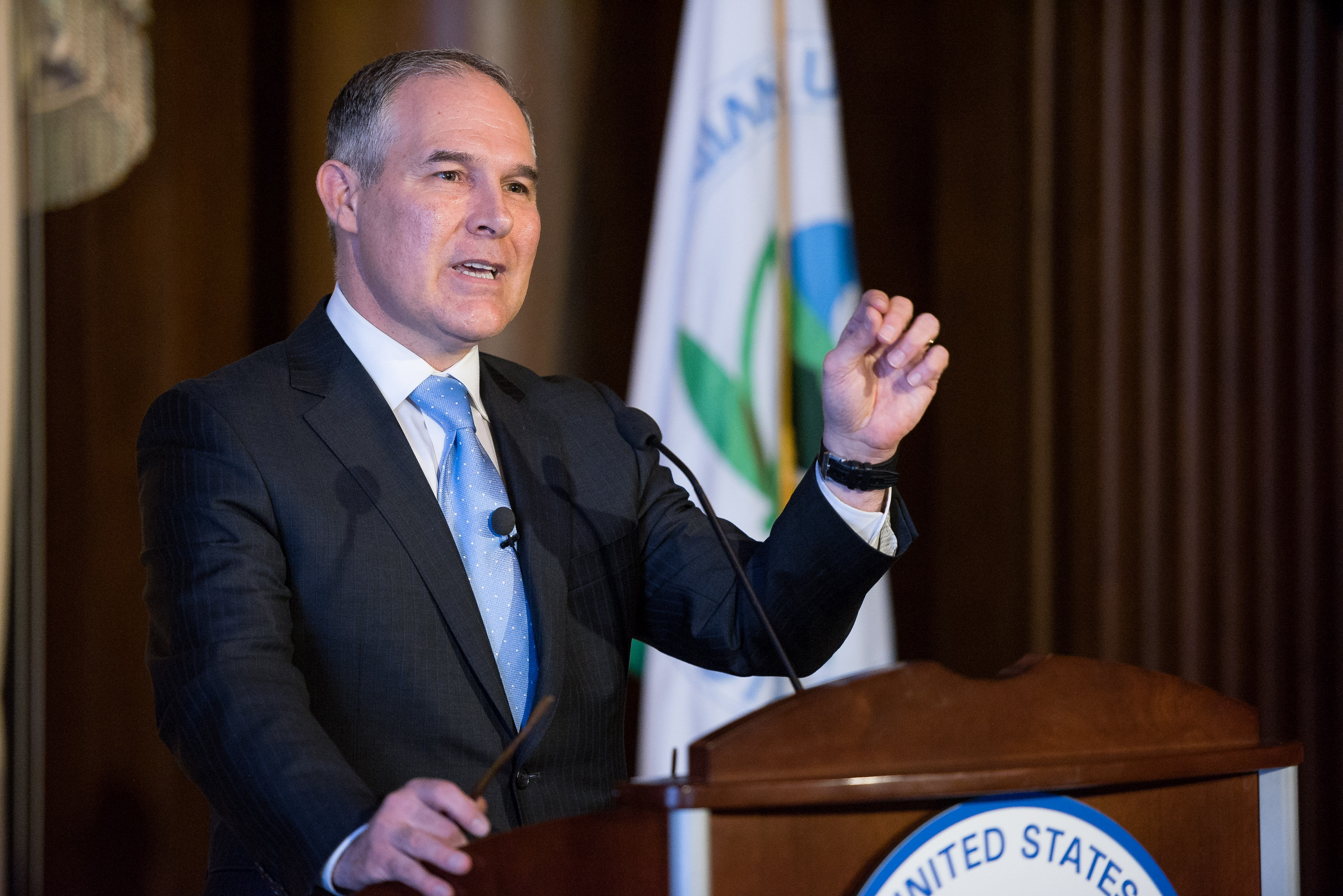
EPA Administrator Scott Pruitt standing at podium

Environmental Protection Agency Administrator Scott Pruitt (photo courtesy of US Environmental Protection Agency)

I know those words sounds harsh and judgmental. I would guess that you and your congregation feel pride that members of your churches would reach such high levels of accomplishment. You are probably already dismissing me as one of “those” Christians.

But please hear me out. I want to speak what I believe is the truth in love. I believe it is important for Christians to see God’s will done on earth. I believe it is especially important that Christians who are prominent live out a whole Christian faith their words and deeds that is an attractive testimony to the Christian faith.

Secretary Perdue recently called a jury award in the case of people around a factory farm in North Carolina “despicable.” As you may know, concentrated animal feeding operations (CAFOs) holds thousands of farm animals together in factory-like buildings. Agriculture industry leaders point out these factories give our economy cheap meat. But what is not considered in the cheap prices is the cruelty to God’s animals. Nor do the cheap prices make up for the large streams of waste generated by the confined animals that often pollute streams and foul ground water that neighbors downstream need for drinking.

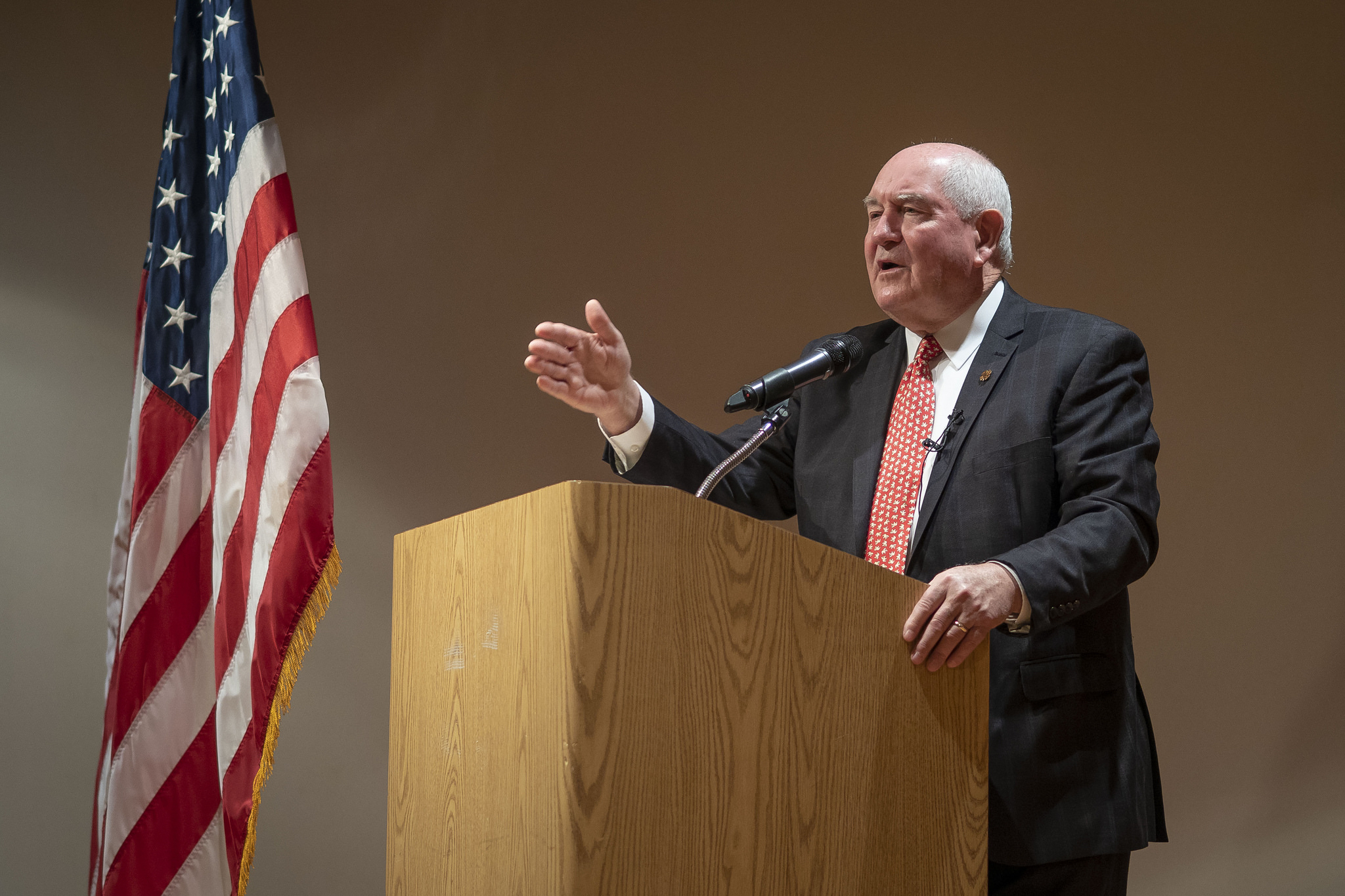
Sonny Perdue, Secretary of the U.S. Department of Agriculture (photo courtesy of the USDA)

Did you know that most antibiotics today are not consumed by people but are given to animals, especially those in factory farms, because they promote unnaturally fast animal growth? This overuse is leading to the outbreak of strains of bacteria, like Staphylococcus aureus (known as MRSA), that are resistant to antibiotics. This is leading to the painful deaths of thousands, like 18-month old Simon Macario in Chicago.

CAFO farms also generate awful smells that cause misery to their neighbors while reducing their property values. Oftentimes, the neighbors of CAFOs are poor and minorities who find it harder to get justice and protection.

CAFOs are just a symptom of our industrial agriculture system. This system has generated great productivity. It has also compromised our public health and God’s earth and emptied out our rural towns. In many ways, as John Ikerd has pointed out, this system has put priority on faith in the market economy over faith in God and over concern for the wellbeing of our neighbors and God’s earth. I have not seen any indication that Secretary Perdue has wrestled with these questions and our country’s industrial approach to agriculture.

For his part, Administrator Pruitt has consistently looked to weaken restraints on business that have otherwise protected people and God’s land, water, and wildlife. A recent example was his decision to exempt Foxconn’s planned 20-million square foot electronics plant in southeastern Wisconsin from rules in place to reduce the emission of smog pollution that harms people’s lungs. This was despite the recommendations of his staff. Pruitt has also shown a consistent tendency to favor powerful industries, even to the point of ethical transgressions.

What you and I have in common is faith in Jesus. Through this belief and trust, the Spirit begins to transform every dimension of our hearts and our lives.

One of the concepts that Jesus taught was that fruit in the form of words and deeds revealed the condition of a person’s heart. Secretary Perdue and Administrator Pruitt profess their Christian faith emphatically. But I see the fruits revealed in key policies they are responsible for to be counter to the God I see in the Bible.

As I know you know, there is a consistent theme throughout the Bible of God’s concern for the poor, vulnerable, and marginalized. These were the people to whom Jesus reached out. Prophets spoke against powerful people like Ahab and Jezebel who misused their power to rob vulnerable people of their integrity and what had been promised them by God. In Psalm 104 and in Job we also see God concerned with and revealed in all of Creation, the Creation that God included in this covenant with Noah in Genesis 9.

So I have sincere questions for you:

Do you believe that what your members are doing in their public roles as it relates to God’s earth and vulnerable people is God’s will?

If yes, is that because of the concept of dominion you teach? Have you considered the nuances of the whole Bible as it relates to our relationship to God’s earth? Have you considered God’s model for dominion over us as seen in Jesus’ life, death, and resurrection?

If yes, is that because you believe that God would never allow things he cared about to be destroyed or harmed? Am I wrongly reading Jesus’ response to the Tempter in Matthew 4:7, which shows that God does not exist to save us from purposeful folly?

Will you address Secretary Perdue and Administrator Pruitt and urge them to exhibit the fruits of the Spirit and demonstrate their first allegiance to God’s ways rather than to the interests of the powerful?

Are you concerned that the actions and words of Secretary Perdue and Administrator Pruitt might be the reason people who naturally respond to the beauty of God’s earth are being turned away from coming to faith in Jesus? Could these people know in their hearts the truth that it is wrong to do unnecessary violence to the beauty and complexity of God’s order in Creation?

Francis Shaeffer wrote, “Thus God treats His Creation with integrity: each thing in its own order, each thing the way He made it. If God treats His creation in that way, should we not treat our fellow-creatures with similar integrity? If God treats the tree like a tree, the machine like a machine, the man like a man, shouldn’t I, as a fellow-creature, do the same thing – treating each thing in integrity in its own order? And for the highest reason: because I love God – I love the One who has made it! Loving the Lover who has made it, I have respect for the thing He has made.”

If you look closely you will find that many of the policies of the Department of Agriculture and of the EPA under Secretary Perdue and Administrator Pruitt do not have respect for the things God has made.

What does God make of that?

Above all, can you help Secretary Perdue and Administrator Pruitt question the assumptions behind their policies?

They are in a unique positions to lead good stewardship of God’s earth and to reveal to millions of people what Christian stewardship really looks like. They could be amazing witnesses to the regenerative and restorative power that God offers us and offers the world.

You are their pastors. You are in unique positions to counsel them, open their hearts in humility and sensitivity, and give them the courage to consider carefully what kind of lives God would want them to lead. Without doubt, It takes courage to go against the principalities of this world who tempt bright and charismatic people with riches and crowns.

I know that Secretary Perdue and Administrator Pruitt are probably very decent people in many respects. I know, too, this letter likely challenges how each of you and your churches read the Bible. It may challenge how you think about the connection between Christians, the economy, and the role of government. And I want you to know I know I don’t live out my Christian faith perfectly. I have failings. You could build a cabin with the logs in my eyes.

Nevertheless, please be open to whatever measure of God’s truth I have been able to include in this letter.

I hope, too, you will pray with me for the day when Christians are known for wholly transformed lives that testify to their love of God through their love of their neighbors and their energetic efforts to prosper the life of God’s good earth.

Sincerely,

Nathan Aaberg

As I wrote earlier, I stopped going to church a while back for a variety of reasons. With my son back from college for spring break, however, my wife and I agreed that we should attend both a Good Friday service and a service on Easter Sunday.

Because of my conflicted feelings about church and my absence from services for a while, I had a heightened senstiviity to what I experienced at those two services. I want to share just a few of my feelings and perceptions.

We attended the Good Friday service at a church we had gone to in the past. I was struck by the power and creativity of the service. It brought together Scripture, music, poetry, and even physical sensation.

We had, for example, our hands washed ceremonially upon entering the sanctuary. And for most of the service we held a smooth stone in our hand as a reminder of our sins. As the service ended, we dropped it in a bucket before a large, rough-hewn cross near the altar.

There were a variety of sounds. Piano and organ music. We sang hymns. The sound of a whip snapping cruelly was heard at one point. We cried out, “Crucify Him!” at another point.

And the music, sounds, and words were offset by moments of silence for reflection on heart-challenging questions.

What struck me most were the gestures of warmth from a number of the congregation’s members, despite the fact that we had not attended regularly there in some time. Smiles from across the aisle. Strong handshakes. People making the effort to come over to us even though it was out of their way. Hugs.

Isn’t this a blessing of the highest order?

We went to the church of some friends on Easter Sunday. It, too, featured creativity and beauty. We first gathered outside on the lawn for opening prayers and words. As we moved into the narthex, we received candles, and these were then lit. We entered the sanctuary and used our candles to light the candles on the altar, on the window sills, and other places. This modestly-sized sanctuary became filled with nearly a hundred small flames giving out gentle, cheerful light. Holiness and hope.

There was great joy throughout the two-hour service in the songs and message. Songs. Clapping. A full-immersion baptism preceded by the singing of “Down to the River to Pray.”

There was one intriguing common element between the two services.  In both services, the beginning of Genesis was read and given prominence.

This was encouraging. By drawing our attention to the amazing goodness of the Creation and the tragedy of the Fall, the two churches drew attention to the full context of Good Friday and Easter. The story and truth of the Bible begins with all of creation in harmony and peace. In the Bible and in the world around us, we see what the Fall has brought – sin and brokeness causing pain to people and to all of Creation on an epic scale. Yet the Bible ends with a new heaven and a new earth where all of creation is again in harmony and peace with God.

Jesus – his life, his words, his death, and his resurrection – is at the heart of all this. God, our loving God, cares for people and all of Creation. Easter should remind all Christians of this. It is truly good news. Awesome news.

Was the note of all Creation being part of the salvation story part of your Holy Week? I hope so.

And I end this post admitting that there is a certain wistfulness in my heart after attending those services.

I long to have a community of faith where Creation matters and where worship and fellowship are part of the rhythm of our family’s life.