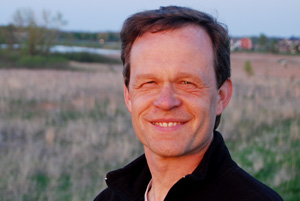

Barbara Waller by the native plant garden of First Baptist Church (Waukegan, Illinois)
There are many Christians who are living with compassion towards God’s earth and working to foster a better relationship between people and nature. And what they do is an outward manifestation, a good fruit, of the work of the Spirit in their hearts. By sharing their stories and insights, I am hopeful that you will be encouraged and inspired by the goodness that a whole faith can bring.
My first interview is with my friend Barbara Waller. She was gracious enough to sit down with me recently to talk about a summer learning program (Cool Learning Experience) she has been organizing and leading in Waukegan, Illinois, through the First Baptist Church. This program serves 3rd through 8th graders in this economically depressed area, engaging them in science learning experiences focused on the environment. Through the program, they also encounter the natural world in a variety of settings. And if you’re around the kids at all, it’s clear that they’re just plain having fun. Known to her campers as Ms. Coyote, Barbara has worked tirelessly to build this camp in partnership with senior pastor Keith Cerk. Barbara has also been an effective ambassador for the program, inviting a multitude of generous partners in the greater Chicago area to share their services and resources. She is a gracious, warm, energetic, modest woman who loves God and cares for God’s earth deeply.
Q: Can you tell me about the Cool Learning Experience program and how it started?
BW: Cool Learning Experience started in concept in 2007 at First Baptist Church in Waukegan when our denomination, American Baptist Churches USA established a children in poverty initiative. That year, one of the senior pastors and I participated in the denomination’s national conference for leaders from local churches to explore ways to provide outreach ministries to support children in poverty as an expression of our faith. We came back, and we thought, “Why not bring a summer learning program to our community?” As a church we decided to offer the program to middle elementary age children in the summer months when children generally experience the greatest learning loss and when many parents need a safe place for their children to be engaged in learning. In July 2008, First Baptist launched it as a three week, all-day, nature-based summer learning program to children in 4th and 5th grades. With an all-volunteer staff, we served an ethnically and racially diverse group of 10 children, most of who came from families reporting incomes at or below the federal poverty level.
Truly for me, and I believe for Pastor Keith, too, it was a walk of faith. After he and I read Last Child in the Woods by Richard Louv, we knew immediately any program we offer must be nature-based. We were convinced that providing opportunities to experience the awe and wonder of nature while engaging children in fun learning outdoors would best support our mission to foster the well-being of children in every way – emotional, mental, physical, and spiritual. We decided to co-direct the program. This allowed us to draw upon Pastor Keith’s skills and passion for engaging people in exploring the wonders of nature and my experiences and passion for developing and implementing summer learning programs. We decided on a full day program to better serve those parents needing an organized program that would accommodate their workday schedule. They needed more than a half-day or 9-to-3 program.

Children examining a rare prairie wildflower as part of the Cool Learning Experience summer program.
N: How has the program grown since 2008?
BW: We grew from a daily maximum attendance of 10 children the first two years to maximum attendance of 73 in 2012 and 2013. In 2008, we served children in 4th and 5th grades. In 2014, we served 3rd – 8th graders. The program expanded from three weeks in 2008 to eight weeks in 2013. Teaching staff has grown from one part-time certified elementary teacher in 2009 to a 2014 staff of three full-time teachers, three teaching assistants, one administrative assistant, and five part-time counselors. The continual growth in volunteers from teens to senior adult has been most amazing. We have grown from an all-volunteer staff of 5 in 2008 to 45 regular volunteers in 2014, and this does not include our many faithful parents who volunteer in various capacities as needed. We are very pleased to have more partners join us each year, creating even more diversity in our faithful supporters. We experienced the same with the cadre of volunteers who give thousands of hours each summer.
N: I understand the program engages the children in learning in nature in a number of ways.
BW: Yes, the goal is to provide an inter-disciplinary, multi-year curriculum. Since 2012 our theme has been exploring water, land, and air. Thanks to one of our funders, we developed a curriculum which integrates science, math, technology geography, arts and creative writing to offer hands-on learning focusing on water, land and living things over a three year period. We treat air as an integral component essential to each system as well. We explored water in 2013 and land in 2014. Next year we will explore the living things in the diverse ecosystems of water and land. The curriculum is designed for delivery in six weeks of the eight-week program. Children are engaged daily in hands-on learning experiences in the outdoor classroom of nature around us, such as our butterfly and raised-bed gardens as well as local ravines, prairies, woodlands, local waterways, and Waukegan Harbor. Field trips to local and regional sites also support the written curriculum in significant ways. Visits to the Chicago Botanic Garden, Lake County Forest Preserves, Volo Bog, Prairie Crossing Learning Farm, and Horicon Marsh in Wisconsin have become standard trips each year. These repeat visits bring deeper learning for the children.
N: Can you share a story of a child who was impacted by Cool Learning Experience?
BW: During a trip to Volo Bog in 2013, a fifth grade boy suddenly grabbed me as we were following a naturalist into the bog and walking on a rickety boardwalk. In a fearful voice he said, “Ms. Coyote, she’s going to drown us. I don’t want to go!” He was very frantic and insisted on not moving another step. I said, “Come on, it’s going to be OK.” And literally within five minutes after spotting a turtle, he turned around and said to me, “Ms. Coyote! I can’t believe this. This nature is awesome. Nature is beautiful.” It seemed like a spirit of calm overwhelmed him. He truly enjoyed the rest of the walk as we went throughout the bog pointing to another turtle and some frogs. He was full of excitement when he saw a blue heron. That was a life-changing moment in his life. Since then I have never seen him express fear when exploring new places in nature. As a matter of fact, he now encourages other hesitant children.
NA: All of the camp participants have nature names. Can you explain how you chose your nature name of Ms. Coyote?
BW: You know what? It was by default. I selected it in 2008 when Cool Learning Experience participated in the U.S. Navy Starbase Atlantis program at the Great Lakes Naval Base. As part of this program, all of us, including the navy instructors, chose a name to adopt from a prepared list. After our children and staff picked their names, there were only two names left. Coyote was one and I chose it because the other didn’t appeal to me. Interestingly, I’ve learned much more about coyotes since then, and I’ve learned that the coyote is an extremely adaptable animal. For many years I have thought of myself as having an adaptable personality. I attribute this primarily to living the first 21 years of my life in the rural, segregated South. You learned to adapt. It was necessary for survival in some pretty hostile environments. As I read more about the coyote’s qualities of adaptability and survival, I thought, “That’s me. That name fits me.” So, I now embrace my nature name with pride.

Participants in Cool Learning Experience enjoy the natural world in a variety of places (like the Skokie Lagoons in this photo) in the Chicago area.
NA: Can you tell me more about your faith journey?
BW: I’m grounded in the sacred texts known as the Bible. I remind myself daily of the awesome price was paid for me to be a free person inside and a transformed person for the better. That is very humbling. God knows all about me and loves me and loves all of the other billions of people on this planet. Knowing and experiencing His deep everlasting love makes me feel special, and at the same time I feel such a sense of responsibility. If I believe Scripture to be God’s truths and I’m grounded in it, then I’m called to be transformed and to be an agent of transformation. My daily walk with God – freely choosing a discipline of daily prayer, studying the Bible – leads me on a path of service to humankind out of His deep everlasting love.
As I said earlier, I grew up in the country in the segregated South. I am grateful that my parents were people of faith. I witnessed my parents show love and forgiveness in the midst of unjust treatment and acts of hatred. You know, there is much truth in that old saying: children learn more by what we do than by what we say. I saw my folks love those who mistreated them and others in our community. I have a memory of my mom saying, “You can never hate.” I never saw them hate other people no matter how much injustice they experienced. As I grew older and reflected on that life, I realize that attitude was rooted in their faith, in their sense of who they were as children of God. And we caught it because they taught us well! I know that the God that I serve is a God of love, a God of forgiveness and compassion and grace and mercy who calls me to be likewise.
NA: It’s very clear from your life that you care a great deal about God’s earth. Why? How does taking care of God’s earth relate to your faith and your walk with God?
BW: I have loads of fun memories growing up in the country surrounded by wild places to explore, creeks to fish in, wild berries and plums to pick, lightning bugs to catch at night under star filled skies, and much more. My childhood was a time when we were immersed in the natural world. Nature offered us endless fun adventures, wonders, and peaceful places. I still remember falls in Memphis, Tennessee. I would lay out under the trees and on the leaves. There’s something about the fall sun in the South.
Nature also offered us food to sustain life. I strongly believe I learned some foundational life lessons growing up in the country where we depended on the land for growing vegetables and raising animals to provide food for our family and others in need. I remember when it was time to kill the hogs, there was always a man designated to shoot the animals. As a child I didn’t ask why this man had that job. Years later, I realized their reasoning. He was the marksman and better skilled than others. My parents and others didn’t want these creations of God to suffer needlessly. So, for them it had to be done as humanely as possible.
They were also mindful of how they use other natural resources of nature, especially water, wood and, coal for cooking and heating. I remember my mom saying, “Waste not, want not.” Honestly, this was drilled in us. So there was never waste of water, food, wood, or anything. I learned early that there were neighbors who had less than we, and you just didn’t waste because there were many needs in our community. Just as God had instructed his chosen children throughout scripture how to care for others, like gleaning the fields – all of those things we just did. We didn’t question it. I learned caring for others was the righteous thing to do.
And caring for the earth was a part of caring for others. You see my folks were depending on the land to provide vegetables and fruit to feed their children. They knew if they didn’t care for this land, it wouldn’t continue to care for us, producing enough quality food. They were thankful for hogs and chickens to sacrifice for food to sustain human life, so they acted humanely. I read in one of Michael Pollen’s books something like, “Food is not a product of industry. It’s a gift of nature.” I love that statement. Food produced from our land was indeed a gift of nature that sustained us. How could you not take care of the land? I observed much through the senses of a child, but when I became an adult those observations became instructive and life shaping. My folks understood God as creator of all things – land, water, plants and animals. He created it for our use and pleasure. Yet, they knew to respect and value all these creations.
Scripture tells us He gave humans dominion over all living things. As I now understand Scripture, dominion does not mean we can do whatever we want to His creations. No, we are called to be respectful and responsible for all God created. God has entrusted all that He created to our care. I have dominion and responsibility for my children but it doesn’t mean I can abuse them or leave them home unattended when they were infants. I couldn’t feed myself first. No, you care for them first. So God has given us an awesome responsibility.
I’m not of the mindset that we can say, “Well, I can mess this earth up because we’ll get a new earth anyway.” In the first book of the Bible, Genesis, we read of God giving humans this awesome responsibility of dominion and at the end of the Bible in Revelation we read of His plan to create a new heaven and a new earth. In the end God is going to bring it all together according to His will. Now, the question is what have I done in between the beginning and the end? And I believe that’s what I’m going to be held accountable for by our loving God who created it all.