Archives For Wrestling with Doubts

Some time ago I wrote about the 10 ways in which being committed to shepherding God’s earth deepens your faith.

I now feel compelled to explore the ways in which living as if Creation mattered to God tests us and challenges us.

There is an obvious but oft-overlooked reason why some Christians are averse to seriously shepherding God’s earth.

It’s because it can be just plain hard.

I believe, however, that when you know what’s coming, you can brace yourself. You can, at least to some degree, gird yourself mentally and emotionally for the challenge. I hope this is useful as you grow in determination to take on the challenges of Creation shepherding..

#1: Living in a World of Wounds

As human beings, it is fairly easy for you and me to imagine the pain that other human beings experience due to violence, poverty, and even emotional blows. At least it is if you had a childhood in which empathy was modeled for you and God’s Spirit has helped you be other-centered. It helps, too, if you have protected your heart as Proverbs 4:23 urges us to do. That can be radically hard to do today.

If we allow the Spirit to shape our hearts so they are open, pure, and child-like, we can have that same kind of empathetic imagination for Creation.

When we do, we will pay attention to Creation and eagerly learn more about it. We’ll carefully pay attention to trees, birds, bobcats, dolphins, soil microbiomes, and even the ecology of whole landscapes. We will actively restore life to Creation, tapping the regenerative ecological capacity God gave to it. When we use Creation, as we inevitably must, we will do the best we can to be respectful and reciprocally beneficial to God’s earth in ways that express love for God and our neighbor.

The expansion of your empathy beyond yourself and beyond humanity brings both profound kinship and vulnerability. This is because the more expansive your empathy the more easily you can imagine the pain and fear that beings in Creation experience. When you become convinced that the land, water, and living things around you are precious to God and when you know how beautiful Creation can be when fully healthy and complete, then you will begin to grasp how challenging we have made life for our Creation kin. Your heart will be wounded by the wounding of Creation.

You will also be aware of what you should see and hear but do not. There is a silence that is not the silence of peace but the silence of missing life. Being aware of that will cut your heart. You will feel pain at what is missing in Creation because of human sin. 
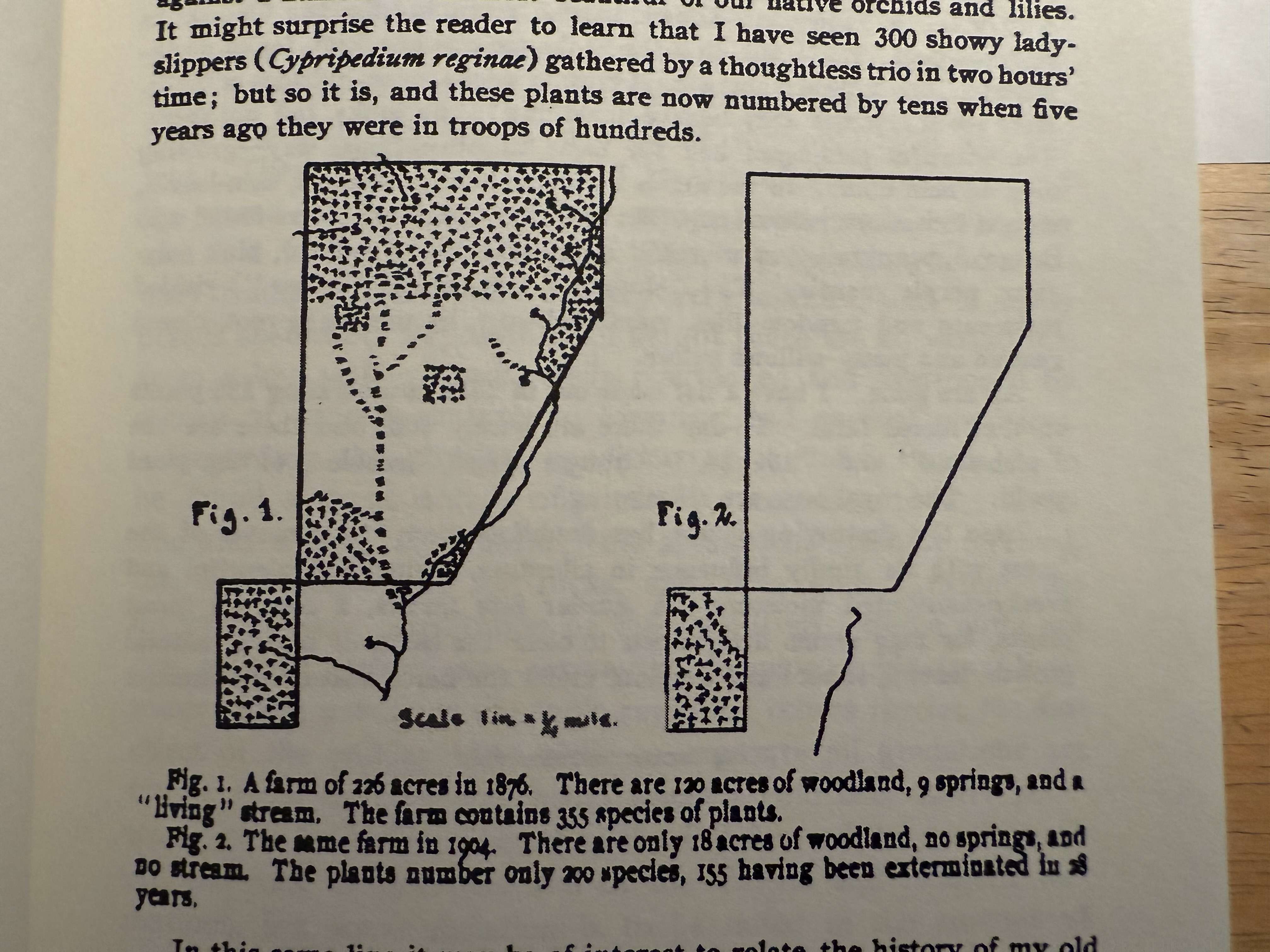
I have been reading some essays and papers by H.S. Pepoon, a biologist who documented the flora and fauna of Jo Daviess County, Illinois, (where we now live) more thoroughly than anyone else ever has post-settlement. In one short report, he documents the decline of life on his 226-acre family farm. In 1876, there were 355 species of plants. In 1904, there were just 200. One hundred fifty-five species were, as Pepoon writes, “exterminated in 28 years.” What, I wonder, is the state of that farm today? From what I’ve seen and what I know, I’m guessing the number is less than 50.

The decline of life on the Pepoon farm is a smaller version of what the whole world is experiencing on a much vaster scale.

When you take the blue whole faith pill of seeing what is happening to what our Creator God created, your heart can be broken..

#2: Living Alone in That World of Wounds

Ecologist and writer Aldo Leopold wrote: “One of the penalties of an ecological education is to live alone in a world of wounds.”

There are two pain points to which Leopold calls our attention. Seeing, thanks to one’s ecological education, the way humanity breaks the individual pieces and systems of nature is one “penalty” (what a euphemism, by the way). The other is experiencing the pain of that awareness largely alone.

Leopold was speaking largely of the loneliness experienced in American society as a whole.

I would argue, however, that there is a particular species of loneliness that Leopold probably did not understand. That is the loneliness of being among Christians who praise God for creating this world but who seemingly believe that God does not take personally how we treat it. Worse yet, some Christians will even criticize other Jesus followers who act compassionately and respectfully towards Creation do for being political, liberal, woke, or just plain unchristian. Facing that kind of critique and its accompanying personal castigation is no easy place to be.

Of course, being mindful of God’s earth does not represent a falling away from the roots of Christian understanding. The true situation is that mainstream Christian culture and theology have, in this area, fallen away from the roots of the Bible, the love of God, and God’s second scripture – Creation.

When you and I show concern for God’s living earth and question how it is used, we are actually bringing up uncomfortable truths. We are reminding others that the vineyard we are using is not actually ours. The criteria for what is right and wrong about our use of the vineyard is not what grows our power and wealth. The criteria for right and wrong is whether the vineyard owner will be pleased with the condition of the vineyard when the owner comes to reclaim it.

This all can complicate your experience of being in a local faith community. Do you compromise your principles? Or be a persistent voice in your community for Creation shepherding? Or take some kind of third path?

#3: Resetting Your Life Habits and Mission Overload

A Christian serious about a whole faith will, among many things, seek to create habits that daily reduce negative impacts on Creation and contribute to its regeneration. You wil, for example, think about what you eat. What you give to. How you treat your piece of God’s earth. How simply you live. It can be all-encompassing.

Between making a living, caring for family, maintaining a dwelling, and being involved in activities of one’s church, where does one make room for a real commitment to protecting and renewing God’s earth? All that needs changing can be overwhelming.

Creating new habits can be challenging. And when our lives are busy already, adding another layer of consciousness can seem like just too much to handle. This is especially true when a place we live in makes it hard to do good for God’s earth.

I can tell you, however, that you will eventually find that striving to be faithful and thoughtful in your life actions, including how your actions impact God’s earth, will grow your faith and increase your awareness of all of the world mattering to God. New choices will become new habits. Gradual yet tenacious effort will bear fruit over time. You will ultimately feel good, even as you realize we can never live perfectly.

#4: Between Faithful Response and Zealotry

The awareness of how frequently we interact with God’s earth and how marred Creation often is by our individual and collective actions can prompt a number of different responses.

One is overwhelm. This leads us to try to avoid thinking about it.

Another is a life of intense effort to be environmentally pure in every single act or habit of living. Because so many people don’t pay any attention to their life habits, this approach could actually seem extreme. Choose not to eat meat from an inhumanely treated pig? The average person might consider you a zealot.

A zealot, however, is not someone who builds habits so that they are as faithful as possible in a particular area of life, like the shepherding of Creation.

Zealotry, in my mind, is something different. Zealotry is when your passion for purity in one area of life overwhelms faithfulness in other areas of life. It is when purity in one area of life becomes the sole measure of your life’s morality.

Let’s consider the example of being invited to a new neighbor’s houses for a party. The food is not food that is healthy nor raised and produced in ways good for Creation, one’s farmer neighbors, nor their communities. Do you reject it all?

That might be pure, but how would your new neighbors understand your reaction? And what would your rejection or abstaining do? The food is already produced and purchased. Your new neighbors might have no frame of reference for understanding why you are acting the way you are. If they’re not Christian and they know you are, that might impact their impression of you and your family. Are you loving your neighbor in that situation?

Living out a whole faith with intentionality and consistency while avoiding zealotry requires God’s help and wisdom. It means paying attention to all of the facets of our life and all of the facets of what it means to love God and love our neighbor and follow Jesus.

It’s hard, but not impossible, to do this.

#5: Caught in Tsunami-Scale Systems

Almost all that we do every day is a form of interaction with God’s earth. The food you and I eat (even the food that is not really food) comes from God’s earth and the work of our neighbors.

Our furniture comes from God’s earth, whether it be from trees or petroleum by way of plastic. Our clothes come from the earth. So do our cars and homes. Plastics are a sadly good example of how our wizard-like powers to transform petroleum into everything from plastic bags to plastic bottles have the unintended consequences of poisoning Creation and ourselves.  The growth of artificial intelligence technology is taking our energy and water consumption for virtual activities to a whole new and disturbing level.

Yet, how does one live without being part of the depletion of Creation? How could one change global systems?

Abstaining from eating factory farmed meat, although it is a good and righteous thing to do and sends a virtuous economic signal, does not change the system of factory farming that dominates places like Iowa.

Walking and biking as much as possible, as good and righteous as that they are, does not change our world’s consumption of fossil fuels on a system’s level.

Individual good deeds are not enough to turn us around from systems that degrade the life out of the earth on a massive scale.

This is one of the biggest challenges I experience in caring about the fate of God’s earth.

I believe in building habits of faithfulness in our everyday lives towards other people and Creation. I want to believe that if enough people do good things that that will contribute to a better world.

But it is clear that there is a tsunami of larger forces and trends at work. It is also clear we live in a world in which laws (or a lack of laws) and systems often enable the strong and powerful to take advantage of the weak, whether the weak are the poor or vulnerable beings of Creation.

Can better systems be built on local scales? Absolutely. There are example all around the world. But will those examples replace the systems degrading God’s people and world? It’s not clear to me that will happen before God brings a new heave and new earth. And that is, at least for me, a heavy thing to live with.

 #6 Running Upstream Against Economic Nationalism

The power of a country, including its military power, depends in large part on economic power. Economic power is derived, in large part, by the extraction of wealth from Creation.. It logically follows that if you and I speak up for restraining humanity from extractive and violent uses of Creation in our community or country, then we could be seen as obstacles to success, wealth, and power.

And calling for restraint and restrictions on how individuals, businesses, and national institutions will use Creation also puts us at risk for being seen as unpatriotic. Nationalists, even Christian nationalists, will castigate us. Or worse.

A recent article from Inside Climate News shared this:

Since Global Witness began tracking annual deaths in 2012, more than 2,253 environmental defenders have been murdered or disappeared. Many of the victims opposed extractive industries, such as mining, logging and industrial agriculture, or had challenged systemic issues like organized crime and land theft. 

These sad and tragic statistics mostly come from countries like Colombia and Guatemala. Someday, if we extrapolate from current trends, there could well be similar violence done in the United States, as our country becomes increasingly ruled by power rather than by law.

Being faithful isn’t so hard when your version of being faithful fits neatly within the value system of the dominant ruling class of the country you live in. But if your country’s actions and systems are counter to actual Christian values, like the shepherding of Creation, then being faithful will put you at personal risk.

Nevertheless, we are first and foremost patriots for God’s Kingdom.

#7 Torn Between Present Anguish and the Joyous Certainty of Renewal 

Seriously shepherding Creation compels you to wrestle with the one of the paradoxes of the Christian faith. On one hand, violence done to the fabric of God’s people and world is a clear and present sin that should provoke outrage in us. On the other hand, we have confidence that people and all of Creation will someday have an eternal, joyful existence with God.

This is difficult to live with and process.

One of the reasons I’ve not released a blog since August is that I’ve been struggling with this post for months now. It has been hard to get it to a point that feels complete, authentic, and clear. And this paradox in particular twists my heart and mind into a knot.

I don’t know what face to show the world. Or how to organize my own attitudes.

There are Christian leaders in the Creation care field who seem to only show a positive, upbeat face to the world. I believe this is, in part, because they believe the voice of lament and grim anger is not winsome. I also believe this is because the Gospel’s message of hope and future world renovation fills their hearts so much there is no room for sadness and doubt. I admire their work, but the one-dimensional tone of optimism doesn’t land for me.

I also find that I don’t feel at home in faith communities where every service is 100% full of optimism and happiness.

And with that statement, I’m sure there are some readers who will feel I have gone completely off of the deep end. How, you might ask, can the Christian faith be anything but positive, hopeful, and reassuring?

Let me be clear – worshiping in hope and joyous faithfulness is a powerful centering force for my heart and mind.

But wouldn’t there be good that came from reminders, both in content and tone, that the reason the Good News is such good news is that Jesus came because God hates to see all of Creation so dysfunctional, so warped, so full of pain and frustration?

And isn’t it Good News that our salvation, our being turned by God towards Him and filled with God’s Spirit, equips us for good works in this world so darkness is pushed back, even just a little?

We are meant for being God’s active and good presence in this world. We are called to address the pain and dysfunction of the world.

There is a line of Christian theology that says the conviction that all will be put right does not have to reduce the energy of the conviction that we must step forward to address the world’s sickness from sin. It makes some sense in theory. But it feels like the practical default application is for Christians to feel that injustice towards people and Creation is unfortunate but acceptable collateral damage. There can be easy rationalization for minor responses or just plain inaction.

Life would be easier for me if I accepted pat theological answers and focused only on the happy ending Christian theology tell us is coming. But I can tell when I’m not yet fully convinced in the deepest depths of my soul.

I find the mixture of emotional chords in the Bible resonates with me in a way that I have a hard time finding in church.

I am, for example, challenged by the prophets. There is so much strident, unsettling, harsh emotion there. Yet, simultaneously, there is also hope and faith in the compassion of God. I find Isaiah 11 to be one of the most moving and inspirational chapters in the Bible, especially the ninth verse:

They will neither harm nor destroy
    on all my holy mountain,
for the earth will be filled with the knowledge of the Lord
    as the waters cover the sea.

The prophets did not believe the exile of the people of Israel was the final word, but their words expressed deep outrage at the idolatry and injustice that caused God’s judgment. They lamented the fall and captivity of Israel, even as they had faith that there would be a return. That is the kind of paradox I believe we need to lean into.

When was the last time your liturgy dived deep into the prophets on a regular basis?

Interestingly enough, Jesus brought those same paradoxical chords of tone and message. He was full of both love and sharp outrage. I am convinced, even though I don’t know exactly how to apply the conclusion in my life, that we need to be Christ-like in this way. Getting the balance right is no easy thing.


My hope is that these reflections strengthen your faith and prepared you for the challenges of doing what you and I are meant to do – love God, love our neighbor, confront injustice, and be the image of God for all of Creation. May you and I do so with 100% commitment that comes from a whole life-faith centered on Jesus. Jesus offers us both an easy yoke and a life purpose that will stretch us and grow us beyond what we might have expected.

Let’s lean into that.

So I’m back.

Last year, as I’ll describe in a future blog, I worked two demanding jobs for two non-profits in the food and farming field. This squeezed the rest of my life. Even though I continued to think about all things Creation every day, I took a break from the blog to leave room for my family and my health.

And to be very candid, even as I took a sabbatical of sorts, I questioned whether I should continue to make this blog a life pursuit. Was what I was writing, I asked myself, significant to anyone else?

Adding further sharpness to that question was turning 60 and experiencing the limits of my constitution in my working life. I ran into my limits while appreciating more acutely that my life itself had limits. That created habitat attractive to other questions and doubts.

What do I want to give my energies to going forward? Is diving into the ideas that this blog has been my exploring the right thing to invest in? Or should I devote more energies to acting in the world out of my faith for Creation?  

Even deeper questions, questions I thought I had long ago resolved, surfaced.

Do I believe?

Am I willing to rest my life choices and convictions on commitment to God and Jesus? And if I am, how does it make sense to do so?

How, I sometimes wonder (and you may find this heretical), could God choose to give us the Bible as we have it as a major revelation of himself when it can be read so many ways and when there are threads within it that can be woven in many varieties of cloth? Why do so many of those varieties of cloth result in Christians who believe God created this world and then treat it, collectively and individually, with so much indifference?

The following tweet by a thoughtful rancher and land steward out West encapsulated it all perfectly. You can tell from her words that she has met many people of the Christian faith who are completely indifferent:

I am horrified. I know that you are horrified. But if you went to the average church and expressed your horror and asked for prayers for Creation, they would literally not know what to do with you. 


But Here I Am Paying Attention

When I find myself asking all of these questions, I am a little envious of people whose faith in God and Jesus seems so secure, deeply rooted, and unshakable.

I believe. Yet I need God’s help with my unbelief.

After 60 years on this earth, I am more convinced than ever that there is more to life than the random interaction of atoms. I also find myself compelled (and I can find no other word for it) in heart and mind by the Bible and the God I find there and by that same God I find reflected in Creation. I find myself captivated, thanks in part to The Bible Project, by how the whole Bible fits together and by how Jesus fits within that whole. 

I have also come to understand this after ten years of writing — any attempt at weaving the threads of the Bible together into a satisfying and whole cloth depends on you and I really paying attention. This applies to Creation and much else that relates to how we live faith-lives.

All too often we don’t actually see what is in front of us, around us, and even inside of us. We get carried along. Sometimes we are carried along by our busy-ness and our eagerness to get on to the next thing. Sometimes we get carried along by what we expect to see or experience. The culture in which we swim and breathe can blind us. The theologies we have been taught can cause us to miss things or interpret things in a way that isn’t fair or respectful to what is right in front of us.

I believe, too, that is very possible for us to have hearts that have gone numb. We can no longer know at a deep level what really gives us life and energy. The capabilities we have that come from being made in God’s image can be covered up by the habits we fall into. Confusing the Christian faith-life with pledging alliance to the correct theology can be one of the most effective blinders to actually paying attention.

Often we need to look anew and question anew. We need to pay attention to all that is in the Bible, in Creation, and in our hearts. 


A Signpost in the Psalms

I recently read through all of the Psalms. It was not the first time, but in the process I saw new things I had not remembered before. Here is just one of many verses that struck me:

Psalm 145:16 

You open your hand; you satisfy the desire of every living thing.

The desire of every living thing – from fish and birds to moss and plants and even lichens – is something the Bible is mindful of. Any theology that ignores the desire of every living thing is inherently incomplete. A Christian faith-life that ignores the desires of the living things around us is unwhole.

And I would be so bold as to say that its incompleteness is not just equivalent to a puzzle missing a minor piece on the edge. It is like an engine missing its valves or its gas tank. The absence actually causes the whole not to work.

As Wendell Berry wrote, “We are are holy creatures living among other holy creatures in a world that is holy.”

Are you aware and thoughtful of the desires of every living thing? How do we balance those desires with our own lives, much less our civilization? It almost seems too much to bear. At the very least, it should force us to question how we and our community and our economy and our laws relate to Creation.

Maybe that is the role of people like me, people who live in both belief and doubt. Maybe we are here to pay attention, to balance off people so set in the narrower tracks of their faith and lives that they no longer pay attention to the world and the many subtleties and cross currents of both the Bible and Creation.

And perhaps we are in the better place to respond (as I did) to Ariel and say, “Yes, you are right. This is a precious world. And yes, I am horrified and feel despair about what people have done to God’s world. And, no actually, I can’t really explain why other people who believe this is God’s world don’t care. But the fact that they don’t care doesn’t mean God doesn’t care.”


Do I Believe in Words?

I sat down to write this with a general but fairly good idea of the parameters of what I intended to write. But as I let myself write, ideas and thoughts emerged that did not fit into my initial mental outline. This is when writing becomes even harder. You want the process to be smooth and predictable. Instead, you find yourself wrestling and slogging. 

And why engage in that struggle? Why does one combination of words formed from a 26-letter code seem more right than another combination of words? Why do they matter? Don’t real tangible things – like trees, houses, computers, etc. – matter more?

Maybe that is one more reason why I question this blog writing and even my desire to write a book. Maybe what I really question are words themselves.

Do I believe in words? Do I believe that words matter?

Because of how much I care about God’s earth, I’ve tended to see the production of words as somehow a lesser form of action than actually changing how God’s earth is treated. After all, if matter matters, shouldn’t I be devoting time and energy in the world of matter? Planting trees. Restoring wetlands. Farming in ways that produce nutritious food while renewing the life of the soil, of landscapes, of water?

Ironically, I like words. I love to read, especially books with a skillful and lyrical approach to words and ideas. I find a certain kind of felicity from using words in writing and speaking and especially asking questions. I felt I could not not write this blog, which seems like something you could call a calling for words.

So why would I devalue what gives me pleasure and that allows me to create with God’s help?

Perhaps it is partly because my calling, the fact that I cannot look away from God’s earth and see it treated so indifferently, is all about tangible life around us. 

So I’ve meditated further on words. And I’ve begun have a better appreciation for their deeper value and importance beyond the obvious value of communication.

Note that in Genesis God uses words to interact with matter, to call upon it to move from a state to another, to develop boundaries and to bring forth new complexity. I would suggest this is both command and invitation that gives matter direction but also creative freedom. 

And isn’t it interesting that humanity’s first work – the naming of the animals – is creativity with words? 

Words can be used for evil and wrong. That cannot be missed in the Bible. By words, you will know the intentions and state of the heart of the people around you.

Note, too, that in the Bible words have power even when used by people. There are blessings and curses. The power of the Spirit at Pentecost is revealed by an explosion of ability to use words and languages. 

One of most astonishing elements of the Gospel of John is how it labels Jesus as Word. And somehow through Jesus the Word all things are said to have been created. And in this Word-figure all things on heaven and earth will be unified and brought together in some kind of cosmic shalom. Not only will that mean an absence of conflict between people and between people and God. It also promises to be the whole connection of the whole universe. God, people, and Creation will not just have an absence of conflict but will be in joyous union and flourishing.

From all that, I’ve come to believe that words connect and they shape reality in the world itself. They have power. They are tied into the deeper structure of the universe. In a flight of fancy I even see the parallel between how the Bible depicts the creation of humanity – the merging of breath/spirit and matter — and what words themselves are – the merging of spirit/thought and the vibrating molecules all around us. 


At Home With Words and Deeds

I admit that I am out of my depth here. Probing the metaphysical meaning of words is a good indication that one is not in Kansas or normal company anymore. I even feel a certain self-consciousness about being so candid about my doubts and my tendency towards this mysticism. 

But at the edge of certainty and feeling alone in my convictions, I feel a surprising settledness. It is as if I have climbed to the top of a ladder with nothing to hold onto with my hands. Yet, I stand. My legs feel solid and well-braced. Even as my head says I should feel fear, I find my body balanceing. My arms no longer seek security but they do not know what to do with themselves. And yet I stand.

The purchase of balance I have comes from things that are not enough in themselves to give 100 percent stability and security.

The mysticism I find true and that resonates with what I encounter in Creation is, I realize, Biblical.

I cannot imagine not writing, not engaging with words in other ways. I need also to act beyond words, but words are also my way of acting.

I have believed what I have written. I have found belief, perhaps my own unique belief, through what I have written.

I have received emails from readers thanking me for particular blog posts. That is something.

I am coming to accept that I am who I am and that God’s abundant love is all around me and everyone  and everything. And that following what is my way, however modest it may be, is what I should give myself to. I cannot be concerned about what my particular impact is. 

Being faithful and faith-full is what I need to be about. And part of my faithfulness is to be candid about my doubts even as I proceed.

There are many more ideas and topics I want to explore around whole faith faith-lives. I also want to share more of the stories of Jesus followers (and others) who are striving to live out a whole faith. I need to wrestle with what it means to be faithful in a whole faith way in the midst of increasing climate chaos. Somehow I will find the time to do that.

Look for more blog posts to come. Look for more words.


P.S. While I was not writing this blog, a number of people found my blog and signed up to receive updates via email. Thanks very much for that. I also received a few direct emails expressing thanks for particular posts. I’m very grateful and pray that your convictions around cherishing Creation will grow stronger. I pray, too, that you will find others of faith who share those convictions. And not every post is so long. 🙂

I was driving home late last year on a familiar road when I saw a sign for a new church that I had not seen before.

There was no traditional church building in sight. But there was a barn with fresh red metal siding and a metal roof. That, I realized, was the church’s sanctuary. Intriguing.

Perhaps this was it. Perhaps the alternative approach to church architecture signalled an assembly of believers where Creation mattered, where people really believed God loves the whole world.  Could this be a community of faith where Creation’s presence in the Bible was reflected in theology, culture, and way of living? Maybe this would be a place where I could belong.

After pulling away from church a number of years ago, I’ve longed for belonging around faith and Jesus. Seeing that new church in a non-traditional building brought that old familiar pang back to the surface of my heart.

When I got home, I promptly visited the church’s website. It was bright and well-designed. Its photos and text highlighted the church’s racial diversity. The faces, set against a background of wooden barn walls, were friendly, enthusiastic. Promising, I thought.

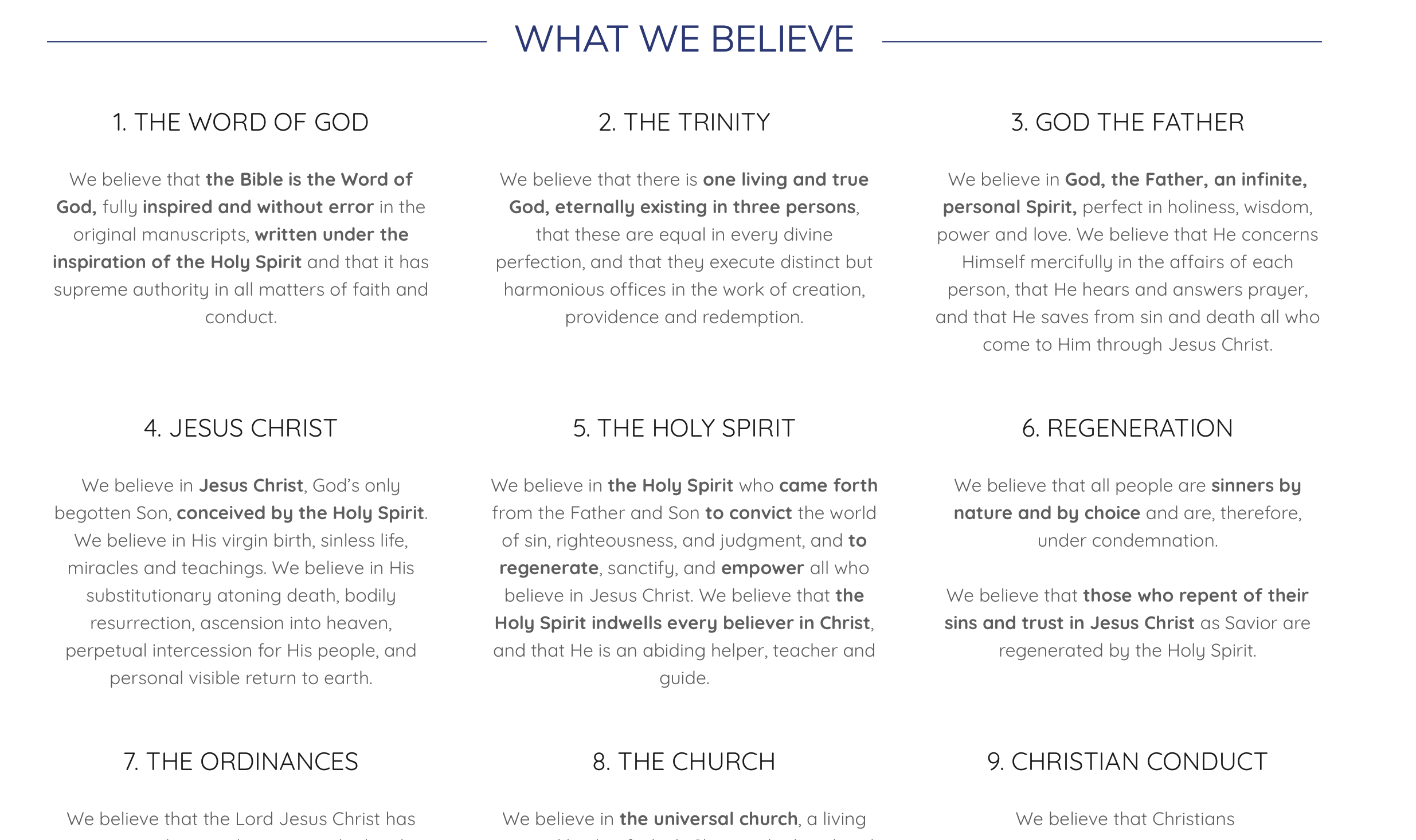
I found the “What We Believe” section of the website. Hope crashed into reality.


Not a word about Creation. Not a single word.

I have to admit this – in that moment, for a moment, I questioned myself.

Maybe I am wrong, I thought. Maybe there’s a good reason why so many churches don’t speak about Creation or care about it. And maybe staying away from church is a rebellion against God’s will. Doesn’t the New Testament speak clearly about the obligation and rewards of being with other followers of Jesus?

That old familiar pang pressed against my heart. Here I was again, feeling guilt for not going to church while longing for belonging in a faith community.


Am I Unforgiving?

Some new friends, who I met at a field walk last September at their farm, suggested a different way for me to consider my situation.

They are faithful believers who steward their land carefully and attend a church in Indiana. There they often find themselves alone in expressing a Creation care consciousness. They are not always understood.

During the field walk, we had bonded over our common convictions. I had shared my challenges in finding a church. They wrote this in a recent email:

For us, it’s forgiveness every single time we walk into our church. It can be a struggle for fellow Christians to understand our views, but we think it’s important to lend grace and forgiveness so we can continue to educate them on this matter. People are starting to listen, starting to realize the connection we have to all of His Creation. We pray that you can find forgiveness in your heart so you can go out to disciple this to His people.

These words brought me up short.

Was that the problem? Am I not being forgiving? Was that why I couldn’t fit in and make a home at a church?

Perhaps I needed to commit myself to forgiving fellow believers as they would need to forgive me for my own blind spots. If I repented of the judgments I was making, would I then be able to find a church where I could belong?


A Buck Outside the Window

More recently, I was having a conversation with a coworker at the nonprofit I work for in a room with a wide window. Out of the corner of my eye I saw movement in one of our organization’s farm fields roughly 80 yards away. I couldn’t help myself. In mid-conversation, I turned to look closer. Through a row of trees between us and the field, I saw a deer. It was a young buck. The head it held high had a small set of antlers.

Then it strode through the row of trees and onto the lawn south of our office. This was midday. It was now in full view and less than 30 yards away in the middle of a subdivision* in a Midwest town.

By now, I was no longer pretending to be engaged the conversation. We both watched as the buck strode across the lawn. Its eyes were watchful. Its posture powerful.

He passed out of sight. The lawn seemed a wilder place even with him gone. My mind and heart were still absorbing the experience even as my coworker renewed the conversation as if nothing unusual had happened and without a word about the buck.


Ears to Hear

Jesus sometimes used the phrase, “He who has ears to hear, let him hear.” (Matthew 13:9, Mark 4:9, Luke 8:8, etc.)

In recent weeks I’ve encountered stories and insights that convince me that…… well, let me share them first and then share my conclusion.

The first came from an article in Christianity Today about Bono’s newly published memoir. In it, Bono shares his recollection of a conversation he had with Franklin Graham, the son of Billy Graham. Billy Graham, one of the most famous Christian evangelists of recent history, had invited Bono to visit him. Franklin had picked him up at the airport. From the conversation that Bono recollects, it’s clear that Franklin was dubious about whether the rockstar Bono was an authentic Christian.

“You … you really love the Lord?” (Franklin)
“Yep.” (Bono)
“Okay, you do. Are you saved?”
“Yep, and saving.”
He doesn’t laugh. No laugh.
“Have you given your life? Do you know Jesus Christ as your personal Savior?”
“Oh, I know Jesus Christ, and I try not to use him just as my personal Savior. But, you know, yes.”
“Why aren’t your songs, um, Christian songs?”
“They are!”
“Oh, well, some of them are.”
“What do you mean?”
“Well, why don’t they … Why don’t we know they’re Christian songs?”
I said, “They’re all coming from a place, Franklin. Look around you. Look at the creation, look at the trees, look at the sky, look at these kinds of verdant hills. They don’t have a sign up that says, ‘Praise the Lord’ or ‘I belong to Jesus.’ They just give glory to Jesus.”


Killer Whale Theology

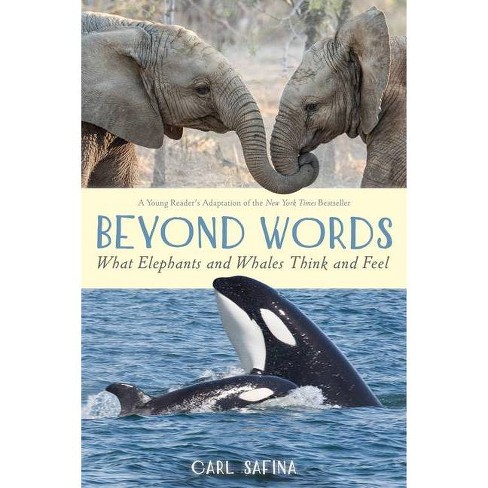
Cover of Beyond Words by Carl Safina


In Beyond Words: What Animals Think and Feel, ocean advocate Carl Safina opens the reader’s mind and heart to the complex world of killer whales.

Three things astonished me. The first is the very creatures themselves. There is, for example, not just one generic kind of killer whale. There are actually estimated to be eight types of killer whales. Some eat only fish, primarily salmon. Others prefer mammals. One type, much smaller than the type that eats seals off of ice flows, hunts penguins. Yet another type hunts sharks. Regardless of type, these are highly social animals with matriarchal leadership. Oddly, pods of the same type of killer whales will not socialize with other pods of the same type. They have their own cultures. Yet, killer whales in the wild have never been seen being aggressive to each other.

Their vocal communication capacity is amazing.

“Killer whales in a  group can be spread out over 150 square miles – and all be in vocal contact,” write Safina.

Having huge nerve cells for hearing and generating sounds from skulls that are sophisticated technologies, killer whales (like other dolphin species and whales) inhabit a world we can only dream of. They live, in fact, by sound.

The second remarkable thing is how little humans have known about killer whales for most of human history. It was only in 1960, just over 60 years ago, that a researcher discovered that dolphins relied on sound for so much and that eyesight was a secondary source of information. And it’s been even more recently that people have differentiated the different types of killer whales and discovered that each killer whale has its own individual personality and remarkable social intelligence.

And the third most remarkable thing?

After detailing how powerfully effective killer whales can be as hunters, with some even hunting down 30,000-pound sperm whales, Safina writes this:

“Even stranger, then, that killer whales have overturned no kayak, emptied no rowboat, and slurped no human. It is perhaps the greatest behavioral mystery on our mysterious planet.”


Seeing Blue

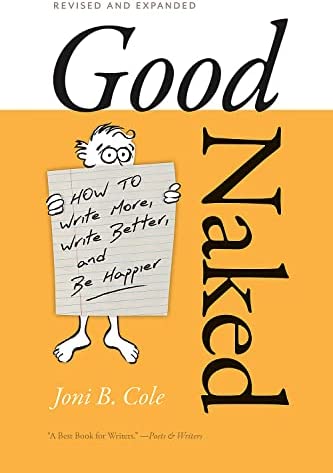
In Joni B. Cole’s excellent and warmly witty book on writing – Good Naked – she has a chapter entitled “Seeing Blue.”  In it she argues why each writer’s writing matters and is worth pouring energy into, even when it seems to have no immediate reward.


Here’s a paragraph in that chapter. It follows her statement that the Egyptians were likely the first civilization to create a word for the color blue and that research indicates few people until modern times really noticed it as a color (don’t worry – you’ll see the point in just a bit):

The claim that a culture with no word for a color it cannot see is supported by a contemporary study with the Himba tribe in Namibia, whose language has several words for nuanced shades of green, but nothing to describe blue. When shown a screen with eleven green squares and one distinctly blue square, the Namibians could not pick out the blue one. Yet, among the green squares that appear identical to a Westerner’s eyes, they could immediately identify the different shade. The ability to see or not see a shade speaks to its important to a culture. Now just imagine if every culture had the ability to see every kind of color!

Her point – every writer has the potential to help readers see something they could not see before.

What I also see in her words is this – our culture can blind us to truth that is right in front of us.


A Misfit Who Can’t Unsee Blue

The blue so many churches and so many church cultures cannot see is the life, beauty, mystery, and vulnerability of God’s Creation all around us. The blue that Franklin Graham and many other Christians cannot see is that Creation matters deeply to God and that care of Creation is part of the very core of what we were created for.

I can’t unsee that blue.

Nor can I force Christians who are happy with their churches to see that blue if they don’t want to see it. Nor do I believe that many churches, who are struggling with declines in attendance, will be open to changing their culture and theology around Creation.

So what is worse? Going to church and not belonging because I see a color in the Bible and Creation others won’t see? Or not going to church and missing the fellowship and singing of songs with other believers? Of longing for belonging to a group of people committed to God and Jesus in a whole way?

Right now, despite those old familiar pangs that emerge from hidden places in my heart when I see a church, I’ve come to accept that I am what Jon Terry called me in our conversation earlier this year.

A misfit.

That’s who I am.

Or, if one puts a more positive spin on it, you could label me an “edge walker,” a term Valerie Loorz calls herself in Church of the Wild.

Is there any reason to think such a path could be faithful to God?

When Jesus responded to the Pharisees who complained that he was healing people on the Sabbath (Luke 14:5), he asked them if they would not act on the Sabbath, despite the prohibition on work, if they heard a child or an ox stuck in a well.

When you imagine the scenario that Jesus presented to the Pharisees, you cannot help but hear the cries. Whether a child or ox fell in a well, there would have been heart-rending sounds – the pleading screams of the child, the plaintive bellows of the ox.

My ears can’t unhear the cries of Creation today. Nor can I unhear the lamentations of people whose lives are or will be in misery because of what is being done to Creation.

Pretending I couldn’t hear those cries or shutting my ears to those cries would be, in my mind, a betrayal of God.

I see the blue.

I hear, and I listen.

And what I hear (and oh how I wish I could hear the sounds of killer whale clans as they race through the ocean) resonates with the thread of Creation’s worth through the whole Bible.

So I need to act as best I can.

I pray that people out there who are like me will find each other and act out of the convictions we have from our faith.

Perhaps we will together form new wineskins?

And perhaps many years from now there will be people who drink the vintage of the wine from those wineskins and smile and nod and make more of their own and please God in the process.


*To be fair, the subdivision is not just any subdivision. It is the Prairie Crossing conservation community, where a significant amount of habitat has been set aside and managed for natural habitat. This makes the buck’s appearance just slightly less surprising. But still a remarkable moment in the middle of an afternoon.


On Sunday, April 24th, I gave another sermon to the good people of North Suburban Mennonite Church. They asked me to do so with an Earth Sunday theme but otherwise gave me no direction. I had complete freedom.

So I considered ideas and thoughts I had had in the past but had not presented about or written about.

I ultimately chose to call their attention to a number of ways in which a Christian faith-life that includes a deep commitment to shepherding Creation contributes to a whole, loving, God-honoring faith-life. This is something I’ve been intrigued by for some time. In this blog post, I’m going to share ten.

Isn’t it enough, you might ask, to just be 100% committed to the truth that Creation matters to God? In other words, do we really need to justify a commitment to God’s earth as one of the fundamental ways people of the Christian Way should live?

No.

And yet yes.

The reality is that the culture of Christianity in America and in the world is very diverse. And it’s safe to say that most Christian culture still either recoils at the idea that Creation matters or gives it some half-hearted adherence in theology but not in everyday habits and choices.

In the spirit of 1 Peter 3:15, I believe it’s useful to be able to offer a defense, with gentleness and respect, to the non-believer and to the believer, for why we follow Jesus and why our following includes loving Creation. I also believe that a whole faith necessarily holds together better and with more resilience than a partial faith. We should, as I have written, have an ecology of theology.

So let’s dive into the list. A whole faith that includes God’s Earth as a fundamental element of it will bear the following good fruit:

#1 Transformed Hearts

We know from Proverbs 27:19 and from many words of Jesus that our lives reflect the state of our hearts. In fact, the state of our heart is a major point of concern for much of the Bible. Being in God’s earth and understanding it and working to restore it all help to shape our hearts in salutary ways.

This can be the peace we feel and experience when we are on the water of a stream or lake or hiking through beautiful mountain forests. This can also be humility and wonder at the blessings of God’s goodness and creativity.

It can also be what the Old Testament labels “fear,” as in Deutoronomy 10:12 or Proverbs 9:10. From these verses, it is clear that this fear is something we need to have. Fear, of course, doesn’t feel like a 21st century notion of how we relate to God. But this is another example of interpretation that hides the original nuance. The Hebrew word we translate as fear is “yirah,” and it actually doesn’t have a simple equivalent in English. It actually conveys fear, awe, and reverence. All at once. Simultaneously.

Where is the best place to experience awe, reverence, and fear simultaneously? Can there be any doubt? It’s being in Creation, whether it’s observing a jumping spider in a backyard garden or encountering a grizzly in Denali National Park. And that awe, reverence, and fear is what our hearts often desperately need to be opened to the deeper realities of this world and to be open to a fuller conception of God in our hearts and minds.


#2 Pervasive Awareness of the Reality of Sin

When life is going well for us in our modern, technological world, it’s actually easy for the reality of sin to seem rather quaint and naggingly troublesome, like a small chronic pain in your knee that won’t quite go away.

The whole equation changes if we believe God holds us accountable for how we individually and as societies treat God’s Creation (and, I would add, the most vulnerable people of our world). If you believe that and pay attention to what we actually do to God’s Creation, then the wounds of sin become powerfully evident.

Consider that fifty percent of the coral reefs have died since the 1950s. And that matters because they are said to provide habitat for 25% of marine life. Factory farms house hundreds of thousands of animals in horrible conditions. Many of the wild animals mentioned in the Bible, like lion and bear and antelope, no longer live in that area because of hunting and human expansion. The existence of some animals on this planet has simpley winked out forever. The list goes on.

The tragedy and loss are clear when we consider that our number one human job is to serve and keep God’s earth. An art museum night guard who took part in the vandalization of some paintings in the museum and allowed others to be stolen and then burned would not be a guard for long  Sin, both individual and collective, is real. Its prevalence in the light of the destruction of Creation is unmistakable and heartbreaking.

This hearbreak illuminates human sin in flashing neon lights. It makes clear to us that we need God’s help and deliverance.


#3 Sharpened Wisdom

Immersing yourself in the systems and interdependencies of God’s Creation will grow the nuances of your thinking and perceptions. You will better be able to understand whole systems work. You will become more observant. You will grow the abiltiy to weigh principles and values in particular specific circumstances and choose the best practical course going forward.

That is wisdom. The Bible celebrates wisdom. Being wise in understanding and applying the whole Bible to one’s life uses exacty the same mental and heart muscles that figuring out how to sustainable use and restore God’s earth does. Being an active steward of God’s earth compels us to grow in wisdom. In the process, you can build your ability to be wise in other aspects of your faith-life.


# 4 Good Saltiness

We are called to be the salt of the earth. We are called to love our neighbors as ourselves.

Enabling Creation to thrive is a way of loving your neighbors near and far. And the neighbors who most benefit from a thriving Creation are often the poor and disadvantaged.

Struggling to prevent wells from being poisoned by agriultural inputs is a way of being the salt of the earth. Designing cities and rural areas in ways that don’t require every family to own many cars is a way to love the poor and build more community. Preventing overfishing so that future generations of coastal communities will be able to live off of the sea as their ancestors did is a way to love one’s neighbor while also cherishing the amazing life God declared to be good.


#5 Awareness of the Tempter

When Satan tempted Jesus and offered him the principalities of the world, Jesus resisted. Using and exploiting the resources of this world for unbridled power is the same temptation we, our communities, and our nations face. There are many ways to rationalize taking from God’s earth beyond what earth and the life of God’s earth can bear. But rationalization for our selfish, God-ignoring motives is the way of the Tempter. And one can, as Satan showed in the story, use Bible verses to rationalize things that are against God’s will.

Being alert to the rationalizations all around us in our Christian culture for going along with the harm to Creation will awaken your heart and mind to the efforts of the Tempter in many areas of life.


#6 Restraint and Simplicity

We live in a world full of conveniences and a myriad of recreation options, all there to meet every wish and need and hunger. Creating habits to protect God’s earth through our daily life choices requires us to limit ourselves, both individually and collectively.

There’s a strong thread of limits and restraints in the Bible that American Christians often want to ignore or categorize as no longer applicable because of the work of Jesus. The Sabbath, one of the core commandments, calls upon us, as Abraham Joshua Heschel wrote, to be part of a ‘palace in time,’ to rest not only ourselves but also give rest to the land and livestock.

The practice of tithing causes us to live with less and have faith that God will provide.

Jesus fasted. Fasting is about restraint.

Restraints and limits are actually, in other words, blessed things.

The only way we individually and socially will protect and restore Creation effectively is if we restrain ourselves and adopt simpler lives. As a society, that will mean leaving some areas forever wild and even pulling back our human presence in other places. That will mean reducing reliance on fossil fuels. Acting and caring for creation help build our capacity to live simply and with restraint and with generous interdependence. That capacity will bear fruit in other parts of our lives.


#7 Resonant Lives and Faith

In the book Simply Christian, N.T. Wright calls the reader’s attention to the fact that around the world people, regardless of whether they are Christian or not, share common dreams of justice and goodness and peace, of what should be. These dream, these yearnings, N.T. Wright says, come from God and from what used to be.

When followers of Jesus ignore Creation and contribute to its destruction and justify its diminishment, we not only harm life that matters we also play a horribly out of tune note that ruins the whole song and the whole chord of what the Christian Way is.

Why would a young person or any person who knows in their heart that prairies and forests and oceans and the teeming life of the soil are all amazing and good, accept the other convictions of the Christian Way if the people following that way foul the world and don’t care that they do so?

On the contrary, when we defend and protect and restore God’s earth, we point to a unifying and compelling whole Way that is beautiful and challenging at the same time. This is a faith and a life that calls out to the heart without any false notes.


#8 Strengthened Agape

Attention and devotion to living in ways that provide for Creation grows selflessness in one’s heart. Animals and plants and fish and the vast universe of the soil rhizosphere cannot vote. They generally speaking can’t speak. To be sensitive to their welfare and to act on that sensitivity is to be selfless and loving at a very high level. It is to think and have empathy beyond oneself and even beyond one’s human neighors. This is taking the story of the Good Samaritan to a whole different level.

God calls us to selflessness throughout the Bible. Jesus, of course, is an obvious example. But I am also reminded of the 42nd chapter of Job: Job’s fortunes are not reversed and restored when he repents and acknowledges to God that God’s wisdom and ways are beyond his comprehension. Instead, God calls upon Job to pray for his three friends who had advanced wrong arguments against him and who God required to show repentance. And that is what happens, despite all that Job had already experienced and despite the further grief his friends had caused. Job prays for them. And then his fortunes are restored.

Caring for habitats or rivers or just a small woodlot or our pet all grow that same selflessness that God desires.


#9 Missional Impulse

Being convinced that we must keep and protect God’s Creation necessarily drives us to be missional and to have an outward focus. Protecting and restoring God’s earth requires us to go out! If we only change how we live as an individual or family or even a church, we will not have done all we need to. You and I, especially in a democracy, are part of collective systems – employers, local municipalities, state government, even a mighty nation. How they act is partly our responsibility.

By going out and speaking up and bringing about change in ways that stretch our comfort zones, we find that our missional and prophetic muscles also grow. Christ-like also means bold. Strong. Tenacious. Radically candid.

In Alan Hirsch’s provocative book The Forgotten Ways: Reactivating the Missional Church, he writes, “We are a message tribe.” By this he means we are meant to be a sent and missional people. We can’t expect to have people seek us out. We must reach out to them. Organizing and advocating for God and God’s earth takes us out of our homes and our church buildings and into the world. This is where we are supposed to be. This is where we are supposed to share God’s Way.


#10 Faith

Anytime we live out the values of the whole faith Way, we will be aware of the necessity of faith.

When we do something that makes us stand out and perhaps endure ridicule, then our faith will grow.

When we work to restore a forest or protect a river, we will not know whether our efforts will ultimately lead to success. But when we do it anyway because it is the right thing to do, then we are acting on faith and building faith at the same time.


I pray you will continue to pray and act for the life of God’s earth.

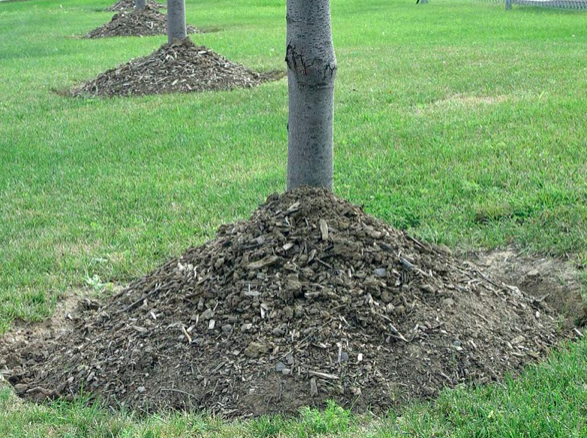
Trees in a row with mulch applied in mulch volcano way

Row of mulch volcanoes (photo: George Weigel)

My wife Mayumi recently learned about “mulch volcanoes” from the Master Gardener class she is taking through the University of Illinois Extension.

People create mulch volcanoes when they pile up mulch high against the trunk of a tree. This makes it appear that the tree trunk is erupting out of a sloping, volcano-like mound of mulch.

Mulch volcanoes look innocuous, but they’re actually harmful to trees for multiple reasons.

Just one reason is that the constant contact of wet organic material starts to break down the surface of the tree’s trunk. This eventually leads to damage to the phloem and xylem layers beneath the bark. These vascular tissues carry nutrients from the leaves to the roots and from the roots to the rest of the tree respectively. Rotting these tissues away is like applying a tourniquet too tightly to a human limb – it cuts off vital circulation. The tree will slowly die.

Ever since she learned about mulch volcanoes, my wife has been dismayed to see them seemingly everywhere.

They were, of course, there all of the time. But now she knows what to look for and knows the damage the practice does. And my wife, being who she is, wants to save every tree she sees in this condition. Her heart hurts to see these vulnerable plants suffering harm in slow motion.

This is a prime example of the truth of Aldo Leopold’s words: “The penalty of an ecological education is to live alone in a world of wounds.”

Once you understand the fascinating elements (plants, animals, microbes, etc.) of God’s earth and how those elements relate to each other ecologically, then the purposeful and unintended damage we do to Creation becomes painful to contemplate.

I know you know the truth of that statement.

I’m sure you’ve become aware of the wounds done to God’s earth nearby and around the world. Like a subdivision replacing a woods. Like a dam under construction that will drown villages and forests.

You may also have noticed that you are largely alone in seeing that harm and experiencing that ache in your heart. This is often the case in general American culture. It’s also usually the case in church culture.

When was the last time you were at a call for prayer and someone lifted up a concern related to Creation?

That combnation of being aware of the degradation of God’s Creation and of feeling alone in that awareness is something I often feel. And because the pain can be overwhelming, I sometimes begin to allow a callus to grow around my heart. Sometimes, too, I try not to see what I see or distract myself with (and I hate to admit this) YouTube videos.

But those attempts to avoid the wounds or keep them from my heart only work temporarily. I become aware of what I am doing. Or something comes onto the scene that just doesn’t allow me to escape.

The war in the Ukraine is the most recent example. The war is a disaster of epic proportions for the Ukranian people. It is also a tragedy for the many Russians who oppose it or who are simply powerless to stop it.

That’s just one level of pain.

If you remember your whole faith and do a simple Google search, then you can easily enter another level of anguish.  You will find that the Ukraine war, like any other war, is a disaster for the animals, plants, soil, and air that are all part of God’s miraculous world.

Here are revealing articles about the tragedy of the war for Ukranians, their pets, and the life of their country. The first. The second. And this is one about a young woman – Anastasia Yalanskaya – who was murdered by Russain troops while trying to deliver desperately needed food to a dog shelter.

God!

I desperately want to look away from all of this brokenness. I desperately want God to make it all all right. Right now.

As if that it isn’t hard enough, I then find myself aware that it feels wrong in America to be sad and heartbroken. That’s not what our culture wants or accepts.

And somehow it can also feel wrong as a Christian to be sad and heartbroken. I feel like a widower who frustrates his well-meaning friends calling for him to buck up and move on. Sure he lost his spouse, but she “was taken by the Lord” and is “in a better place.” There are countless ways Christian culture tries to deaden our hearts towards Creation and what we do to it.

This all leads me to two questions. The first – why could God allow such suffering for people and all of Creation? God has heard all of Creation groaning for millennia like God heard the Israelites groaning in Egypt. How can a father, the Father, not intervene? The second – how do I live in the presence of so much suffering? How can I persist in acting for God’s love of his people and His earth when the cycle of destruction keeps coming again and again? How can I persist when climate chaos threatens so much? How do I persist when the nature of today is a diminished form of what it used to be?

I know there are many complex theological ways of dealing with the first question. But here’s what I have found works for me. It is not an answer. It is more of a resonance.

The Bible makes clear that this suffering was not God’s intent. In John 3:16 and in the very sending of Jesus, we know that God loves this world. God loves this world dearly.

The Bible also makes clear that the brokenness of this world will not always persist. In some mysterious way, through Jesus the grip of evil and of the rule of destructive principalities over the world will be fully broken. There will be a new heaven and earth that is, I believe, somehow like the body of the resurrected Jesus.

And I believe that this new earth will have all of the goodness and diversity that this current earth has ever had and much, much more.

What helps me in a resonant sort of way is to know that God through Jesus experienced the suffering of the world from our sins. And isn’t it interesting that suffering and anguish are common elements of the Old and New Testaments? The majority of Psalms, for example, are laments of one kind or another. The prophets are full of sadness and anger. Jesus, who knew of God’s future for the world, wept.

I am helped, too, by the knowledge that the early Christians were able to be so revolutionary in their living and in their presence within the empire that had killed Jesus. They stood apart. They treated women differently. They welcomed people of all social strata. They offered hope, and they carried a message that changed people. The DNA of the movement must have been incredibly powerful. That also resonates and inspires.

As for how I live, I will follow the God I know through Jesus.

Jesus calls us to follow him. His path informs our path.

We must expect difficulties and be willing to sacrifice. The fact that such a way would lead Jesus to death tells me a great deal, makes it seem more authentic. In this world of wars, factory farms, and toxic agricultural chemicals being found in ambient air even on mountain tops in Europe, we must expect to face seemingly impossible odds. We must also expect to feel anguish at what cannot be stopped, like when Jesus shared his anguish at the coming destruction of Jerusalem in Matthew 23:37-39.

I find, too, a strange sort of comfort in the fact that the name – Israel – given to the people God chose to be a key part of his rescue mission for the world literally means “wrestles with God.”Moses wrestled with God at times.  So did Job and the prophets.

Faith does not mean absence of struggle. I will wrestle with God even as I follow Jesus. I will argue with God that enough is enough. I will pray for God to intervene for the sake of the whole world – people and Creation.

Mayumi and I will do what we can where we live and work to live out a whole faith with God’s help. We will seek to love God with all of our heart and soul and strength. We will seek to be good and loving to our neighors and to do what humans are meant to do – protect, keep and prosper God’s earth. Mayumi, for example, will use her Master Gardener education to help people care for their gardens and yards. I’ll keep giving all I have to my job. There I seek to expand regenerative agriculture and connect sustainable farmers with the farmland they need to farm. I will do my best to contribute my voice for this kind of whole faith. And, I have written an email to our Lake County Department of Transportation about the mulch volcanoes we saw recently in the median on a county road.

We will balance all of that with rejuvenating our hearts and spirits on a regular basis. We strive to use Sundays as Sabbaths. We enjoy good-for-God’s-world food and the company of our sons via Zoom calls. We read together. I’ll take breaks from time to time for enjoyment and relaxation, striving to have the faith to know that it is not all up to me. God is at work in the world.

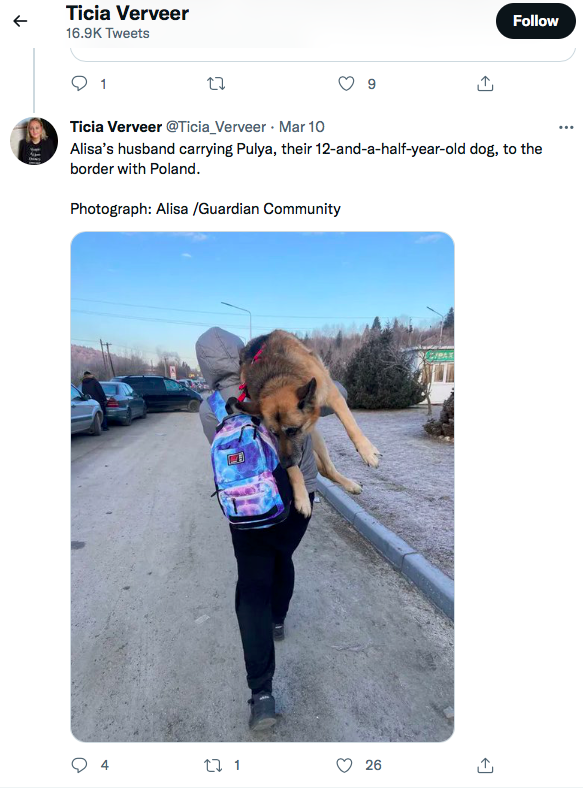
Even as the war in Ukraine has brought despair, it has also brought inspiration. I read of a Ukranian couple who, as they fled the Russian invasion, remained devoted to their German shepherd. They carried their aging pet to safety as you can see in the photo below.

They could not save all of the pets and wild animals from the horrors of a war. But they could be devoted to the dear animal in their care.