Archives For Wounded World

Some time ago I wrote about the 10 ways in which being committed to shepherding God’s earth deepens your faith.

I now feel compelled to explore the ways in which living as if Creation mattered to God tests us and challenges us.

There is an obvious but oft-overlooked reason why some Christians are averse to seriously shepherding God’s earth.

It’s because it can be just plain hard.

I believe, however, that when you know what’s coming, you can brace yourself. You can, at least to some degree, gird yourself mentally and emotionally for the challenge. I hope this is useful as you grow in determination to take on the challenges of Creation shepherding..

#1: Living in a World of Wounds

As human beings, it is fairly easy for you and me to imagine the pain that other human beings experience due to violence, poverty, and even emotional blows. At least it is if you had a childhood in which empathy was modeled for you and God’s Spirit has helped you be other-centered. It helps, too, if you have protected your heart as Proverbs 4:23 urges us to do. That can be radically hard to do today.

If we allow the Spirit to shape our hearts so they are open, pure, and child-like, we can have that same kind of empathetic imagination for Creation.

When we do, we will pay attention to Creation and eagerly learn more about it. We’ll carefully pay attention to trees, birds, bobcats, dolphins, soil microbiomes, and even the ecology of whole landscapes. We will actively restore life to Creation, tapping the regenerative ecological capacity God gave to it. When we use Creation, as we inevitably must, we will do the best we can to be respectful and reciprocally beneficial to God’s earth in ways that express love for God and our neighbor.

The expansion of your empathy beyond yourself and beyond humanity brings both profound kinship and vulnerability. This is because the more expansive your empathy the more easily you can imagine the pain and fear that beings in Creation experience. When you become convinced that the land, water, and living things around you are precious to God and when you know how beautiful Creation can be when fully healthy and complete, then you will begin to grasp how challenging we have made life for our Creation kin. Your heart will be wounded by the wounding of Creation.

You will also be aware of what you should see and hear but do not. There is a silence that is not the silence of peace but the silence of missing life. Being aware of that will cut your heart. You will feel pain at what is missing in Creation because of human sin. 
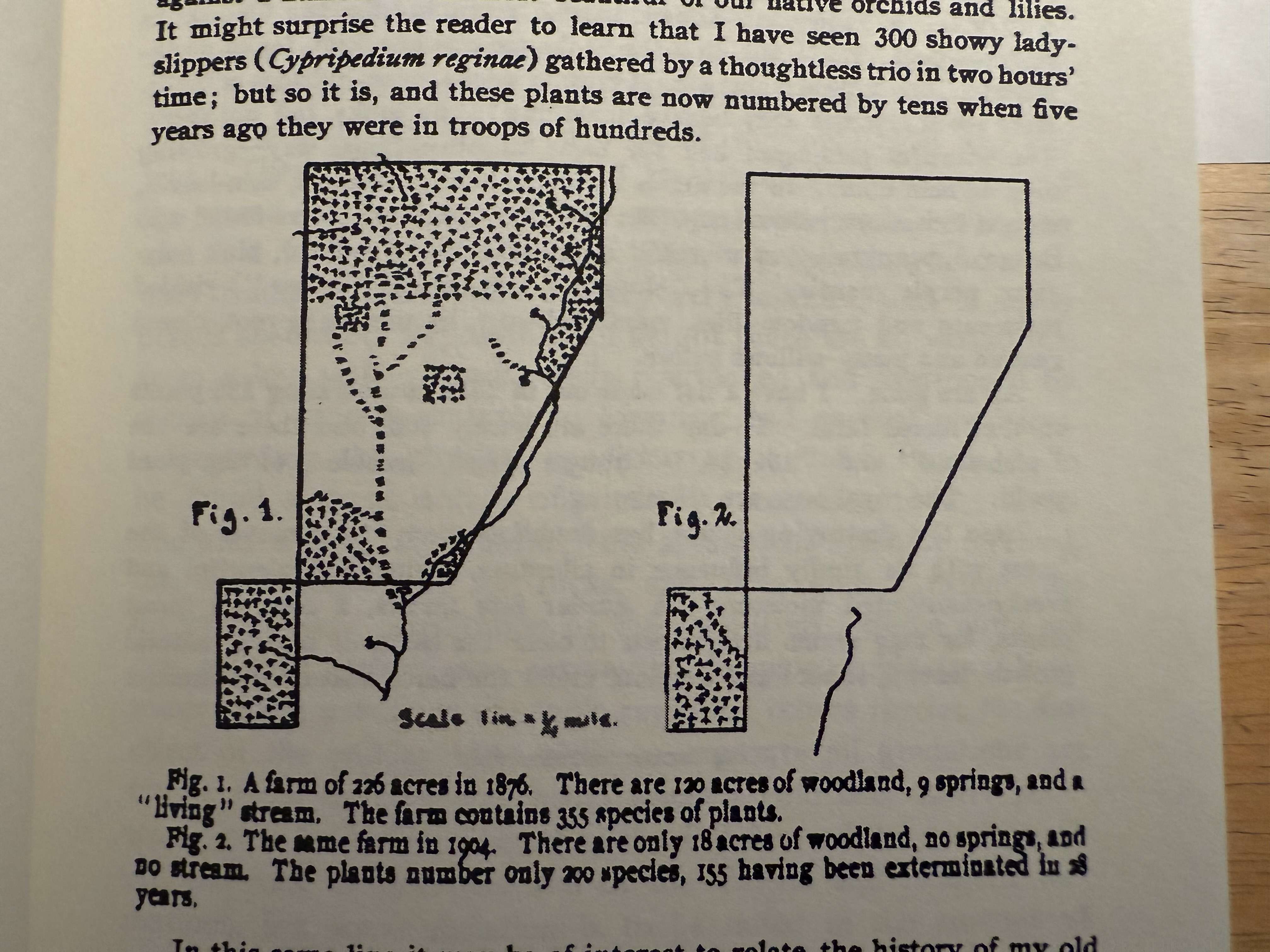
I have been reading some essays and papers by H.S. Pepoon, a biologist who documented the flora and fauna of Jo Daviess County, Illinois, (where we now live) more thoroughly than anyone else ever has post-settlement. In one short report, he documents the decline of life on his 226-acre family farm. In 1876, there were 355 species of plants. In 1904, there were just 200. One hundred fifty-five species were, as Pepoon writes, “exterminated in 28 years.” What, I wonder, is the state of that farm today? From what I’ve seen and what I know, I’m guessing the number is less than 50.

The decline of life on the Pepoon farm is a smaller version of what the whole world is experiencing on a much vaster scale.

When you take the blue whole faith pill of seeing what is happening to what our Creator God created, your heart can be broken..

#2: Living Alone in That World of Wounds

Ecologist and writer Aldo Leopold wrote: “One of the penalties of an ecological education is to live alone in a world of wounds.”

There are two pain points to which Leopold calls our attention. Seeing, thanks to one’s ecological education, the way humanity breaks the individual pieces and systems of nature is one “penalty” (what a euphemism, by the way). The other is experiencing the pain of that awareness largely alone.

Leopold was speaking largely of the loneliness experienced in American society as a whole.

I would argue, however, that there is a particular species of loneliness that Leopold probably did not understand. That is the loneliness of being among Christians who praise God for creating this world but who seemingly believe that God does not take personally how we treat it. Worse yet, some Christians will even criticize other Jesus followers who act compassionately and respectfully towards Creation do for being political, liberal, woke, or just plain unchristian. Facing that kind of critique and its accompanying personal castigation is no easy place to be.

Of course, being mindful of God’s earth does not represent a falling away from the roots of Christian understanding. The true situation is that mainstream Christian culture and theology have, in this area, fallen away from the roots of the Bible, the love of God, and God’s second scripture – Creation.

When you and I show concern for God’s living earth and question how it is used, we are actually bringing up uncomfortable truths. We are reminding others that the vineyard we are using is not actually ours. The criteria for what is right and wrong about our use of the vineyard is not what grows our power and wealth. The criteria for right and wrong is whether the vineyard owner will be pleased with the condition of the vineyard when the owner comes to reclaim it.

This all can complicate your experience of being in a local faith community. Do you compromise your principles? Or be a persistent voice in your community for Creation shepherding? Or take some kind of third path?

#3: Resetting Your Life Habits and Mission Overload

A Christian serious about a whole faith will, among many things, seek to create habits that daily reduce negative impacts on Creation and contribute to its regeneration. You wil, for example, think about what you eat. What you give to. How you treat your piece of God’s earth. How simply you live. It can be all-encompassing.

Between making a living, caring for family, maintaining a dwelling, and being involved in activities of one’s church, where does one make room for a real commitment to protecting and renewing God’s earth? All that needs changing can be overwhelming.

Creating new habits can be challenging. And when our lives are busy already, adding another layer of consciousness can seem like just too much to handle. This is especially true when a place we live in makes it hard to do good for God’s earth.

I can tell you, however, that you will eventually find that striving to be faithful and thoughtful in your life actions, including how your actions impact God’s earth, will grow your faith and increase your awareness of all of the world mattering to God. New choices will become new habits. Gradual yet tenacious effort will bear fruit over time. You will ultimately feel good, even as you realize we can never live perfectly.

#4: Between Faithful Response and Zealotry

The awareness of how frequently we interact with God’s earth and how marred Creation often is by our individual and collective actions can prompt a number of different responses.

One is overwhelm. This leads us to try to avoid thinking about it.

Another is a life of intense effort to be environmentally pure in every single act or habit of living. Because so many people don’t pay any attention to their life habits, this approach could actually seem extreme. Choose not to eat meat from an inhumanely treated pig? The average person might consider you a zealot.

A zealot, however, is not someone who builds habits so that they are as faithful as possible in a particular area of life, like the shepherding of Creation.

Zealotry, in my mind, is something different. Zealotry is when your passion for purity in one area of life overwhelms faithfulness in other areas of life. It is when purity in one area of life becomes the sole measure of your life’s morality.

Let’s consider the example of being invited to a new neighbor’s houses for a party. The food is not food that is healthy nor raised and produced in ways good for Creation, one’s farmer neighbors, nor their communities. Do you reject it all?

That might be pure, but how would your new neighbors understand your reaction? And what would your rejection or abstaining do? The food is already produced and purchased. Your new neighbors might have no frame of reference for understanding why you are acting the way you are. If they’re not Christian and they know you are, that might impact their impression of you and your family. Are you loving your neighbor in that situation?

Living out a whole faith with intentionality and consistency while avoiding zealotry requires God’s help and wisdom. It means paying attention to all of the facets of our life and all of the facets of what it means to love God and love our neighbor and follow Jesus.

It’s hard, but not impossible, to do this.

#5: Caught in Tsunami-Scale Systems

Almost all that we do every day is a form of interaction with God’s earth. The food you and I eat (even the food that is not really food) comes from God’s earth and the work of our neighbors.

Our furniture comes from God’s earth, whether it be from trees or petroleum by way of plastic. Our clothes come from the earth. So do our cars and homes. Plastics are a sadly good example of how our wizard-like powers to transform petroleum into everything from plastic bags to plastic bottles have the unintended consequences of poisoning Creation and ourselves.  The growth of artificial intelligence technology is taking our energy and water consumption for virtual activities to a whole new and disturbing level.

Yet, how does one live without being part of the depletion of Creation? How could one change global systems?

Abstaining from eating factory farmed meat, although it is a good and righteous thing to do and sends a virtuous economic signal, does not change the system of factory farming that dominates places like Iowa.

Walking and biking as much as possible, as good and righteous as that they are, does not change our world’s consumption of fossil fuels on a system’s level.

Individual good deeds are not enough to turn us around from systems that degrade the life out of the earth on a massive scale.

This is one of the biggest challenges I experience in caring about the fate of God’s earth.

I believe in building habits of faithfulness in our everyday lives towards other people and Creation. I want to believe that if enough people do good things that that will contribute to a better world.

But it is clear that there is a tsunami of larger forces and trends at work. It is also clear we live in a world in which laws (or a lack of laws) and systems often enable the strong and powerful to take advantage of the weak, whether the weak are the poor or vulnerable beings of Creation.

Can better systems be built on local scales? Absolutely. There are example all around the world. But will those examples replace the systems degrading God’s people and world? It’s not clear to me that will happen before God brings a new heave and new earth. And that is, at least for me, a heavy thing to live with.

 #6 Running Upstream Against Economic Nationalism

The power of a country, including its military power, depends in large part on economic power. Economic power is derived, in large part, by the extraction of wealth from Creation.. It logically follows that if you and I speak up for restraining humanity from extractive and violent uses of Creation in our community or country, then we could be seen as obstacles to success, wealth, and power.

And calling for restraint and restrictions on how individuals, businesses, and national institutions will use Creation also puts us at risk for being seen as unpatriotic. Nationalists, even Christian nationalists, will castigate us. Or worse.

A recent article from Inside Climate News shared this:

Since Global Witness began tracking annual deaths in 2012, more than 2,253 environmental defenders have been murdered or disappeared. Many of the victims opposed extractive industries, such as mining, logging and industrial agriculture, or had challenged systemic issues like organized crime and land theft. 

These sad and tragic statistics mostly come from countries like Colombia and Guatemala. Someday, if we extrapolate from current trends, there could well be similar violence done in the United States, as our country becomes increasingly ruled by power rather than by law.

Being faithful isn’t so hard when your version of being faithful fits neatly within the value system of the dominant ruling class of the country you live in. But if your country’s actions and systems are counter to actual Christian values, like the shepherding of Creation, then being faithful will put you at personal risk.

Nevertheless, we are first and foremost patriots for God’s Kingdom.

#7 Torn Between Present Anguish and the Joyous Certainty of Renewal 

Seriously shepherding Creation compels you to wrestle with the one of the paradoxes of the Christian faith. On one hand, violence done to the fabric of God’s people and world is a clear and present sin that should provoke outrage in us. On the other hand, we have confidence that people and all of Creation will someday have an eternal, joyful existence with God.

This is difficult to live with and process.

One of the reasons I’ve not released a blog since August is that I’ve been struggling with this post for months now. It has been hard to get it to a point that feels complete, authentic, and clear. And this paradox in particular twists my heart and mind into a knot.

I don’t know what face to show the world. Or how to organize my own attitudes.

There are Christian leaders in the Creation care field who seem to only show a positive, upbeat face to the world. I believe this is, in part, because they believe the voice of lament and grim anger is not winsome. I also believe this is because the Gospel’s message of hope and future world renovation fills their hearts so much there is no room for sadness and doubt. I admire their work, but the one-dimensional tone of optimism doesn’t land for me.

I also find that I don’t feel at home in faith communities where every service is 100% full of optimism and happiness.

And with that statement, I’m sure there are some readers who will feel I have gone completely off of the deep end. How, you might ask, can the Christian faith be anything but positive, hopeful, and reassuring?

Let me be clear – worshiping in hope and joyous faithfulness is a powerful centering force for my heart and mind.

But wouldn’t there be good that came from reminders, both in content and tone, that the reason the Good News is such good news is that Jesus came because God hates to see all of Creation so dysfunctional, so warped, so full of pain and frustration?

And isn’t it Good News that our salvation, our being turned by God towards Him and filled with God’s Spirit, equips us for good works in this world so darkness is pushed back, even just a little?

We are meant for being God’s active and good presence in this world. We are called to address the pain and dysfunction of the world.

There is a line of Christian theology that says the conviction that all will be put right does not have to reduce the energy of the conviction that we must step forward to address the world’s sickness from sin. It makes some sense in theory. But it feels like the practical default application is for Christians to feel that injustice towards people and Creation is unfortunate but acceptable collateral damage. There can be easy rationalization for minor responses or just plain inaction.

Life would be easier for me if I accepted pat theological answers and focused only on the happy ending Christian theology tell us is coming. But I can tell when I’m not yet fully convinced in the deepest depths of my soul.

I find the mixture of emotional chords in the Bible resonates with me in a way that I have a hard time finding in church.

I am, for example, challenged by the prophets. There is so much strident, unsettling, harsh emotion there. Yet, simultaneously, there is also hope and faith in the compassion of God. I find Isaiah 11 to be one of the most moving and inspirational chapters in the Bible, especially the ninth verse:

They will neither harm nor destroy
    on all my holy mountain,
for the earth will be filled with the knowledge of the Lord
    as the waters cover the sea.

The prophets did not believe the exile of the people of Israel was the final word, but their words expressed deep outrage at the idolatry and injustice that caused God’s judgment. They lamented the fall and captivity of Israel, even as they had faith that there would be a return. That is the kind of paradox I believe we need to lean into.

When was the last time your liturgy dived deep into the prophets on a regular basis?

Interestingly enough, Jesus brought those same paradoxical chords of tone and message. He was full of both love and sharp outrage. I am convinced, even though I don’t know exactly how to apply the conclusion in my life, that we need to be Christ-like in this way. Getting the balance right is no easy thing.


My hope is that these reflections strengthen your faith and prepared you for the challenges of doing what you and I are meant to do – love God, love our neighbor, confront injustice, and be the image of God for all of Creation. May you and I do so with 100% commitment that comes from a whole life-faith centered on Jesus. Jesus offers us both an easy yoke and a life purpose that will stretch us and grow us beyond what we might have expected.

Let’s lean into that.

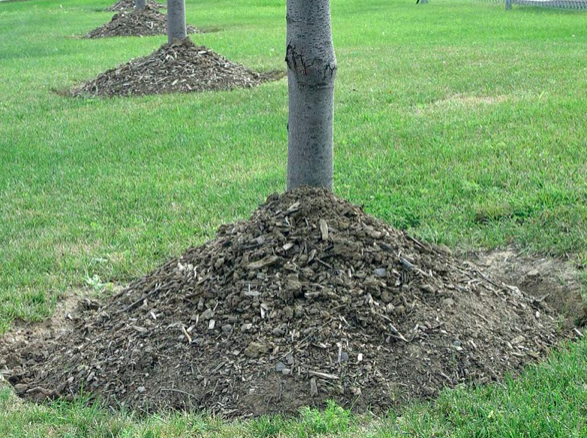
Trees in a row with mulch applied in mulch volcano way

Row of mulch volcanoes (photo: George Weigel)

My wife Mayumi recently learned about “mulch volcanoes” from the Master Gardener class she is taking through the University of Illinois Extension.

People create mulch volcanoes when they pile up mulch high against the trunk of a tree. This makes it appear that the tree trunk is erupting out of a sloping, volcano-like mound of mulch.

Mulch volcanoes look innocuous, but they’re actually harmful to trees for multiple reasons.

Just one reason is that the constant contact of wet organic material starts to break down the surface of the tree’s trunk. This eventually leads to damage to the phloem and xylem layers beneath the bark. These vascular tissues carry nutrients from the leaves to the roots and from the roots to the rest of the tree respectively. Rotting these tissues away is like applying a tourniquet too tightly to a human limb – it cuts off vital circulation. The tree will slowly die.

Ever since she learned about mulch volcanoes, my wife has been dismayed to see them seemingly everywhere.

They were, of course, there all of the time. But now she knows what to look for and knows the damage the practice does. And my wife, being who she is, wants to save every tree she sees in this condition. Her heart hurts to see these vulnerable plants suffering harm in slow motion.

This is a prime example of the truth of Aldo Leopold’s words: “The penalty of an ecological education is to live alone in a world of wounds.”

Once you understand the fascinating elements (plants, animals, microbes, etc.) of God’s earth and how those elements relate to each other ecologically, then the purposeful and unintended damage we do to Creation becomes painful to contemplate.

I know you know the truth of that statement.

I’m sure you’ve become aware of the wounds done to God’s earth nearby and around the world. Like a subdivision replacing a woods. Like a dam under construction that will drown villages and forests.

You may also have noticed that you are largely alone in seeing that harm and experiencing that ache in your heart. This is often the case in general American culture. It’s also usually the case in church culture.

When was the last time you were at a call for prayer and someone lifted up a concern related to Creation?

That combnation of being aware of the degradation of God’s Creation and of feeling alone in that awareness is something I often feel. And because the pain can be overwhelming, I sometimes begin to allow a callus to grow around my heart. Sometimes, too, I try not to see what I see or distract myself with (and I hate to admit this) YouTube videos.

But those attempts to avoid the wounds or keep them from my heart only work temporarily. I become aware of what I am doing. Or something comes onto the scene that just doesn’t allow me to escape.

The war in the Ukraine is the most recent example. The war is a disaster of epic proportions for the Ukranian people. It is also a tragedy for the many Russians who oppose it or who are simply powerless to stop it.

That’s just one level of pain.

If you remember your whole faith and do a simple Google search, then you can easily enter another level of anguish.  You will find that the Ukraine war, like any other war, is a disaster for the animals, plants, soil, and air that are all part of God’s miraculous world.

Here are revealing articles about the tragedy of the war for Ukranians, their pets, and the life of their country. The first. The second. And this is one about a young woman – Anastasia Yalanskaya – who was murdered by Russain troops while trying to deliver desperately needed food to a dog shelter.

God!

I desperately want to look away from all of this brokenness. I desperately want God to make it all all right. Right now.

As if that it isn’t hard enough, I then find myself aware that it feels wrong in America to be sad and heartbroken. That’s not what our culture wants or accepts.

And somehow it can also feel wrong as a Christian to be sad and heartbroken. I feel like a widower who frustrates his well-meaning friends calling for him to buck up and move on. Sure he lost his spouse, but she “was taken by the Lord” and is “in a better place.” There are countless ways Christian culture tries to deaden our hearts towards Creation and what we do to it.

This all leads me to two questions. The first – why could God allow such suffering for people and all of Creation? God has heard all of Creation groaning for millennia like God heard the Israelites groaning in Egypt. How can a father, the Father, not intervene? The second – how do I live in the presence of so much suffering? How can I persist in acting for God’s love of his people and His earth when the cycle of destruction keeps coming again and again? How can I persist when climate chaos threatens so much? How do I persist when the nature of today is a diminished form of what it used to be?

I know there are many complex theological ways of dealing with the first question. But here’s what I have found works for me. It is not an answer. It is more of a resonance.

The Bible makes clear that this suffering was not God’s intent. In John 3:16 and in the very sending of Jesus, we know that God loves this world. God loves this world dearly.

The Bible also makes clear that the brokenness of this world will not always persist. In some mysterious way, through Jesus the grip of evil and of the rule of destructive principalities over the world will be fully broken. There will be a new heaven and earth that is, I believe, somehow like the body of the resurrected Jesus.

And I believe that this new earth will have all of the goodness and diversity that this current earth has ever had and much, much more.

What helps me in a resonant sort of way is to know that God through Jesus experienced the suffering of the world from our sins. And isn’t it interesting that suffering and anguish are common elements of the Old and New Testaments? The majority of Psalms, for example, are laments of one kind or another. The prophets are full of sadness and anger. Jesus, who knew of God’s future for the world, wept.

I am helped, too, by the knowledge that the early Christians were able to be so revolutionary in their living and in their presence within the empire that had killed Jesus. They stood apart. They treated women differently. They welcomed people of all social strata. They offered hope, and they carried a message that changed people. The DNA of the movement must have been incredibly powerful. That also resonates and inspires.

As for how I live, I will follow the God I know through Jesus.

Jesus calls us to follow him. His path informs our path.

We must expect difficulties and be willing to sacrifice. The fact that such a way would lead Jesus to death tells me a great deal, makes it seem more authentic. In this world of wars, factory farms, and toxic agricultural chemicals being found in ambient air even on mountain tops in Europe, we must expect to face seemingly impossible odds. We must also expect to feel anguish at what cannot be stopped, like when Jesus shared his anguish at the coming destruction of Jerusalem in Matthew 23:37-39.

I find, too, a strange sort of comfort in the fact that the name – Israel – given to the people God chose to be a key part of his rescue mission for the world literally means “wrestles with God.”Moses wrestled with God at times.  So did Job and the prophets.

Faith does not mean absence of struggle. I will wrestle with God even as I follow Jesus. I will argue with God that enough is enough. I will pray for God to intervene for the sake of the whole world – people and Creation.

Mayumi and I will do what we can where we live and work to live out a whole faith with God’s help. We will seek to love God with all of our heart and soul and strength. We will seek to be good and loving to our neighors and to do what humans are meant to do – protect, keep and prosper God’s earth. Mayumi, for example, will use her Master Gardener education to help people care for their gardens and yards. I’ll keep giving all I have to my job. There I seek to expand regenerative agriculture and connect sustainable farmers with the farmland they need to farm. I will do my best to contribute my voice for this kind of whole faith. And, I have written an email to our Lake County Department of Transportation about the mulch volcanoes we saw recently in the median on a county road.

We will balance all of that with rejuvenating our hearts and spirits on a regular basis. We strive to use Sundays as Sabbaths. We enjoy good-for-God’s-world food and the company of our sons via Zoom calls. We read together. I’ll take breaks from time to time for enjoyment and relaxation, striving to have the faith to know that it is not all up to me. God is at work in the world.

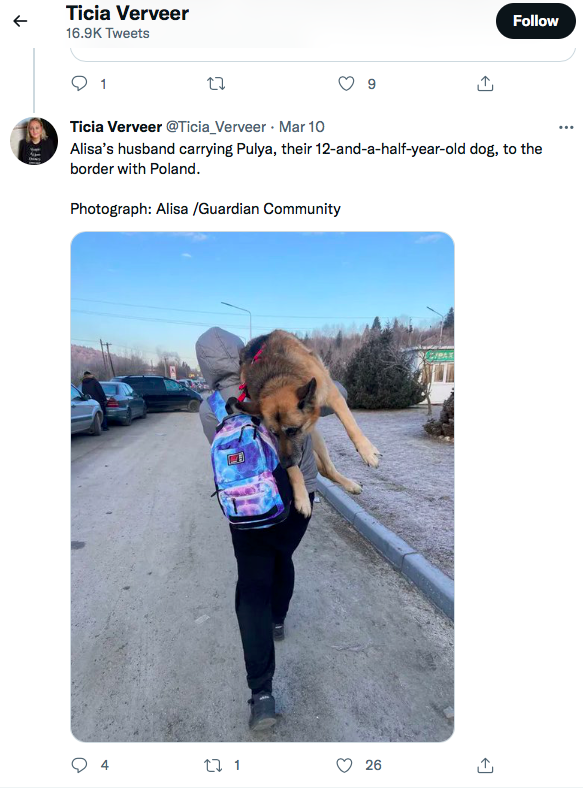
Even as the war in Ukraine has brought despair, it has also brought inspiration. I read of a Ukranian couple who, as they fled the Russian invasion, remained devoted to their German shepherd. They carried their aging pet to safety as you can see in the photo below.

They could not save all of the pets and wild animals from the horrors of a war. But they could be devoted to the dear animal in their care.


Is There Hope?

Nathan Aaberg —  October 4, 2021 — Leave a comment

The North Suburban Mennonite Church in Libertyville, Illinois, has invited me to speak to their congregation and Christ Community Mennonite Church in Schaumburg on October 10th and 17th.

I’m looking forward to it and am grateful to be invited. My family and I spent one year with the congregation some time back. Learning about Mennonite history, singing their music, and understanding how they read the Bible and live their faith made a deep impression on me. My faith would not be what it is without that time with them.

They started their month of services centered on Creation yesterday. During the conversation session that followed the service, I was struck by a trend that two different people’s comments related to. One was a biology teacher who shared that her students despair over the trajectory of the world in light of population trends and climate change. She fears that communicating the trends our world faces without also offering some hope leaves her students in a bad place.

Another person shared (and here my memory doesn’t serve me well) of a young person who had tried to commit suicide in part because of the perception the young person had that he/she was, just by living, contributing to the destructiveness of climate change.

What do we do with that?

First, we must affirm that in the face of the facts we are facing, some level of despair, anger, and sadness are normal and healthy. A person who can shrug off climate chaos and the disappearing of beautiful, complex life is not, in my mind, fully human. It would be as if we expected a child whose parents are getting divorced to be upbeat and calm.

Second, we take all this to confirm what we read in the Bible. There is a fundamental sin and dysfunction in people which results in sin and dysfunction in our human systems of how we treat God’s earth and each other. Sometimes what people in despair need is not false hope or anasthetics but resonance. Knowing that others care and also see the same problems and feel the same things makes us feel less alone.

Third, we need to accept that the pain people are feeling and the diminishment of the earth are signals that we can’t ignore as followers of Jesus. We must be people of action. We sometimes fall into passivity. Yes, God is at work, but there is no sense in the Bible that we are to do nothing. We must be able to offer people in despair a chance to be part of concerted efforts to chance what is causing the problem in the first place.

Fourth, we share stories of regeneration – of people’s hearts and lives through life-changing faith in Jesus and of the earth by people and communities who have committed themselves to action.

That is a response written in a hurry. But I recognize I need to wrestle with this more.

I am grateful to have been part of the conversation and look forward to sharing more thoughts next Sunday. I hope to be able to offer a video recording later.


P.S. I want to welcome members of the North Suburban Mennonite Church and Christ Community Mennonite Church in Schaumburg who are coming to this blog for the first time. Please use the Topics sidebars to jump to blog posts around different topics. In particular, I’d encourage you to click on the START HERE topic category.

Two posts in particular that I’d encourage you to look at are:

True Human Exceptionalism


And my first blog post ever:

William Wilberforce’s Whole Faith


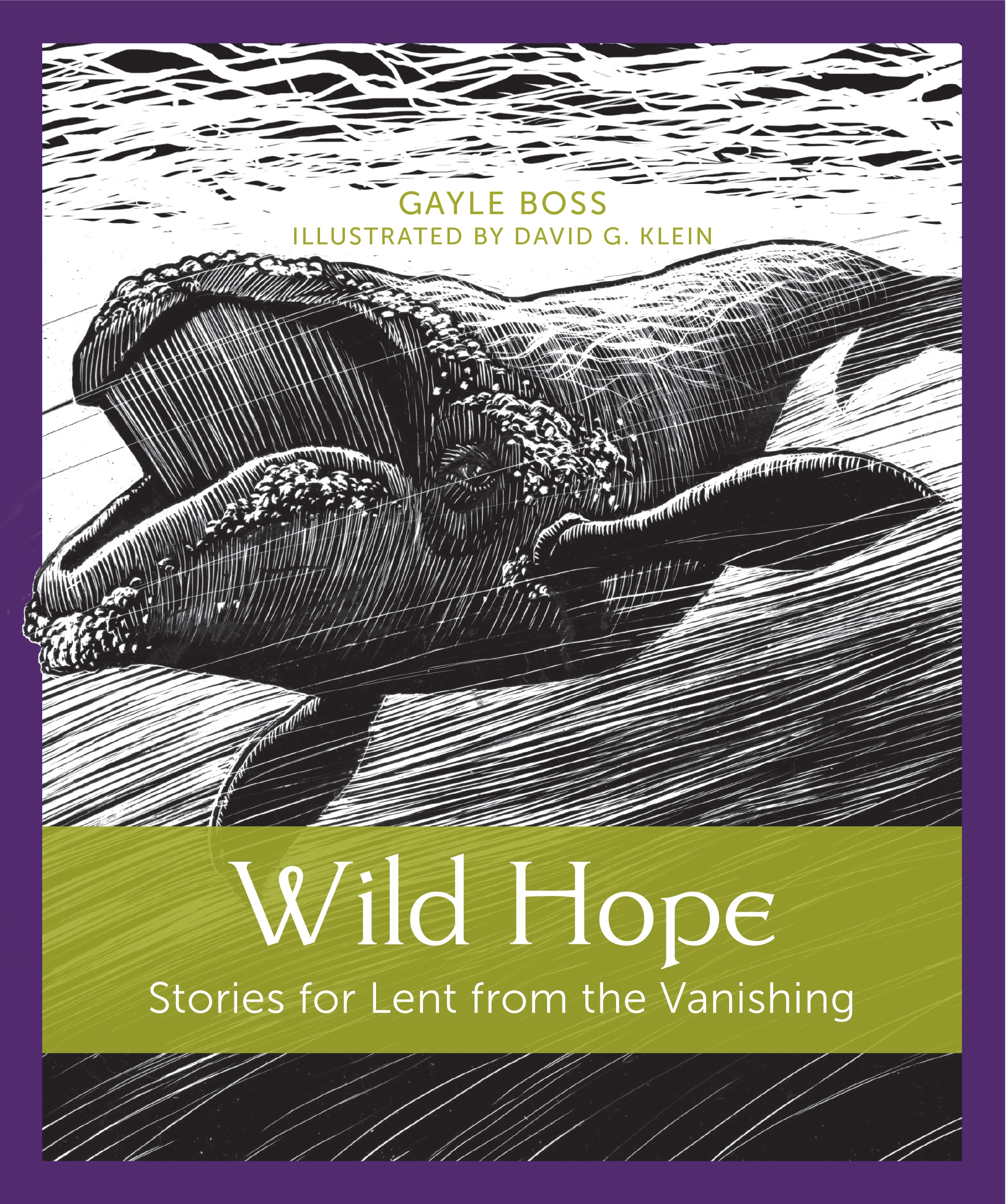
Cover of Wild Hope

My friend Jon Terry from the Au Sable Institute sent me a surprise gift in the mail – a copy of the book Wild Hope: Stories for Lent from the Vanishing by Gayle Boss. The book has six sections for the six weeks of Lent. Each section features the profiles of four animals, from the Chinese pangolin and black-footed ferret to the Amur leopard and golden riffleshell mussel. Each profile opens your eyes and heart to the wondrous qualities of the animal. Gayle also shares, in an understated yet poignant way, the challenges each species faces to survive.

Because Gayle is such a gifted writer, it’s hard to resist sharing a multitude of excerpts. Here are two from her introduction that get to the purpose of Wild Hope: 

“Attention to the amazingness of our arkmates routes us directly to the heart of Lent. The season means to rouse us from our self-absorption.”

“The promise of Lent is that something will be born of the ruin, something so astoundingly better than the present moment that we cannot imagine it. Lent is seeded with resurrection. The Resurrection promises that a new future will be given to us when we beg to be stripped of the lie of separation, when the hard husk suffocating our hearts breaks open and, like children, we feel the suffering of any creature as our own. That this can happen is the wild, not impossible hope of all creation.”

I highly recommend this book for you and your family. You will more deeply treasure God and God’s Creation. Your heart will also go out to the men and women who are dedicating their lives to preserve the life of God’s earth. Gayle’s writing will affirm your own convictions and heart for the life around us. You’ll be struck by the beautiful art of David G. Klein. And the book will move your heart in new ways during this Lenten season

I’m grateful to Gayle for writing this book. She generously took time to respond to four questions I had for her.

Nathan: You write in the introduction to Wild Hope, “I didn’t hear all creation groaning when my sons were young. I was oblivious to the millions dying, their kinds never to be seen on the earth again.” Can you share how you came to be a Christian, a writer, and a Christian writer called to communicate about the life of God’s earth?

Gayle: I grew up in a church-going family (the Dutch Reformed tradition) and loved all-things-church, even as a teenager! It seemed to me the one public place where what really mattered—who we are and why we’re here—got talked about. That impulse to talk about what matters also drew me into a writing life.

I’ve tried my hand at nearly all creative literary forms, from long-form journalism to haiku. In my early forties I wrote a 535-page failed novel. The wish to write about animals and how close bonds with them make us more deeply human grew on me so slowly I’m not sure I can trace it.

This much seems true: When my sons were young, their love of animals woke a long-dormant attention to animals in me. I remembered how I would cry when my father and uncles hung up deer they’d shot from the branches of a big oak tree to bleed out. And I remembered how the rest of the family laughed at my tears. The venison was part of our winter food supply, my food supply, too.

Led by my children, I let my original tenderness for animals rise again. I noticed how good that felt, even when I experienced an animal suffering. I felt more alive, more free. I now believe that’s because I reconnected with the One Love planted in all things at their creation; the love at my core calls to the love at their core. Restoring that connection is a path back to our deepest selves and back to the beloved community of all created things that we call Eden or The Peaceable Kingdom, where “They will not hurt or destroy in all (God’s) holy mountain.”

Nathan: Please share what your goals were for Wild Hope and why you believe attentiveness to “..the amazingness of our arkmates routes us directly to the heart of Lent.”

Gayle: As with All Creation Waits, I wanted to wake, or fan, in readers the kind of love for animals that was dormant for so long in me—a love that doesn’t “cute-ify” them, but sees each one as “a word of God and a book about God,” as Meister Eckhart said. In that first book, I wrote about animals that many of us see regularly, like skunks, raccoons, and chickadees.

In Wild Hope, I describe animals most of us will never see in the wild, from orangutans to olms. I wanted to describe their magnificence and tell their stories, including the stories of their suffering on a planet we’ve made unlivable for them. I thought that if I could tell their stories in such a way that we readers would be drawn into their worlds, our defenses could melt, and we could grieve their suffering. We could see them as expressions of God’s own self and God’s own suffering—at our hands. Which is the white-hot core of Lent.

It’s important to me that we readers respond to the animals’ stories first with love, not shame and guilt. Because we’ll only make the radical life-changes that will protect the earth for all animals, including us, if we’re motivated by love. Guilt-motivated change may work for the short term, but it can’t be sustained. Over the long haul, we only protect and save what we love.

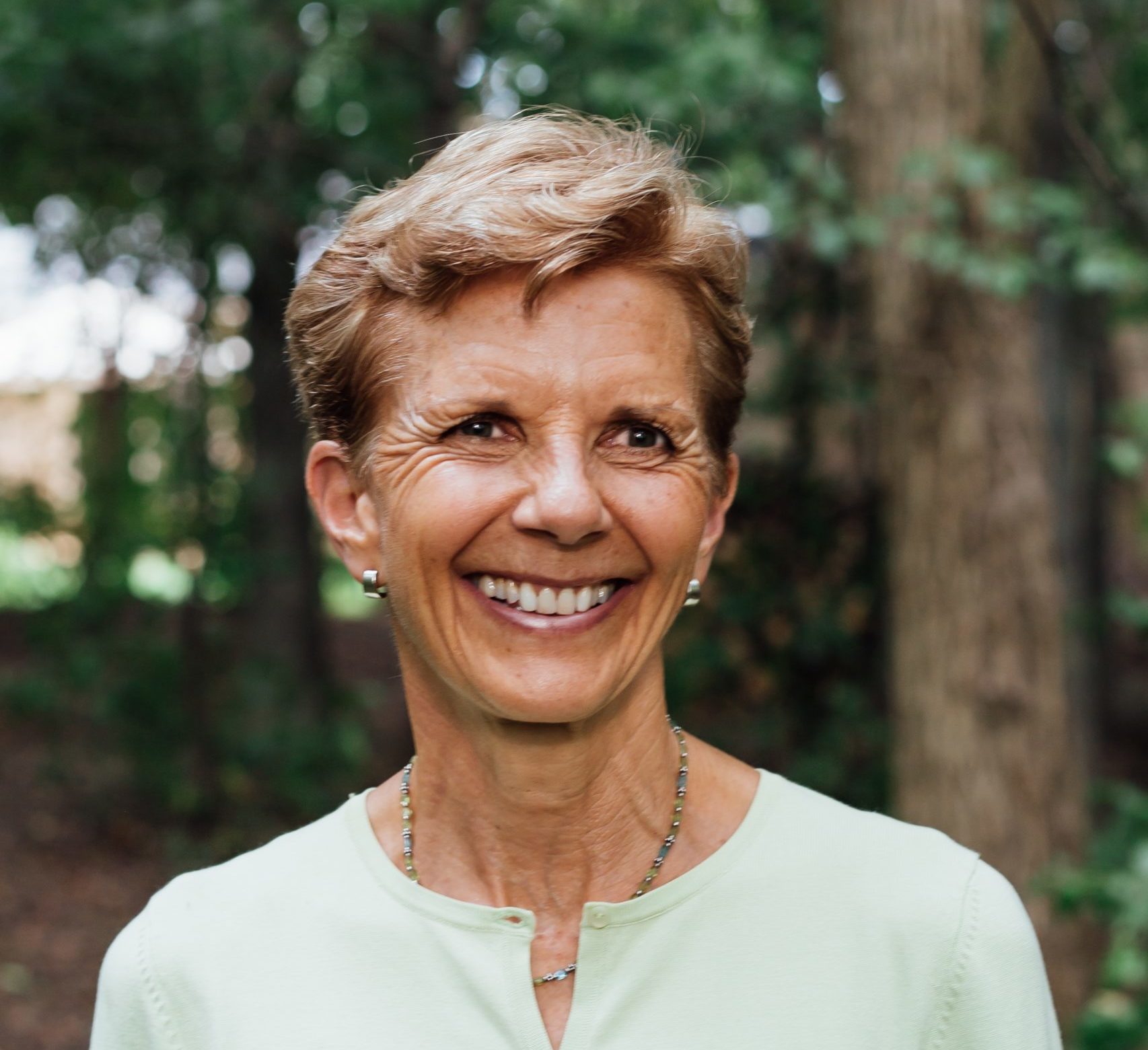
Gayle Boss in woodsNathan: What animal of God’s earth most captivates your heart? Why?

Gayle: Of course you know that I’m going to say I’m smitten by every animal I see and learn about. And it’s true, I really am!

The “episode” of each animal’s story that most undoes me, though, comes when, faced with impending death, they desperately do everything in their power to protect their young. While researching and writing Wild Hope, I saw that episode occur over and over: The mother polar bear struggling to keep her cubs afloat in seas without ice floes, and failing; Laysan albatrosses watching their chicks sink into lethargy from plastic poisoning, and die; the pangolin mother curling around her baby when the poacher pulls her out of her den. As a mother, to recognize that my actions, our actions, inflict the worst suffering I can imagine on other mothers was almost more than I could bear.

Learning the stories of these animals swelled my love for them, and love wouldn’t let me look away from their suffering. It made me fiercer in my commitment to change parts of my life that contribute to their suffering. We only protect and save what we love.

Nathan: What role do you believe art can play in inspiring Christians to understand God’s love for the whole world (including our “nonhuman kin”), to act on that understanding, and to somehow work through the despair and grief we experience as we see our nonhuman kin suffering?

Gayle: I don’t believe we’ll ever “understand” God’s love for all created things. Understanding is a motion of the mind, and God’s love for all things is way beyond our minds. It can happen, though, that we’re grasped by God’s love for all created things. Somehow, that “beyond us” Love that created the universe finds an opening in the hard husk of our egos and “cuts us to the heart,” as It did those who heard Peter tell the Jesus-story at Pentecost. Once Love has got hold of our hearts, it changes how we see everything. And when we see differently, we behave differently. “If your eye is good, your whole body will be full of light,” Jesus says.

At their best, stories, visual art, dance, and music bypass the mental constructs we use to defend ourselves and our walled-off ways of living. True art is the dart Divine Love uses to cut to our hearts. Suddenly or slowly, it reveals a new way of perceiving a world we thought we knew. Think of how differently the night sky appears once we’ve been struck by Van Gogh’s “The Starry Night.” What was static is suddenly full of energy and motion and presence.

It’s important to say that art doesn’t always pierce our thick husks with what we find beautiful. Sometimes art seems ugly or threatening, troubling. Van Gogh’s neighbors did not think The Starry Night” was beautiful. They thought he was a crazy man making unpleasant, offensive paintings – that’s how new his way of perceiving was.

But for those of us who can allow even a crack in our armor, God can use art to peel the scales from our eyes and show us a universe pulsing with Presence, with creative energy unbounded. That vision becomes so compelling, we want to do everything we can to make ways for God’s always-creating energy to manifest in the visible world. “Working for change” isn’t a burden we bear but a dance we cannot help but do. As Paul says in the fifth chapter of Romans, “We rejoice in the hope of sharing in God’s glory.”

At the same time, we also suffer more deeply with the suffering. But as Paul goes on to say, “We rejoice in our sufferings,” because somehow suffering leads to a hope that “does not put us to shame, because the love of God has been poured into our hearts through the Holy Spirit.”

My limited experience tells me that in suffering we sink more deeply into the heart of God, into the Love that is at the core of the Universe—at our core—and know ourselves to be truly alive. Sunk in that Love, we also know that it is the truest thing in the universe—it’s the origin of the universe—and that Love cannot but have the final say. We carry on in the irrepressible hope that God is the one “who gives life to the dead and calls into being the things that are not.” (Romans 4:17)

That’s the Wild Hope at the center of the book Wild Hope: Stories for Lent from the Vanishing. I hope the stories reveal the pulsing presence of God in each creature and the drive of Love for that creature to survive. That’s a drive I want to join.

Psalm 31:24 exhorts us: “Be strong, and let your heart take courage, all you who wait for the LORD!”

But sometimes we need the voices of others to carry us forward. In that spirit, I want to share with you two videos and an essay that have come my way recently.

The first video came from my friend Jon Terry from the Au Sable Institute. Here’s what he wrote about it: “The video is designed to be used by former students in their home church as a way to share their experience at Au Sable and introduce the Biblical mandate to serve, protect and restore God’s earth. Several students have already scheduled a date to show this video in front of their whole congregation as part of the worship service. Others will be showing it at a Sunday School or Adult Ed class and then leading a discussion on the issue.”

The video asks a fundamentally challenging question – will Christians be part of the problem or part of the solution?

It also shows how Au Sable equips young Christians to be part of the solution. The sincere eloquence of the students who appear in the video lifted my heart.

I came across this excellent essay by Jennifer Trafton about the Scottish minister and author George MacDonald through the newsletter of the Rabbit Room. MacDonald’s fairy tales influenced C.S. Lewis and J.R.R. Tolkien as well. Trafton highlights MacDonaldn’s insights into the importance of imagination in the life of the Christian.

My favorite line from Jennifer’s article:

“Revelation is God reaching out to us; imagination is us reaching out to God.”

I hope you will read it. Let us continue to imagine God’s will being done on earth in ways that cause people and Creation to thrive.

And Ryan O’Connor from Madison, Wisconsin, reached out to me recently after a friend pointed him to this blog. During a phone conversation that followed, I shared my struggle and the struggle of others I know with grief. Our hearts break over what is being done to God’s earth.

Ryan sent an email later that, among other things, shared this music video from Christian artist Andrew Peterson. I wanted to share it with you as well. The opening lines resonated deeply:

Do you feel the world is broken?
Do you feel the shadows deepen?
But do you know that all the dark won’t stop the light from getting through?
Do you wish that you could see it all made new?

By the way, the video is done in a crazily inventive way. Peterson’s team shot it all in one continuous take.

Enjoy.