
Archives For How Shall We Live?

Logo for John Kempf (line art of Amish man in hat looking to left)

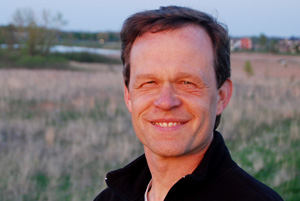
I’ve forgotten how I first became aware of John Kempf, but I do know that fairly quickly I realized that he was a gifted man of deep faith following his calling with all of his heart, soul, strength, and mind. His calling is to change agriculture. He believes it is possible to grow crops in such a way that nature is renewed, healing food is produced, and farmers prosper. He is a leader in the regenerative agriculture world that is all about working within the template of how God’s amazing earth works when given the chance. Through the founding of Advancing Eco Agriculture, speaking, and his podcast, he has directly and indirectly impacted thousands of farmers and their families.

I’ve come to know him best through his Regenerative Agriculture Podcast through which I’ve learned a great deal and been profoundly inspired. So I had long hoped to interview him for this blog and was delighted when he accepted my invitation. You will find his story and words wise, surprising, provocative, and abundant in Christian faith.

John is a man of paradoxes. He is Amish and has been fundamentally formed by that unique Chrsitian culture. (You’ll note how easily he can quote Bible verse from memory, translating them effortlessly from the Pennsylvania German in which he first learned them into English.) Yet, he has a global perspective and spiritual gifts that most Christians might not know what to do with. To the best of my knowledge, he has not attended college but is one of the most erudite agricultural experts in the world. Despite his knowledge and having the entrepreneurial gumption to found Advancing Eco Agriculture and three other organizations, John is humble. In his podcasts, he genuinely seeks to learn all he can from every guest and gives them ample time to speak and tell their stories. He is a man of strong ideals and speaks his mind with blade-like precision. Yet, he is compassionate and has a delightful sense of humor. 

John spoke to me from his front porch of his family’s new house with his new orchard in the background. It is one of the most stimulating conversations I’ve ever had. Enjoy.


Nathan:  I’ve been grateful for all that you have done for regenerative agriculture. The fact that your podcast allows so many people to hear from so many people with knowledge and experience in the field is a great gift. I appreciate, too, how you tease out of the guests’ stories and insights. It’s especially interesting to me how woven into your conversations from time to time are clear indications that your faith is part and parcel of who you are. You don’t beat anybody up over the head with it, but it comes through. That’s a powerful witness.

John: Thank you, I’m glad for that feedback. I’m glad that it does come through. I am hesitant to make it overt. I want to lead people to that gracefully without beating them over the head with it. There have been times when I’ve wondered whether I need to be a bit more overt about it.

Nathan: It’s fun to hear you on other people’s podcasts as well. You were on the Thriving Farmer podcast back in 2020, and the podcaster asked you, “What books do you recommend,” and you said, “Secrets of the Millionaire Mind.” My wife and I were driving in the car, and I remember saying to my wife, “That doesn’t sound like John at all. It wasn’t about agriculture, and the title sounded a little gimmicky.” But because you recommended it, we bought the book. Well, it’s so good we’ve now shared it with some family and farmer friends. Thank you for recommending it.

John: What I’ve found particularly intriguing about the book is that it’s framed around money, which is a turnoff to some people. That’s unfortunate, because I think the digging that he does into our subconscious patterning is so important. It’s relevant and important for all of us to dig into that, and not just about money, but about all the facets of our life. That is what I really came away from the book with. Financial management is one window into understanding our subconscious biases, but what if we evaluated our approach to health, food, and medicine through a similar lens?

It’s been very humbling for me that the podcast and the work that we’re doing are having an impact. On the one hand I always had this dream of having a global impact and really being able to impact the entire beautiful planet that God has created, that he has put us here to be stewards of. But it’s still something to see that actually happening in reality. Some days I’m like, “Oh my goodness, is this actually happening?”

Nathan: Since your faith is clearly a part of what you do and why you do it, I thought it’d be wonderful to ask you questions and to share your answers with people who read the blog. So would you mind, first of all, John, just sharing some insights into your own spiritual development? You’ve often shared about what opened your eyes to a different paradigm of farming, but would you feel comfortable sharing anything about your spiritual development?

John: So I’m going to give you a very different narrative than of what I’m sure you might be anticipating. Growing up on the farm, I always felt very connected to nature, to wildlife and particularly to plants. And for me, being out in nature and observing plants and kind of communing with nature was worship. And in many ways I got as much or more out of that and developing a relationship with God than I did from reading the Bible. To me, the outdoors really was my Bible in some ways. Not that it was a replacement for the Bible obviously, but it really was a very worshipful experience.

There aren’t good words to describe this, so I’ll try my best. I’m going to use the terms observe. I was able to observe kind of the hidden nature of things. I was able to observe what the mature plant would look like when it was still only a seedling, even though I hadn’t ever encountered the mature plant before. Or vice versa. I was able to look at a landscape and just kind of have this intuitive knowing, this spiritual knowing, of what was the highest and best use for this landscape and how it would like to develop and to evolve. And as a part of this, I was also able to have a very strong connection to individual plants and groups of plants. Out on the farm, if we were growing a cantaloupe crop or a cucumber crop, if we made a foliar application of fertilizers, or pesticides, or whatever the case might be, or even not having made an application, I could walk into a field and kind of intuitively, instinctively feel what those plants were feeling. In some cases, I was even able to observe the energy flow around them.

You may have heard the interview that I had with Pascal Fafard where he spoke about actively fostering that ability, and developing the capacity to communicate with plants. I think this is a capacity that all humans have to varying degrees. It’s really Spirit-led communication through the Holy Spirit with God’s creation.

Associated with that ability to observe, there were also some really amazing experiences where I was able to work with plants that were unhealthy, or were perhaps being consumed by diseases and insects. Just by being able to be present with that plant for just a few moments and intend a different outcome and intend for this plant to recover and to express gratitude for the gifts that this plant was bringing into the world and by expressing love and appreciation, I would have problems completely resolve. In a few cases within hours or certainly within days. And then shifting that from plants to entire landscapes and having experiences with entire landscapes where I would ask certain pests to leave and they would leave, they would all move. I would designate one part of the field or one corner of the field and say, “You can come over here, but I need you to leave everything else alone.” And they would do that.

So, that then led to a deep study, because I grew up within the Amish culture in which those types of conversations were not considered acceptable or appropriate. I wanted to deeply understand what is happening, what’s going on here, from a spiritual perspective. And that really led to an in-depth study of the gifts of the Holy Spirit and what they really mean. Some of the things that Jesus meant when he said (I’m used to reading this in German, so I’ll paraphrase in English, and I’m sure you’ll pick up the reference), “Be perfect as I have been perfect,” which I think is in Mark. Our understanding of the word “perfect” is to mean without fault, but that’s not actually what Jesus meant in the original Hebrew. He did not mean to be without fault or without sin. What He meant was to be fully functional in all the gifts of the spirit.

Because that is what He was. He was fully functional in all the gifts of the Spirit, the nine different gifts (1 Corinthians 12: 1, 8-11). And so, to the best of my knowledge, he’s the only person that was fully functional in all nine of the gifts of the Spirit. And so I think when we read the parable of the talents and we read the parable of the different things that we are given, those to me are really an expression of the different gifts of the Spirit that we have been given.

And so we have this perception that the gifts of the Spirit are something that were active in the early Church, but are not active today. And yet there is no good rationale or justification for that. And in fact, there are many people who experience those gifts of the Spirit on a routine basis. And so, that really was what led me into kind of a deep spiritual search initially and was also kind of the foundation for what led to my scientific inquiry.

I then started trying to have this conversation with my family and parents and people around me about the gifts of the Spirit, about what I was experiencing and observing in working with plants in a spiritual framework, in a spiritual context. But that was not an acceptable conversation. I was misled and lots of other things, but that has now dramatically shifted. My family has come to a very different perspective over the last decade.

Nathan: As a result of your experience and what you’ve explained?

John: That may have been a contributing factor, but I think they were on their own personal journeys. So they’ve come to their own realizations as well. I think they’ve been led by the Spirit also. So, since that was not an acceptable context and not an acceptable framework, that then led me into a deep scientific pursuit to try to kind of work myself out of the corner that they thought they had worked me into. By being able to describe these phenomena from a scientific perspective… (I thought I could do that).

Nathan: So, it sounds like you had these personal experiences while also being immersed in the Amish culture of Christian faith. One of the things that strikes me about the Amish approach to Christianity is that it ties faith and life together. That was part of the fabric of your life.

John: It’s absolutely supposed to be a lived faith. It is not supposed to be something that you practice on Sunday and then you do something else the rest of the week.

Nathan: Exactly. In John 3:16, which is often used as the Gospel in a nutshell, Jesus declares that God loves the world. And then, Jesus states that whoever believes in him will have eternal life. From my understanding “eternal life” is describing a very abundant, full, complete whole life rather than only a life that goes on after death. I believe Jesus meant for us to make a connection in the verse that he did not spell out explicitly. He loves the world so much that helping people to have eternal life now, providing them all the gifts of the spirit to live out a full God inspired life now will actually help heal the world. His way of loving the world is to get more people to care for the world. Does that make any sense?

John: It makes perfect sense. And I think it aligns with another very common, incomplete understanding of what was Jesus really here for. You ask people a question, “What was He here for? What did He come here for?” The first answer is for the purpose of salvation. But, I think that’s only a third of the answer in my understanding. Yes, He did come for salvation. And salvation was a part of a much bigger piece, which was establishing His Kingdom here on earth. And not just here on earth, but also in heaven. Jesus had a kingdom message. We are actually here to be in His Kingdom while we are here on Earth.

Another aspect is He came to heal us physically. Not just at that moment in time, and not just spiritually, but He came to heal us spiritually and physically, then and now. So He was the great physician. He was the healer. And there’s so much reference to this when you start digging into it.

When we look at the gifts of the Spirit and when we look at, really having His Kingdom here on earth, and you talked about the aspect of eternal life in John 3:16, there’s a very simple question – “When does eternity begin? Does it begin when we die?” No, it is now present in this moment. This is a part of eternity.

Nathan: Absolutely. We’ve already talked about some Bible verses, do you have any favorite Bible verses or stories that kind of connect with this theme of the fact that being a Christian is about being here now and also caring for the Earth?

John: I have lots of favorites. One of them that I really enjoy is in Job 12:7-8 which says something like, “But ask the beasts, and they will teach you; the birds of the heavens, and they will tell you; or the bushes of the earth, and they will teach you; and the fish of the sea will explain to you.” And to me, that is an expression of God’s capacity to speak to us through His Creation, and to have His Creation teach us if we are willing to learn and to adapt the insights that we gain to our own spiritual development.

I’ll give you one example. When I look at the process of photosynthesis, there are so many incredible parallels between plant growth and development and our own spiritual growth. In the process of photosynthesis, plants collect light energy, while the sun is shining, and they store that energy temporarily for a short period of time. And then they use that energy to grow at the darkest time of the night and at dawn. So 80% of plant growth, 80% of cell division, happens between 3:00 AM and 8:00 AM. So think about the spiritual parallels for that. We are also to collect energy from God’s light while the sun is shining on in our lives, so that we have the energy to grow during our trials and tribulations.

Nathan: How has reading the Bible and thinking about faith informed your farming and the agricultural consulting, and how has farming and consulting effected the way you read the Bible?

John: So it’s difficult in retrospect, to look back and see how our perception or how our frame of reference has evolved. But I think one of the foundational reasons for our success in our work at AEA and our consulting work is that I always try to deeply understand what are the root causes of why we have a certain symptom. And, of course, we must try to identify the root cause at different levels.

So if you look at an individual green bean plant, you ask the question, “Why does this green bean plant have aphids?” you will arrive at a certain set of answers that include mineral nutrition and the microbiome and how the soil was managed. And then you can back up and ask that question one level higher – “Why is this field being managed in a way that produces plants which are conducive to aphids?” And you go to another level, and you ask, “What is it that this farmer believes to be true that has led him to managing this field in this way?”

If you keep backing up and you keep digging deeper, this then leads to the question – “How is it that we, the farming community, profess to be composed primarily of Christians and yet we have this incredibly destructive model of agriculture?”

And so I tried to dig into that by asking these root cause questions of why? What is it that we as farmers believe to be true that has allowed us to adopt this destructive model of agriculture that is so degrading to God’s creation?

I believe that there are two fundamental misbeliefs or two beliefs that are fundamentally incorrect about the Christian worldview. And one of them is the belief that the Earth is cursed. We will always have diseases and insects. We will always struggle against nature. The second is the incorrect belief that we are here to dominate, we are here to have dominion over.

This, of course, leads to the verses in Genesis, where it says that we are to have dominion over all these animals. But when you look at what was intended to be communicated there in the original Hebrew, there’s actually a very different meaning than the way we perceive the English word dominion today. It is really meant to convey “to minister” or “to be a steward of.” And this is obviously reflected very clearly in Jesus’s New Testament teachings. We are here to be a minister. We’re here to be a steward. And I think on a kind of an intuitive soul level, on a spirit level, we all instinctively know that we are here to be stewards. It is not the correct framing for us to think that we are here to subjugate and to dominate.

But when you think about mainstream agriculture that has so tremendously degraded the environment and ecosystems and a planet that God has created, it is really based on this ethos of domination and subjugation.

The second misconception I noted earlier is that the Earth is cursed. And anyone who believes that the Earth is cursed and always will be cursed has not fully read and appreciated Genesis 8:21. Genesis 8:21 takes place after Noah emerged from the Ark, and he offered a burnt offering to God. The first part of the verse goes, “The Lord smelled the sweet savor and said in his heart, “I will never again curse the ground any more for man’s sake for the thoughts and imaginations of a man’s heart are evil from the days of his youth.”

We all are, at least in my experience, taught and hammered in the second half of that verse: “the thoughts and imaginations of a man’s heart are evil from the days of his youth.” But we missed the first sentence, which is, “I will never again curse the ground any more for man’s sake.” It’s right there.

So if we’re a farmer and we believe that the land is cursed, then it is for us (despite what the Bible says.) That belief will create the reality that we are farming within. I think there is, in fact, a third belief that is also perhaps inaccurate or incomplete, but I don’t yet have the arguments to refute it, and so I’m not quite ready to tackle it yet.

The third belief is that it’s all going to burn up anyway. This belief, in combination with the other two beliefs I’ve mentioned, gives people permission to pillage and destroy.

Nathan: Have you read anything by N.T. Wright?

John: No. I have not.

Nathan: He’s an Anglican bishop, and he has written a book called Surprised By Hope, which is primarily about what happens to the world and us when we die. It is very biblically based and also very rich in a very different understanding. One of the points he makes is that the real point of the Bible is not whether you and I go to heaven. The real point of the Bible is that God is out to restore and recreate all creation. That’s His goal. There’s going to be a new heaven and a new earth according to N.T. Wright. Wright even notes that Paul at one point refers to us as being fellow workers with God. So there’s some positive role for us to play with using our human creativity and innovation to do things that God wants only us to be able to do.

John: I think that is such a very important point. I believe that creation is not something that happened at one moment in time in the beginning, but creation is something that happens new each and every moment. And that if we believe that we are the sons and daughters of God and brothers of Christ, then that means that we are co-creators with Him of the new reality each moment in time. And I think it is accepting that it’s a responsibility and accepting that ministry and that calling is really what gives us the capacity to create a new reality, to create a new future. Within that, I believe that as the sons and daughters of God, the integrity of our intentions, what we intend is what we create and what we intend is also what we become. Going back to where we started this conversation with our subconscious beliefs, the intentions of our hearts are ultimately who and what we become in our lives.

Nathan: And the faith that we have in Jesus and the Spirit that God sends us helps us to have different intentions?

John: Yes. I’m using the word intentions because it’s a word that a popular audience can relate to, but you could also use the word prayer. You could also use the word or the thought process of being led by the Spirit because I’m not excluding the Spirit from this. I think that we have to be Spirit-led and when we have Spirit-led intentions, we are the co-creators of what is happening here on this planet.

Nathan: I think this is a good segue into your work with Advancing Eco Agriculture. Can you share just a little bit about what AEA does? And if you wouldn’t mind, do you have a story of how AEA has helped a particular farm family and how that has changed not only their agriculture but maybe even the spirit of their family?
John: Yes. I have many of those stories. They’re so powerful and they’re often very emotional. So what does AEA do? Well, it’s difficult because we do many things. We are agronomists. We are crop scouts. We do consulting for plant nutrition. We do consulting for microbiology. We make recommendations on nutrition management and microbial management. And we have products. So it’s this really multifaceted approach.

It all came together for me in a flash of insight when I realized that what we actually do as a company is we redefine relationships in a farming operation. We redefine the relationships between farmers and their soil, between soil and plants, between plants and insects, and we help to facilitate and bring all those relationships back again closer to what they were originally intended and created to be. So that may not be a very clear answer for your audience, but I’ll expand on that just a bit further.

We have demonstrated that it is possible for plants to be completely resistant to all diseases and all insects and completely eliminate the need for pesticides when we manage nutrition and biology differently. Particularly, when we manage nutrition and biology, where the primary consideration is health rather than exclusively yield. When we do that, when we manage nutrition and biology differently and we produce plants that are completely resistant to diseases and insects, they can also transfer this immunity to livestock and to people. We can then have a legitimate conversation about growing food as medicine. Ultimately, this is about a return to a deeper understanding of God’s design and allowing God’s creation to fully express itself the way that it was designed to rather than trying to force it and direct it and manipulate it into unnatural directions.

Here’s a story of a farmer that perhaps might be a clear description of this process, of what this relationship process looks like. About seven or eight years ago, we started working with a cherry grower. He had heard about us, and he came to visit our exhibit at a trade show. He stood at our trade show table and he said, “I have no desire to be organic. I don’t want to reduce fertilizer applications and don’t have a conversation with me about reducing pesticides. What I really want to do is I want to grow large firm cherries that qualify for the export market, and I’ve heard that you can help me do that.”

And that’s where we started. So we started working with this grower to help him produce large firm cherries from about 370 acres in Oregon that qualified for the export market. On this path, he was very open-minded and very engaged. He started using compost. He started using cover crops, started managing nutrition and biology.

Obviously, the transition doesn’t happen in the field first. It first happens in our hearts and minds and then the fields follow that. At the end of three years, we sat across his desk for an annual review meeting and he looked at us for a moment. He was just silent. And then he said, “When I first met you, I told you that I have no desire to be organic, but I don’t have powdery mildew anymore. I don’t have bacterial tinker anymore. If I wanted to, I could be organic.”

This was a farmer that over the course of three years had shifted from being one of the most intensive fertilizer and pesticide applicators in the region to applying none. And his yields had increased. His profitability has significantly increased. And his relationship with his farm and with his land had changed as well.

As we work with farmers, we specifically seek to develop an empathy in them for the landscape and empathy for the crops. I think people are specifically here to minister. The function of administering and being a steward is a function of having empathy with the landscape.

There is this characteristic that is considered to be perfectly appropriate or normal for livestock farmers, but not for crop farmers. This is the characteristic of being intuitively connected to their livestock. So when you have a dairy farmer, a smaller scale dairy farmer, a hundred or a few hundred cows, or perhaps even less, there’s the expectation that a good dairy farmer will be able to walk into a herd of dairy cows and say, “Something is off with that cow,” when there is nothing visually observable that you can point to. It’s an intuitive, spiritual if you will, process that they just know. So we consider that to be appropriate for livestock farmers, but that hasn’t been considered to be a part of the required stewardship lexicon for crop farmers.

But yet when we work with growers who make this transition the most rapidly, and this cherry grower’s one example, they move very quickly to having that intuitive empathy and understanding. Three years is a rapid transition for the type of crop that he was working with. But we would walk with him through his orchard, and we would walk into a block of trees and he would say something like, “There’s something off with this block. I don’t know what it is, but it doesn’t feel right.”

Nathan: Wow.

John: And it’s when you have that empathic connection and you start sensing where the crop is and where the plants are and that they need something, that you get these extraordinary responses and turnarounds. So that is really, I think, one example of us helping to transition the relationships that farmers have with their crops and with the landscape.

Nathan: That’s really interesting because I’ve been reading some Jewish thought as well and one of the Jewish tenants or principles is that sometimes the doing of things can actually shape our spiritual character. I think sometimes in the Christian tradition, we believe we have to think our way to things and new behaviors and new understanding, and in the Jewish tradition, whether it’s ceremony or ritual or doing the right thing, doing those things in real life can reshape our hearts and build new understanding. That seems like in a way that that’s happening right there.

John: Yes.

Nathan: John, you have a remarkable breadth and depth of knowledge, and you’re able to articulate and communicate so clearly. Clearly, learning is a fundamental part of who you are. What have you learned about learning? What can you share with people? Because it seems to me anyone can benefit from learning. But this is especially true of farmers who are working with so much interrelated complexity. Do you have any tips or any advice or insights about how to learn?

John: Oh, my. I’ve got so many I don’t know where to begin. Well, I’m actually not going to talk about the process of learning. Instead, I want to talk about the types of learners. There is a difference between heart knowing and head learning. And there have been many times where as I was working in the field, being closely led by the Spirit, where I knew something to be true, but I did not know how to describe it scientifically, only to have it validated scientifically some period of time later, sometimes a decade later. I think it has been harmful to us that we have given so much credence to the scientific method and to mechanistic, linear, logical learning, because that is not really how the Spirit works. The Spirit speaks to our heart, not to our minds.

I think being open to and actively seeking that spiritual knowing will bring us to answers and to places that intellectual knowledge learning never can and never will. And in some ways, this is almost a parallel conversation to the discussion of indigenous peoples and their indigenous knowledge of knowing and grasping the complexity of a whole without knowing all the intricate details of the whole. So that’s one thought that comes to mind.

I frequently hear people make the comment that, “You are so smart. You’ve learned so much.” They’ll also say I have such a depth of knowledge. And there’s actually a part of that that really distresses me, and the reason it distresses me is because I was born with the same potential, although perhaps with different innate skills and talents, as anyone. Each one of us is unique. Each one of us has our own skills and talents, but we all have the same or a similar raw potential. And I don’t believe that the potential for intellectual knowledge that I have been given is significantly greater than a large majority of the population. And again, we’re all on a spectrum, but I don’t have a particularly extraordinarily high IQ for that matter, or EQ or whatever parameters you want to use to describe it.

The point that I’m trying to make is that every one of us has incredible potential that we consistently fail to tap because we don’t believe we can. We believe it’s beyond our capacity.

Nathan: Yes.

John: We should actively cultivate a desire to constantly expose ourselves to new situations and new ideas. Many of us prefer comfort, and we find the exposure to new ideas that challenge our preconceived ideas or beliefs to be uncomfortable. But it would be wonderful for us to shift and become comfortable in those contexts, because it’s in that manner that we can expand our breadth and depth of intellectual knowledge. So I don’t know. I’ve not really spoken to this before, and I don’t know how much sense I’m making, but…

Nathan: You’re making a lot of sense. In your podcasts you often ask your guests something like, “What question didn’t I ask that you wish I would have?” So I’ll ask that question.

John: That’s my question. And you can’t do that. (Laughter)

Nathan: I will pay you whatever copyright fees there are. (More laughter)

John: Give me a moment to consider. Well, a question that you didn’t ask that is perhaps worth digging into a bit more is that the distinction between heart knowledge and mind knowledge and the distinction between spirit and soul and heart versus mind. It’s very clear in the Bible. It’s hidden, but it’s very clear once you know what you’re looking for.

Let me give me a moment to paraphrase this verse from German to English. “The Word of God is like a two-edged sword; so sharp that it divides heart and mind.” (Hebrews 4:12) Rather than going too deep into the scriptural explanations for it, we know that there is a clear distinction. It is sometimes difficult for us in our world today where Greco-Roman thought dominates, and we have become so consumed by this mechanistic, linear, science-based belief that it is sometimes difficult for us to really capture or to really feel what heart-based knowledge is actually like and to learn more about it.

I would suggest that if people want to dig into this topic more deeply, I would recommend an author, Stephen Harrod Buhner. He’s written quite a number of books. Unfortunately, I do not believe that he’s a Christian. He is a very talented author, and he’s one of my favorites for his writing style, but he has written a trilogy of three books that I think if people were to read those and internalize them, would completely shift the way they see the world. The first one is titled The Lost Language of Plants. The second is titled The Secret Teachings of Plants, and the third is Plant Intelligence and the Imaginal Realm. In each of his books, he approaches each topic from both a heart and mind perspective in alternating chapters.

I find the topics themselves to be incredibly, incredibly fascinating, but the way he approaches the conversations is a really incredible as well.

(Above is an episode of John Kempf’s Regenerative Agriculture Podcast you will enjoy. In the episode, he interviews Ray Archuelata, who is a tireless and dynamic educator for a soil-life-building approach to farming and whose faiht also comes across loud and clear. Here is the podcast link for the interview.)

Nathan: Excellent. You might take this as a strange diversion, but I don’t think it is. If you look at websites for a lot of more mainstream Christian churches, there’s an incredible focus on this intellectual theology of what they believe and what they don’t believe, and there’s really no sense of what their heart is or how they’re trying to live with a heart-led faith in God. I don’t know if mainstream Christianity knows how to help shape people’s hearts so they have open hearts, that they fully have empathy. Maybe that’s part of the missing link.

John: Well, I think modern Christianity for the most part, at least what I’ve been exposed to (and this is a very strong statement and I’m almost hesitant to make it and yet I do believe it to be true) has largely denied the gifts of the Spirit. Because that’s really what we’re talking about and we’re using the language of the heart right now. Most people today don’t believe that those gifts of the Spirit are relevant for us in this day and this moment in time. So they disavow the gifts of the Spirit. And as a result, they are never going to experience what you and I are talking about.

Nathan: Wouldn’t it be interesting if you had a spreadsheet, and you had the fruits of the Spirit each in their own columns, and each agricultural practice (like prophylactic use of antibiotics) was a row? And you considered whether each practice exhibited each fruit of the Spirit by checking or not checking the appropriate column.

John: That’s fascinating.

Nathan: So let me come to a close here with sort of two related questions. One is – how dire is the situation we face in terms of how we currently do agriculture and how it affects the health of people and the planet? And what can non-farming people who want to live out a God-fearing, God-focused life, do about it?

John: If we were to approach the question of how dire is the situation from a purely secular point of view, then it appears to be exceedingly dire. We are actually insulated from the majority of the severe climactic changes that are happening around the world here in North America. We actually see some climactic fluctuations and weather fluctuations, but we don’t actually see what is happening in the world’s oceans and what is happening in large forested areas around the world. We are, at this moment, experiencing the most rapid extinction events in recorded history. And it’s really interesting to consider that the earth is experiencing this extraordinary ecological disaster, if you will, and that it has been caused by human hands, which are to be stewards and ministers. And instead they are dominating and subjugating into extinction.

So when we look at it from that point of view, the situation can appear to be almost hopeless. But then when we consider our capacity as co-creators, and God beside us, with us, helping us to create the reality that we want to see in the future, then it actually appears extremely hopeful. It’s extremely hopeful, because for the first time these issues that have been compounding for generations are now entering the collective consciousness in a significant way. In a significant way that hopefully leads to action and changes the reality that we want to see in the world. So I’m actually very hopeful.

I’ve set as a mission for myself that regenerative agriculture becomes the global mainstream in the next 20 years, by 2040. My metric for that is that I want to see 80% adoption on all agricultural lands globally of these regenerative agriculture ecosystems. I believe that that’s a very reasonable and realistic and achievable goal, and that we’re well on the pathway to achieving that goal.

Now, along that pathway though, there’s a very real possibility, actually I would say that it’s a probability and that some of it is already coming to pass, that there will be a great deal of human suffering along that pathway. And we’re seeing this already in our modern civilized societies, where we have this epidemic of degenerative illnesses, diabetes, stroke, heart disease, cancer, et cetera.

Today, basically, one out of two people living in America today is going to have cancer sometime in their lifetime. Autoimmune diseases for people under the age of 18 has gone from 10% of the population in 2010 to 20% of the population in 2018. And perhaps one of the very significant trends worth mentioning is the rapid decline in fertility where we’re actually looking at tremendous losses in the human population’s ability to reproduce as a result of toxins in the environment and in our food supply.

Nathan: What can we do if we’re not farmers? Obviously, eating choices are obviously super important, but is there anything else we should be doing?

John: It’s not a question that I’ve prepared for, but remember that each one of us, as stewards and ministers and co-creators, is co-creating the reality that we want to see in the future. We need to fully invest ourselves in our own personal health and journey. And that’s not just food choices. It goes deeper than that. It means taking full responsibility for our health and our family’s health. That means you do not delegate responsibility to the doctor. You don’t delegate responsibility to other people. You take full responsibility yourself for learning and implementing.

There’s a great book that I’ve just read a little while ago that I would recommend people read, entitled Health for All of Life. It really encapsulates this whole personal responsibility and spiritual perspective on health and food, dietary choices, and lifestyle choices as well. Then, beyond that (and I’m realizing as you asked the question that I actually need to think about this more deeply and provide a more comprehensive answer) I would also suggest that obviously we have a lot of power in prayer and in action beyond just the food choices that we make and how we lead our daily lives.

So are we invested in the stock market? How are we managing our money? And if we’re invested in those places, why not invest in local farming? Why not invest in the solutions? It’s about managing all the different aspects of our life to create the change that we want to see in the world and living it. But then also doing more than just living it, also communicating it to others through our values and our actions and our business decisions.

By and large, the majority of farmers profess to be Christians. And yet we have adopted a model of agriculture that is directly the antithesis of these foundational Christian values.

And to a similar degree, we can say the same thing about businesses. Think about all the businesses that interact with agriculture and our food. If we picked some of the Christian nonprofits that feed lots of people, they buy a lot of food. If they were to change their food purchasing decisions, to bring about a different reality, they would have tremendous power and tremendous clout.

Nathan: That is an excellent point. I have pretty well given up on finding a church where I feel like I can be true to all of these things that we’re both sharing and discussing and I feel so strongly about. I read the Bible every day. I pray every day. I read a lot. But clearly in the Bible, it’s hard to get away from the fact that we need to have some sort of communal gathering of faith with other people. Do you have any advice for me, John?

John: Well, I have the same question. I have an incredible group of people that I commune with and that I fellowship with that are not in close geographical proximity to me. That’s been very valuable for me, but I would like to have geographical proximity and actually commune with people locally.

You know, Nathan, I think you are doing powerful work by sharing this on the blog, and you are attracting those people to you. So perhaps you should approach that question from the T. Harv Eker (author of Secrets of the Millionaire Mind) perspective and ask the question, “What can I do to become a like-minded believer magnet (instead of a money magnet)? What are the subconscious beliefs that I have that might push people away from me?”

Nathan: John, it has been such a pleasure and a blessing to have this conversation with you. Blessings on your family and on your new farm.

John: Thank you. Be well.

One of the ways we can live out a whole Christian faith-life, whether as families or as communities of faith, is to restore and maintain natural habitat on our own properties.

Whether or not we do so matters.

Without natural habitat – without food to eat and places to find shelter – much of the wildlife of God’s earth cannot survive.

Restoring habitat usually and primarily means replacing lawn with vegetation that is native to your particular place. But if your property already has areas that you do not keep as lawn or garden, then restoring habitat can also involve removing invasive plant species and, again, planting more native plant species.

To inspire you, I want to share the video below of a presentation by Stephen Barten entitled “Backyard Wildlife: If you Build It, They Will Come.” He gave this presentation for the non-profit group Chicago Living Corridors through the Barrington Library in October.

Stephen, a veterinarian and award-winning wildlife photographer, has been restoring his family’s property in the Barrington area for the last 25 years. In the ~75-minute presentation, he shares photos and trailcam footage of 70 species of mammals, insects, reptiles, amphibians, and birds that have been seen on their property.

If you’re like me, you’ll be gobsmacked by the sheer variety of creatures Stephen documents.

That experience of sharing their world with a wide vairety of creatures is something Jesus and the other people of the Bible would have understood. From bears and jackals to the white stork and partridge, the Bible is full of many references to wildlife in the air, on the land, and in the sea. We need to visualize the many shepherds in the Bible interacting with livestock, wildlife, and complex vegetation ecologies all of the time. We know, too, that King Solomon paid a great deal of attention to plants and wildlife as well. I suspect Solomon and Stephen would have a great time discussing their observations together, despite being native to two very different places.

You will also appreciate the insights Stephen provides about a number of the different species of wildlife he encounters. He even shares tips about living with some of that wildlife, like what to do if you find a fawn.

Stephen and his family do benefit from living within two blocks of a lake and from living in a wooded area with few homes. If you are living in a dense city area or subdivision, you will likely not be able to attract flying squirrels and mink no matter how much habitat you restore. But you will still see God’s creatures and help sustain them.

Now is the time to plan for what you will do with your personal property or church’s property in 2022.

Study the habitats of your area. Figure out where you will source native plants for planting in the spring. Get help from someone who knows those plants in designing your habitat. Remove and treat invasive woody brush (like Stephen describes in his presentation). Start small to get the knack of it all. Plan to plant some native plants (even just a few oak trees) in the spring. Get ready by spring.

There are a wide variety of resources available for learning about native plants and restoring habitat to your property. The organization Wild Ones is a good place to start. I would also highly recommend Doug Tallamy’s book Bringing Nature Home. (And if you don’t have your own property, volunteer to help create and restore habitat at your church or another place.)

Will your property look a little different from your neighbors?

It may.

But work to retrain your eyes and cultural assumptions to be in line with God’s perspective. Ask yourself this question – what kind of culture and values does a yard (or a church landscape) really communicate when the plants there almost completely deprive the life of God’s earth life itself?

A well-designed yard that includes habitat and a bit of well-placed lawn, on the other hand, communicates something very different. That yard communicates that the people of that place care about God, the life of God’s world, and their human neighbors, too.

Enjoy. Learn. Grow. Embrace challenge. Show your love of God. Create habitat.


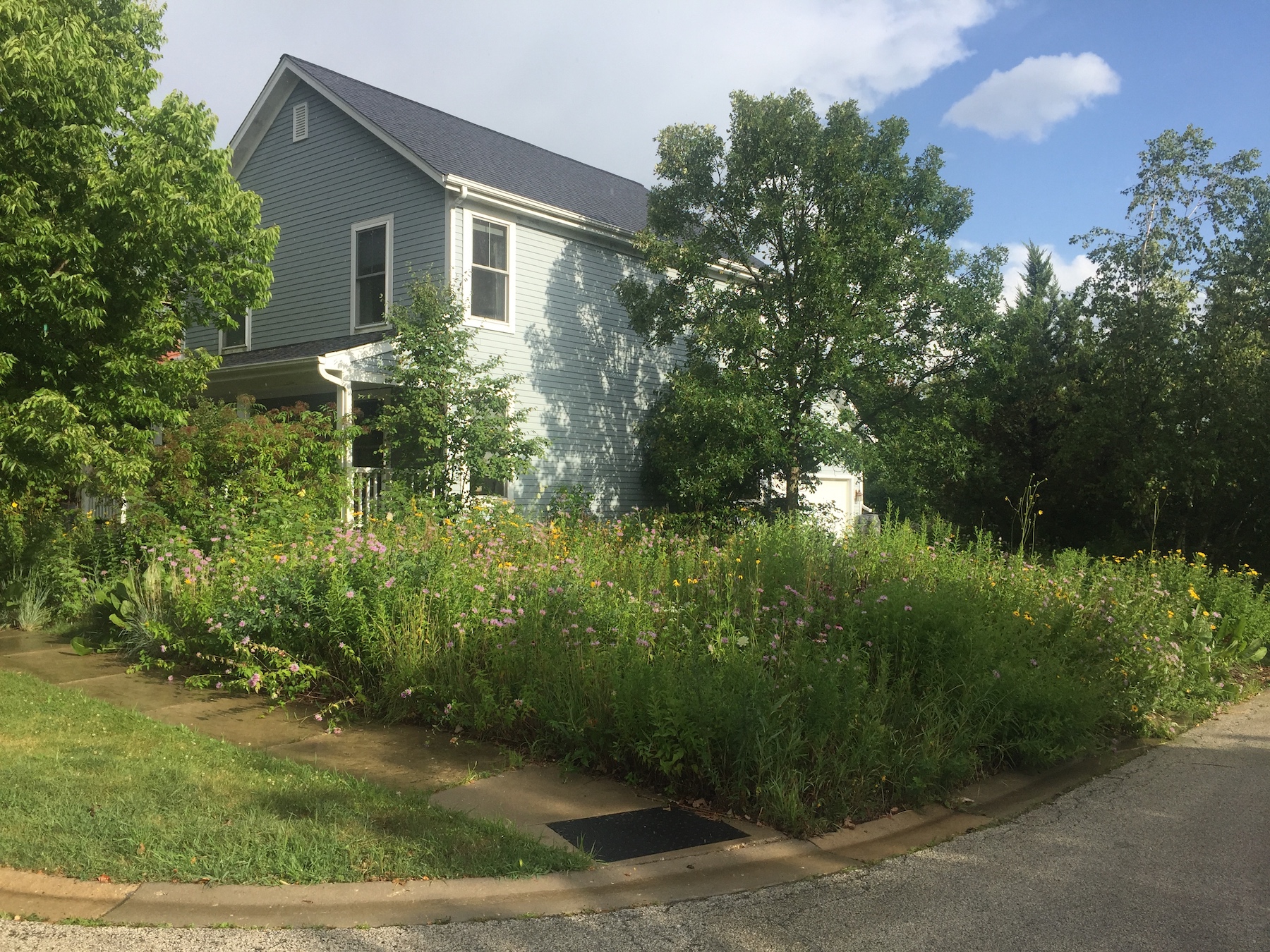
P.S. My wife and I have devoted much of our small property in Grayslake, Illinois, to native plants and maintain the prairie sections with occasional prescribed burns. We’ve been delighted to see cedar waxwings, cardinals, squirrels, chipmunks, voles, chickadees, goldfinches, toads, a variety of bees, monarch butterflies, hummingbirds, house wrens, rabbits, Cooper’s hawk, and a red-tailed hawk eating a rabbit. And, honestly, we’re still learning as we go.

Image of Nathan's home with native plants and prairie habitat using most of space

Here is an image of the habitat around our small home just after a late summer rain. Native shrubs and trees are great additions to your home landscape. This section of our yard includes native trees like hackberry and bur oak. There are also native shrubs like elderberry, serviceberry, nannyberry, and witherod viburnum. A native habitat landscape in Arizona would, for example, look very different. Please share images of the habitat you create on your property with me at wholefaithlivingearth@gmail.com.


In this episode of the podcast How to Save a Planet, you hear of native peoples protesting against oil pipelines because the pipelines break their tribes’ treaty rights, threaten the water and land they rely on, and continue actvities that are propelling our planet towards climate change.

I encourage you to listen to it.

In addition to the sheer bravery and commtiment of the native peoples involved in the protests, two small details of the podcast were particularly striking me.

One was hearing a speaker share that not only did native peoples from around North America rally together at the protests, but there were even indigenous peoples from Ecuador and northern Scandinavia (the Sami) who had traveled to stand with the protesters.

The other was hearing of a group of Quakers from New England who blocked a fuel pumping station at a point along the Line 3 pipeline project route in Minnesota.

Tara Houska, a Native American who is a leader in the protests seeking to stop that pipeline, describes how the Quakers used a piano to block the station and to play beautiful songs together as well. “One of those moments you’ll never forget as long as you live,” she said.

So here’s my question.

What would it take for it to be part and parcel of being a follower of Jesus to defend God’s earth and to help others, whether they are Christians or not, who are doing the same thing?

In other words, what would it take for followers of Jesus to love God, to love people, and to love God’s earth that is full of God’s glory with all of their heart and strength? What would it take to give our highest allegiance to God and what is God’s?

I honestly would like to hear your answers and ideas.

I need to know because seeing that happen is my dream and my prayer.

One of the challenges of writing a blog is feeling at times like one is writing in a void. I write words. Are they read? If they are read, do they catch? Do they find traction? Do they add anything to the reader’s life? I am forced to ask sometime, “Why do I write?”

When I started writing this blog all the way back in 2014, I literally could not not write.

I had to get my thoughts and perceptions out there. There was a fire in my belly. I had, perhaps like many introverts, many things I had thought but had not expressed. But I found I needed to express them. And I needed to examine and explore why I thought keeping God’s Creation was somehow essential to the Christian faith-life. Was it essential? My heart said yes.

I have since had the opportunity to meet remarkable Christians through this blog and to understand at a deeper level how Creation is interwoven through the Bible. I have seen how keeping Creation in an attentive, focused way grows one’s “faith muscles” and one’s love of God. This has been a blessing. I hope it has been a blessing for you in some way as well.

I still have the fire in the belly about Creation. It is, I am convinced, full of the glory of God. I am still amazed by the things I learn about how Creation works. Its mysteries and patterns will fascinate me to the end of my life and, I pray, beyond that. I still find my heart broken and angered by how Christendom as a whole accepts violence and diminishment of the life of God’s earth and even condones it at times. I am grateful for my wife Mayumi and her insistent voice that Creation matters.

Is this a calling? I don’t know. I do know I seek a more specific, rooted calling, a way to do the most I can for God’s will for Creation and people to flourish in a particular place. I sense I am at a transition point which I cannot name.

Below I will share some thoughts and impressions from this moment of my life. For someone raised as a Midwestern Lutheran, it feels a little too self-focused. But I hope it may resonate in some way with you. I would certainly welcome any wisdom you might have to offer.

1. A spiritual challenge I face is that I do not belong to a community of believers. Yet, I find more truth and beauty and conviction in the Bible and the words of some saints of our tradition than I ever have before. Tim Mackie and The Bible Project are great blessings right now in seeing consistent and beautiful patterns throughout the Bible. Priya Parker’s book The Art of Gathering actually gives me some ideas about the kind of worship gathering that might resonate for me and others. I’d highly recommend the book.

2. A blog post coming in the next month or two will be transcription of an interview I did with John Kempf. John Kempf is one of the leading voices and practitioners of regenerative agriculture. He also happens to be a brilliant Amish Christian. I’d highly recommend his podcast (start with this episode). The way he combines a deeply spiritual understanding of how God’s earth works with a comprehensive, scientific, practical mindset amazes and inspires me.

3. I continue to work on a novel that incorporates themes that I have written about here and that I see in the Bible. Are there parallels between writing a novel and being a Christian? One I’ve found is that writing a novel is completely different than trying to outline it and plan it in theory. Just like there’s a difference between reading about following Jesus and actually trying to do it. I’ve had to learn to not try to control the narrative. I’ve had to be OK with starting writing sessions not knowing where things would go. And I’ve found I’ve had to face my own weaknesses, even my weaknesses in understanding how people actually think and feel and how the world works. It’s humbling, very humbling. One needs grace. God works through our weaknesses as we read in 2 Corinthians 2:19. Maybe when life is easy and smooth, we’re not actually putting ourselves out there enough for what God wants us to do?

I’ve also been struck by how hard it is to write of faith and life and the significance of Creation without making the narrative chock full of theology. And it’s occurred to me that perhaps Christendom has devoted way too much energy to theological disputes. It’s actually a mindset, this dwelling on doctrinal borders seems to be a cultural way we often do the faith. What if the Amish concept of ordnung (a collection of unwritten guidelines for all parts of life) was applied in some hybrid way to Christians of a particular community so that how we lived was as valued as what we believe?

4. Want to read to a challenging novel? Check out Kim Stanley Robinson’s The Ministry for the Future. It has all kinds of insights about climate change and what people will be like when facing the consequences of a world made more chaotic and dangerous by forces that could have been prevented. A question that is often asked by characters in the book in different ways is, “If we looked at our situation from the future, what we should do is so obvious. So why don’t we do it?” What is the answer for Christians and churches? Maybe this is a world-wide version of the situation the good Samaritan faced. Maybe doing life and church as usual is the wrong thing. Maybe acting like this is an emergency and stepping out of our comfort zones is the right thing.

5. Today, I saw the biggest toad I have ever seen. I had gone out to just check in with the high school youth who are participating in the farming program the non-profit I work for offers each summer. I joined in for a bit in the weeding among the cabbages. There are weeds to pull because it is an organic farm, which means insects can live there. And when there are insects and cover, toads can live as happily as toads can, although their expressions don’t necessarily convey happiness very intensely. The toad was in the midst of the cabbages and weeds. Its back was dark, its eyes large. It didn’t seem very alarmed, perhaps because its dark skin made it blend in with the dark, rich soil of the fields? The youth around me seemed to take it all in stride. I’m glad they associate farming with wildlife.

My thought – Christian farming should be measured by productivity, quality of life, and how much the life that farm supports.

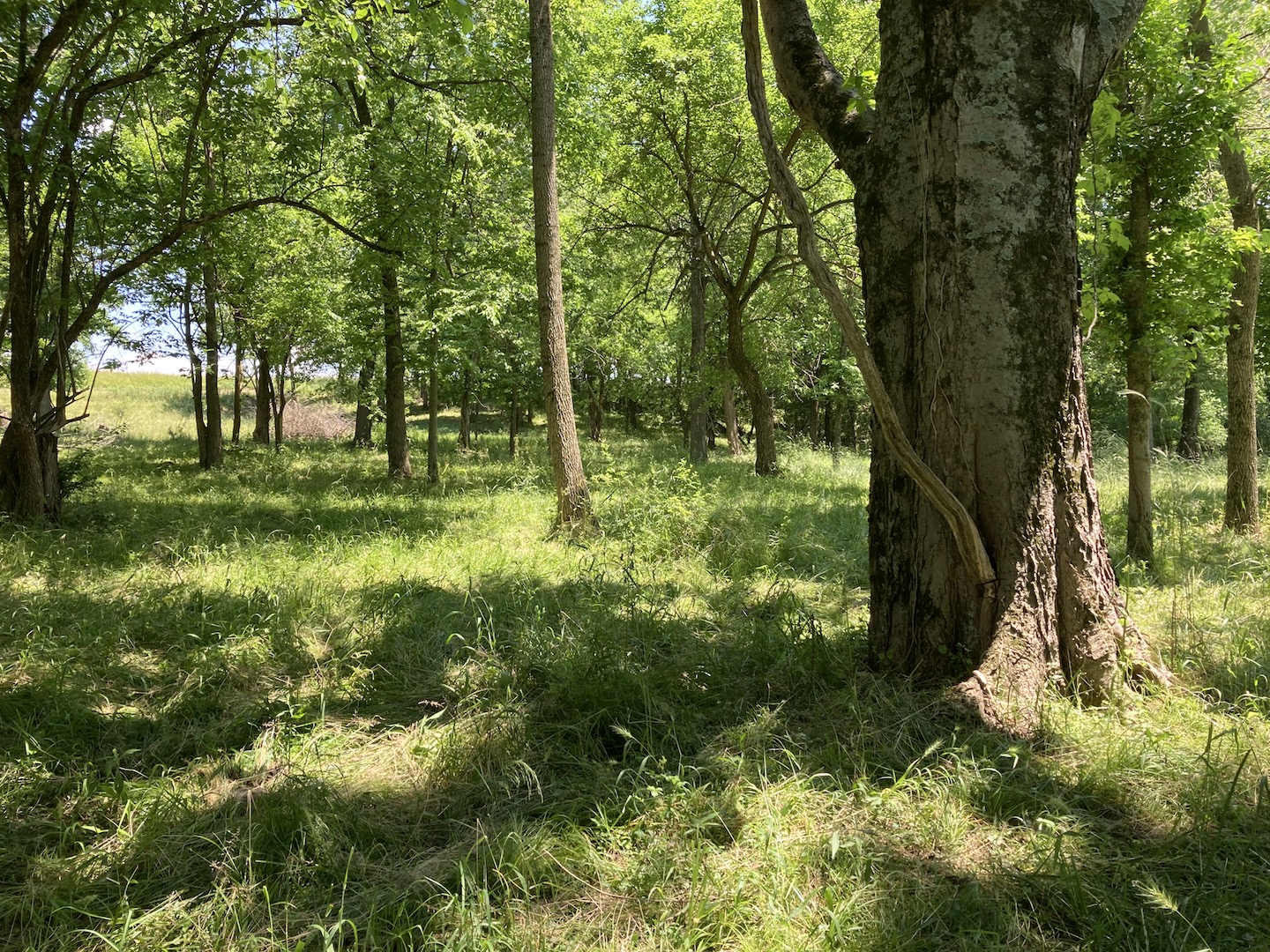
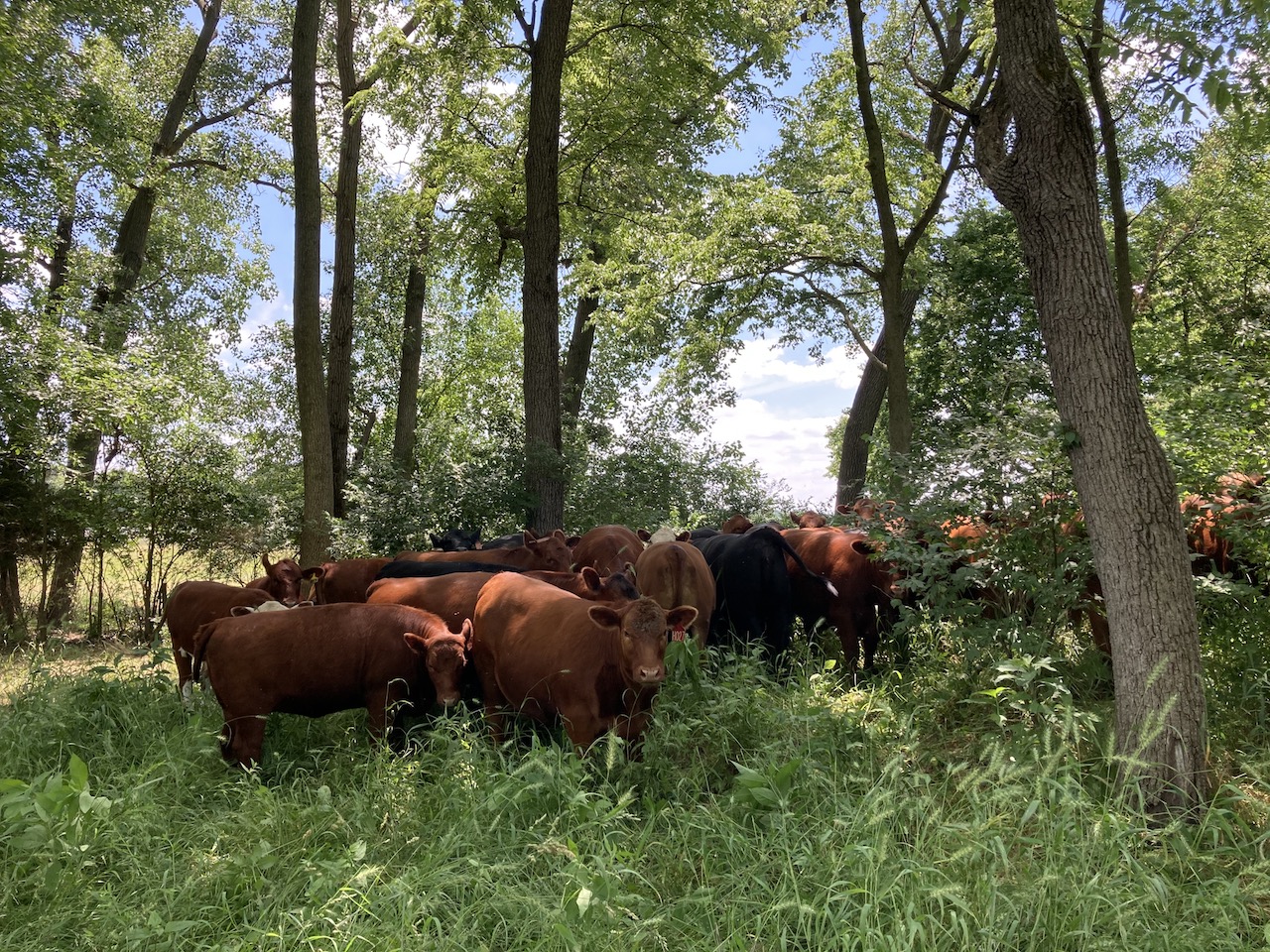
6. Finally, I need to say that Mayumi, our younger son, and I all visited a farm of a friend in southern Illinois a few weeks back. Like the Riemers, the farmer is grazing cattle in a way that mimicks how ruminants and the land can productively benefit each other. The land was absolutely beautiful. We saw an eastern meadowlark, a great blue heron, lush pastures that hold water and provide habitat, and healthy cattle. The farmer patiently shared with us the planning and effort that goes into stewarding the land so attentively. All of the fruits of the spirit are at work in his heart and mind as he farms. In his way, in his deeply rooted and deeply focused way, he is serving God with love and devotion. I am still moved at the memory of that tour and the life he and his wife have built.

Careful grazing can benefit woods like these. A great blue heron flew up out of the pond in these same woods about 30 yards away.

A herd will appreciate the shade of woods on hot summer days. This was a very curious herd, by the way.

7. I find myself praying for the love, strength, and wisdom of Jesus in all of my life.

I hope this finds you convinced of God’s love, filled with love and strength and wisdom, and living consciously and fully for God’s purposes. I’d love to hear what you are doing and what you are finding to be your purpose and focus, especially as they relate to God’s Creation.

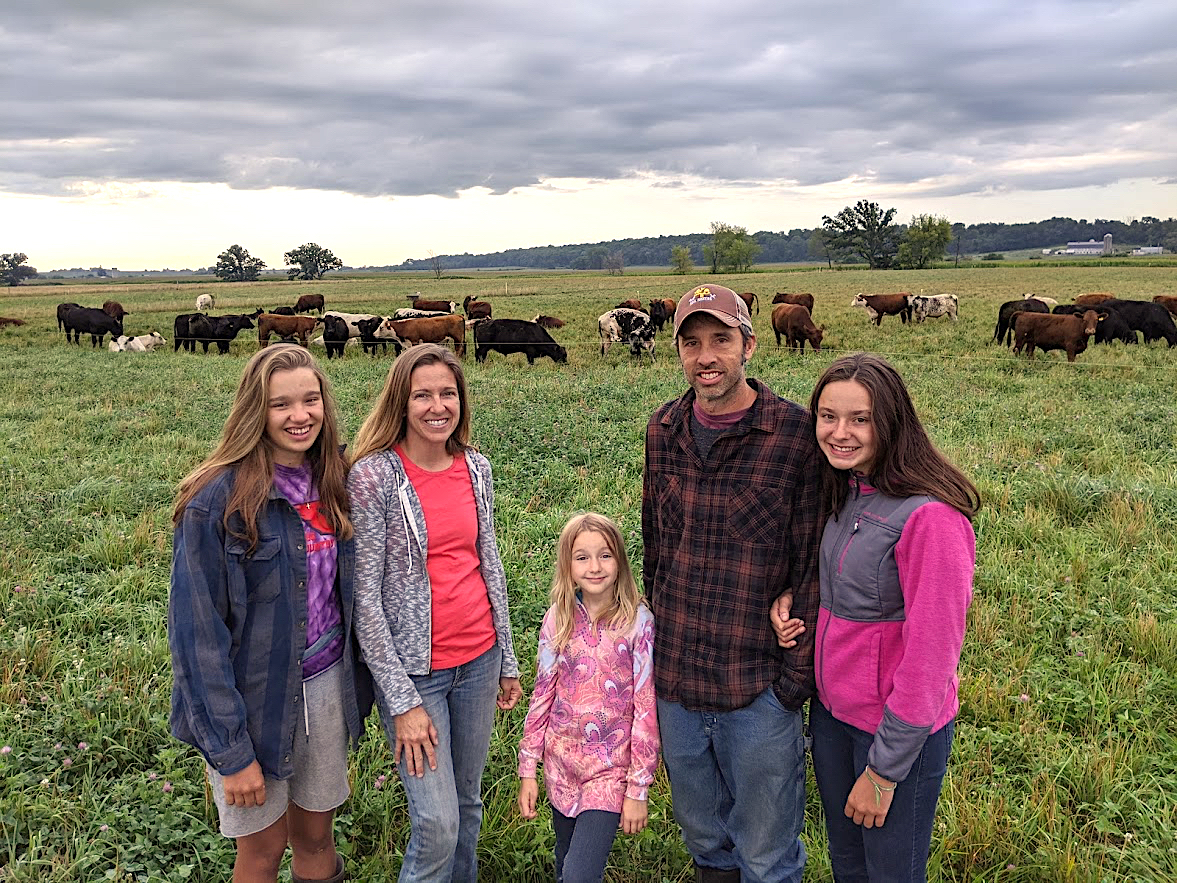
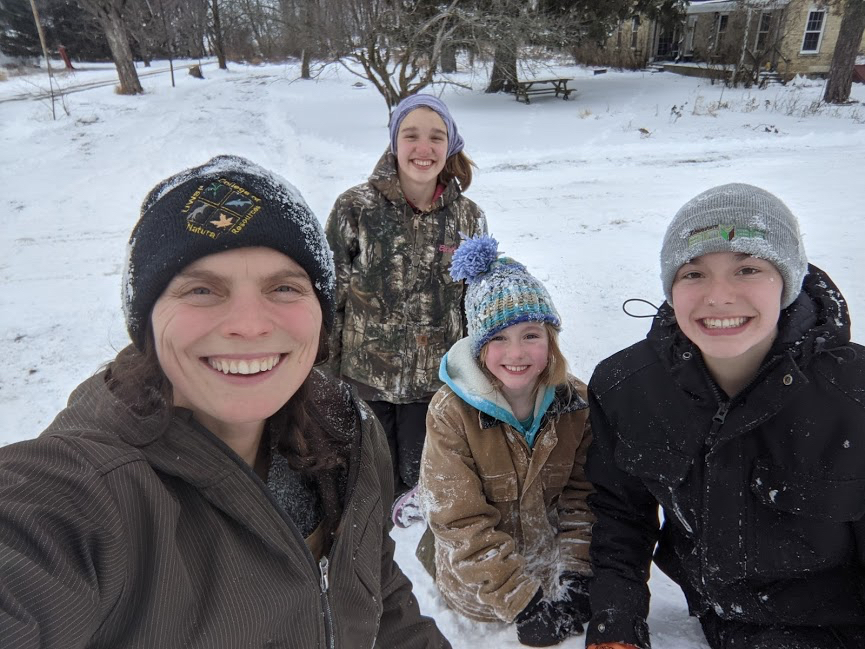
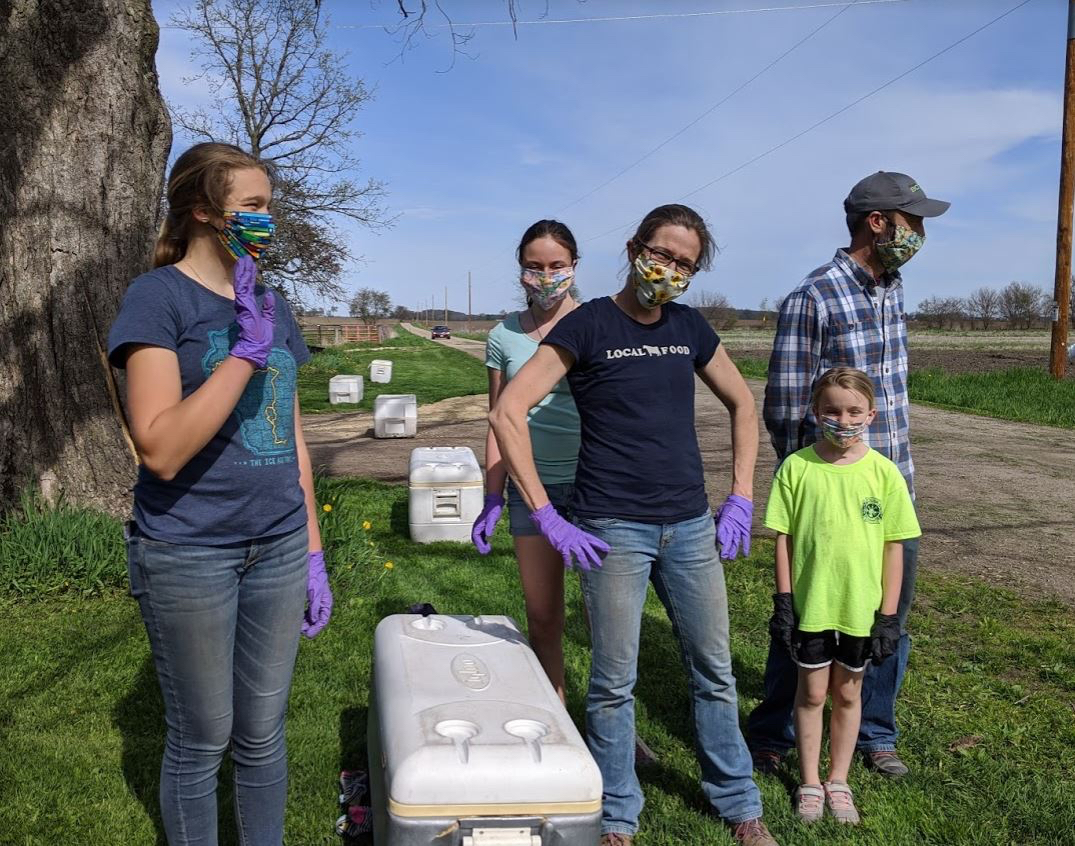
This interview with the Riemer family (from left to right: Elli, Jen, Caroline, Bryce, and Kalena) is something I’ve wanted to do for some time. We connected some time ago around faith and farming, and that connection has been a great blessing to my family and me. They hosted the first gathering I wanted to organize of Christians who care about God’s earth. They’ve been good friends. They even hosted our younger son for several days of farm work that I “voluntold” him for. I don’t know if he was initially thrilled about the idea but he came to enjoy the work, their family, and their hearty cooking. 

It’s a bit easy for a person like me to be convinced in theory that a whole Christian faith-life can’t help but include a commitment to doing all that is possible to enable God’s earth to thrive. That’s because I’m not a farmer. Farmers are working squarely at the intersection of the human economy and God’s earth. Their ability to make a living, to put food on the plates of their children, depends on their success at producing food that people will buy.  When farmers like the Riemers decide to honor God in how they raise food, even if that means not following the mainstream food system, they are testing their faith in the real world. 

But that is what the Riemers have been doing. So I wanted to share their experiences and insights of what that is like. This interview is about God-honoring farming. And it’s much more. It’s also about the courage of a family to live out their faith. It’s about glimpses of the abundant life that this world can sustain when people truly reflect God’s image. it’s about being pushed to the limit by the forces of the market that often drive us away from God’s ways. And there’s that empty, lonely feeling that you probably know, too, of being aware that many Christians don’t seem to care about Creation.

I hope you’ll take the time to read this. I also hope you’ll pray for their ongoing success. You can learn more about Riemer Family Farm in Brodhead, Wiscsonsin, here

(By the way, you can learn much more about their farm business history and how exactly they farm by listening to this edition of the Edible-Alpha podcast. I’m also embarrassed to admit that this interview took place in 2020 during the fall. It’s taken some time for me to complete the transcription and condense it down a bit. So, here in the middle of winter, you will read of sheep, cows, pigs, and monarchs all thriving on a farm. I appreciated, too, that Bryce and Jen wantd thier three daughters to be part of the interview. And one last thing – we are grateful to Anastasia Wolf-Flasch for allowing us to use all of the images she took of the Riemer family and their farm.)


Nathan: In the Edible-Alpha podcast that you did with Tera Johnson, you shared a great deal about the growth and evolution of your business from a sustainable farming and entrepreneurial perspectives. Can you talk more about what role your faith had in how your business has evolved? How has it shaped your decisions and helped get you through tough times?

Bryce: Our faith shapes our business, because it shapes who we are in our business. Our business is kind of an outflow of who we are as people. Jen and I, as a married couple, just keep looking at the gifts he’s given us and the resources he’s given us and just keep asking, “What do we do with our lives? What direction is Jesus taking us together?” And that whole thought process is the process that got us to where we are today.

This business is the best way that Jen and I believe we can use all of our, the gifts, the resources that God gave us to make a big impact on people that we wouldn’t otherwise be able to do.

Kalena: I probably wouldn’t be able to have the same mindset going out every day and doing the work without faith.

Jen: Well, I think faith was a big part in us getting started with our philosophy of farming with the very deep need to care for Creation and not just grow a commodity, which is not environmentally sound nor very profitable nor very fun. I think that God puts us here to enjoy our work. It’s not supposed to be a slog, although it’s hard work. We set out with the holistic point of view that if we’re going to do this, it’s going to honor God. And it’s going to be something that honors Creation, because that’s what we’re all about.

I think that’s the filter through which we make decisions. Obviously from a marketing perspective, that’s what our customers expect from us. But, we continue to uphold that integrity because we’re Christians and because we’re not going to say something and do something different. That’s our ethics.

Nathan: I know as part of your transition, you were farming Bryce’s parents’ land that had been in more conventional production. Did your faith also help shape how you communicated with your parents and did that transition?

Bryce: Well, obviously, we started with the concept of honoring your parents. There were times early on where there was a lot of tension, because we were changing stuff and Dad wasn’t comfortable with that. So it took patience and valuing relationships over the work or over things. That’s why it’s so hard for a lot of farms to transition to the next generation – they fight about stuff and forget about the relationship.

Jen: And then they lose their relationship with their parents.

Nathan: Can you briefly describe what it is about your farming that benefits or sustains creation?

Elli: When God created the world, he had the cattle grazing. There were no commodity crops and that’s what He wanted it to be. And that’s what He wants it to be still. So we try and mimic the best practices that we could be using while trying to respect the nature of the animal. If the pig is able to root, it is obviously more happy. We don’t humanize our animals. We don’t give them all names and all that, but if they get to express their innate nature, then I feel like that’s honoring God, honoring the pigness of the pig.

Caroline: Except when they get out!

Jen: It’s a lot harder to deal with animals when you’re grazing them. There have been moments where I thought, “Oh, this is why people have CAFOs and feedlots, because the farmer’s day is easy. You just run your machine and feed them and you’re done.”

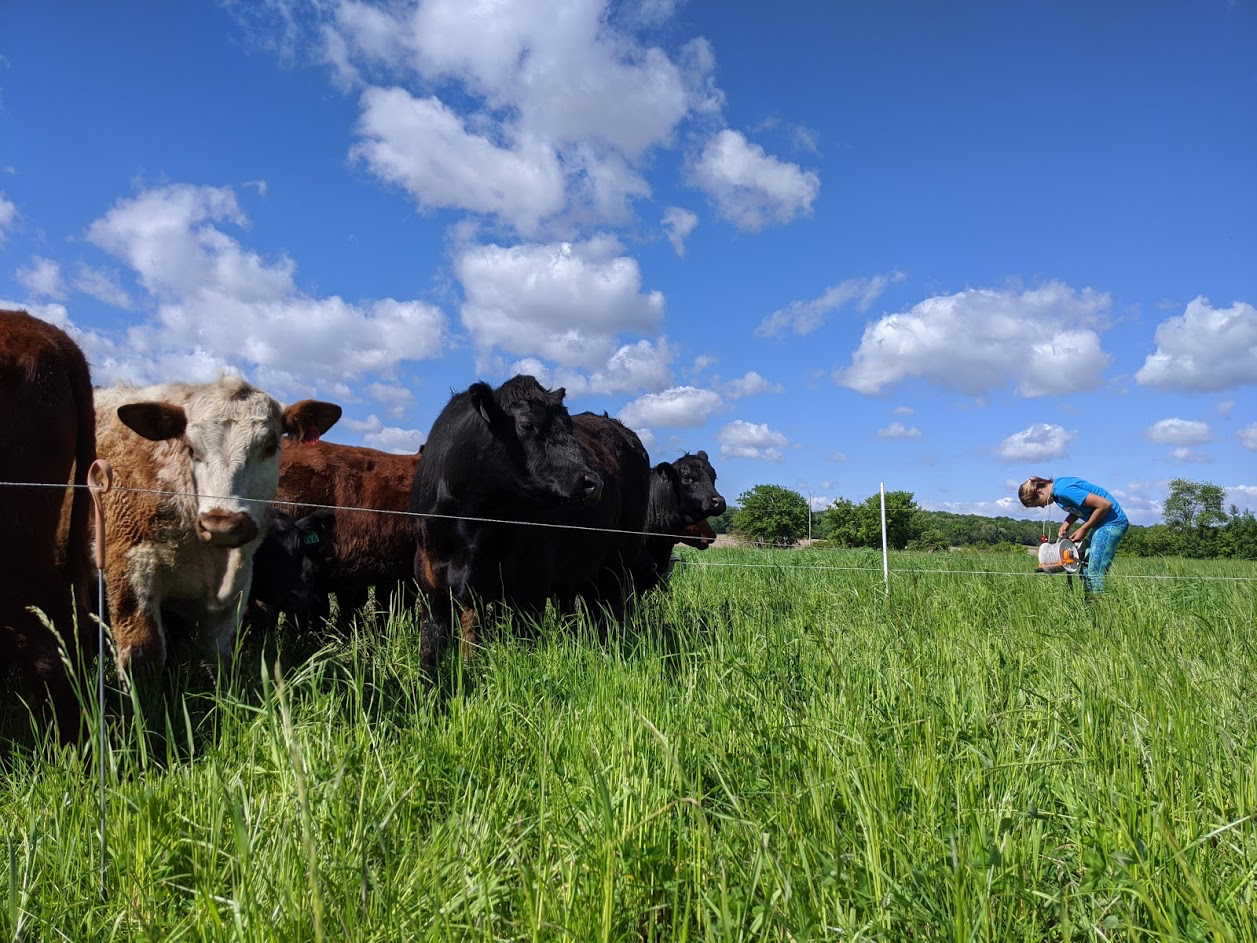
Bryce: Moving the cattle is very peaceful. We had hundreds and hundreds of monarch butterflies come through here again this year. Even after the cattle graze – they don’t eat it all – there’s still clover there for the monarchs. It’s just the interrelatedness of everything. It just feels like a spiritual experience. And it’s way more a spiritual experience than you would get trying to get the animals to do something that they weren’t supposed to do in the first place.

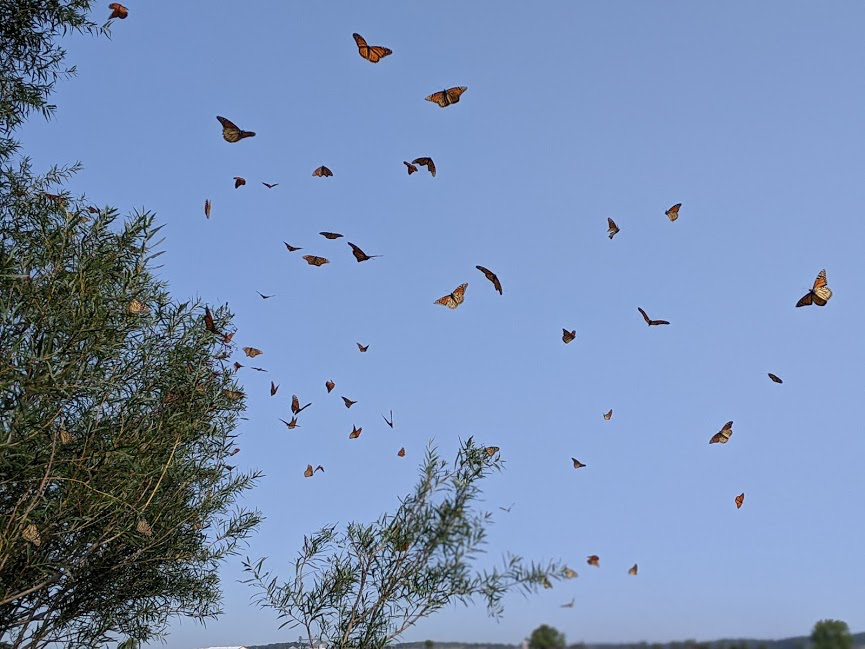
Monarch butterflies find sanctuary at the Riemers farm – trees for resting in and clover for energy.

Nathan: This is going to sound like a weird question. Do the animals seem happy? Or is that completely anthropomorphic?

Jen: I think they’re happy. The sheep, when they get led into a new paddock, they’ll like literally leap, even big nine-, ten-month old lambs. They’ll still do that. They’re happy.

Bryce: Our cattle especially are. They’re happy now because they’re healthy. They’re happy. They stay healthy. They’re shiny. They’re gaining weight and they don’t beller. Cattle beller when they’re hungry. They’ll complain.

Nathan: “Beller?”

Jen: It’s not like a moo. It’s like a scream. Turkeys will make noise when they’re happy, but generally a quiet animal is a happy animal. If you have a bunch of noisy animals, they’re upset about something.

Nathan: So speaking of the livestock being happy, are they healthy? I’ve heard that with rotational grazing animals stay healthier. Is the case for your cattle?

Bryce: Absolutely. My dad used to have a regular vet who would always come. We had to have the vet this year twice because of some pink eye. Everybody struggled with that this year, but it was only 20% of the herd. Other than that, we have not had any vet issues in the last year.

Jen: Sheep tends to get parasites. We have breeds that are pretty parasite-resistant, so we don’t have to deal with that as much. We move them every three days, especially when it’s hot and humid in the summer, because that’s the parasite cycle. Otherwise they could go back into the same grass and ingest the same parasite that they’ve pooped out. We are very good about keeping them ahead of the parasite cycle so they’re not going to reinfect themselves. Every sheep or goat carries a small load of parasites pretty much no matter what. So movement is key to animal health. And that’s why we were a little late to this interview – we were moving sheep.

Nathan: You have been living on the edge, trying new things, transitioning the farm, raising kids all at the same time. Have you learned things about the faith and has your faith grown because of the way you farmed?

Jen: Well, honestly, part of what I’ve learned, and I’m not going to articulate this well, has been endurance. It’s been a long stretch. There’s been a lot of blessings and a lot of moments where it’s like, “Yeah, God, this is what we are meant to do, and this is what we need to do.” And other times I have literally said, “I really don’t like farming today. Like today really sucks. Things are not going right.”

I say it to myself usually or out loud if I’m alone. It’s Murphy’s Law. It seems like when there’s a rough stretch, it is like all at the same time and it’s hard. But there’s not ever a thought of “I’m done” or “We need to do something else. I give up.” That’s kind of from faith. I’ve struggled at times recently. It’s like, “This is hard. I’m not feeling it.” But we keep moving and keep doing. We move forward because that’s what I want to do and what I know to do. That’s not profound.

Bryce: Being on the edge can be lonely. There’s not a lot of fellowship out here on the edge, which makes us feel like pulling everybody else closer to the edge and saying, “Why aren’t you out here taking more chances?” You know we’re dealing with people that most Christians don’t deal with, whether it’s a business or neighborhood or in town hall meetings and with customers. So we have connections to so many people. It’s a big opportunity to influence, whether it’s our social media followers or through our newsletters.

As far as the faith, there’s a chance to demonstrate it every day. Before we were doing this, when we had regular jobs and went to regular church, we would hear stuff in church and wonder if we’d ever get an opportunity to do that with somebody. Now, there are situations with people in our lives where we can demonstrate what we believe.

One of the ways God’s love has been expressed through the Riemer family has been the way they have made Anastasia (on the left) part of their family when she needed both work and a place to know love and family connection.

Nathan: Psalm 23 talks about the Lord being our shepherd, and Jesus referred to himself as the good shepherd. You have sheep. Does raising sheep make you think differently about when God compares us to sheep?

Kalena: When the Bible talks about how the sheep follow the shepherd, it really is true. And it’s kind of cool to be able to compare that to what we see every day.

Jen: Well, Ellie is really the shepherd of our sheep, and they will respond to her differently than they will to anyone else. We don’t even call them, because if she calls them in a loud voice, they will be like, “Oh, that’s where we go!” It’s just pretty cool. They know her differently from the rest of us.

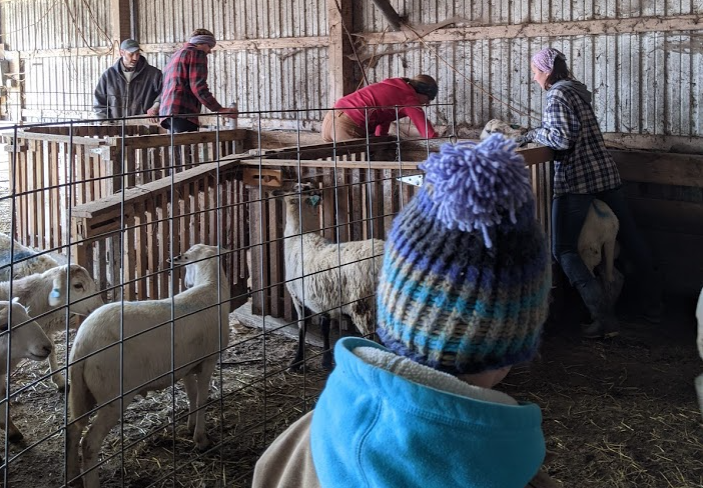
The Riemers sort sheep as a family.

Nathan: One of my favorite Christian authors is Dallas Willard. In The Divine Conspiracy, he talks about why the early Christians called themselves the Way and what Jesus was about in his life. He was trying to help us understand how the universe really works. God put certain things in place and certain ways of living. And if we’re in alignment with God, even in a broken world, that will bring greater harmony than if we go against God’s pattern, the framework he’s put into the universe. And so one of the things that it’s occurred to me is that with rotational grazing you’re essentially mimicking the pattern of how the natural world works and when you do that, you get healthy animals and healthy food. We don’t have to fight against the universe. We can work with it, if we’re creative and we’re willing to put in some extra effort.

Bryce: Yes, the spiritual and the natural can all line up. You don’t have to fight the system, but the system we do have to fight is the economic system. If it just paid a farmer well enough to be able to go do it (the sustainable way), then everyone would do it the way it’s designed to be done. But right now it’s just hard to do that.

Nathan: What temptations do the conventional farming system offer that make it hard to go the way you’re going?

Jen: Crop insurance – guaranteed prices for things. You can grow a losing crop year after year after year and still make money from the government. It’s mind-blowing really. It’s easier. You buy your seeds from the feed guy. You buy your fertilizer from the fertilizer guy, and you take everybody’s recommendations. You can even hire somebody else to drive the tractor to plant it.

But we’re making hard decisions most days on either production or financials or just when to make hay and bale it. It’s constant, which is not the case with the commodity farm.

Bryce: It’s not farming anymore. Creating jobs and creating work – no, you’ve got to have more technology and bigger machines, so you don’t have to have more jobs. And now it’s CBF – corn, beans, Florida. You don’t want to have to be tied down to all these animals and the old ways of doing stuff.

The temptation used on me to do conventional farming came from the Confined Animal Feed Operation (CAFO) people. When they first were getting to know us and first made their pitch they said, “Why don’t you just sell us your corn silage (that gets harvested a lot earlier than fuel corn)? And then you’re done for the year and you can go buy your Corvette.”

How could I refuse the allure of being done early and Corvette shopping, instead of doing all this other work?

Jen: Which also implies that they had all the answers and they were actually going to pay a fair wage, which we all know is not really the case.

Nathan: So since you mentioned the CAFO, can you share how the struggle against the CAFO operation that has ultimately been built just down the road has challenged your faith? (By way of context, the Riemers, with Jen taking the lead, were part of a years-long community effort to try to stop a dairy factory farm from being built less than a mile from their farm. They were ultimately unsuccessful. Sadly, our government tends to serve business interests far more than long-term community interests. Here is an article that explains more about the issues surrounding diary CAFOs in Wisconsin.)

Bryce: The CAFO is a chapter of our lives that that changed our lives in big ways. It impacted our faith. We were here farming, and, at least in our opinion, we were Christians. And when they came in, it actually rattled us to the point where we thought that somebody else’s bad decisions might prevent us from being able to always be here farming and just be Christians farming.

That’s when the faith became real, the Bible came alive. Because the ideas of going through these tribulations and being that affected by other people’s negativity/stupidity made us have to face the fact that we were holding onto this farm too tightly. It was maybe before God. And then we realized that if this is God’s, he can take it from us, just like he gave it to us, then we need to give it up to God, consecrate it, and say, “It’s yours. If you want us to farm here, we will. We will do it in a way that follows your calling and gives you the glory. And if not, we’ll go do something else.”

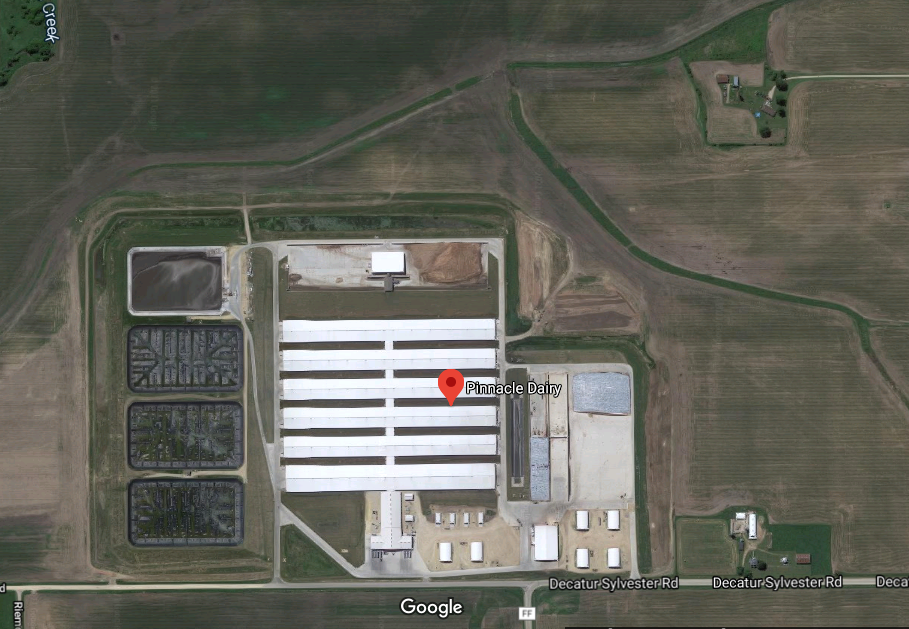
This is an aerial photo of Pinnacle Dairy, the dairy CAFO right down the road from the Riemer Family Farm. Six thousands cows will ultimately be housed inside the long buildings. The rectange at the top left is a manure pit which government authorities are allowing to be uncovered.

Nathan: So you had that peace of mind even as you, especially Jen, were leading the community fight against it.

Bryce: Well, it took me a little while to get there. We really had anguish.

Jen: It took me a longer while. It was pretty annoying, actually, when Bryce got the vision a lot earlier than I did. It felt like giving up in that I’m holding so tightly to this thing that I must keep holding tightly to. And it just got to the point of exhaustion. And I finally it was like, “Ok. Well, I’m obviously not in charge here, so this needs to be held loosely, and we’ll move on from here.”

Bryce: It’s kind of confusing at times about how to know how hard to fight for something that you believe is right versus God’s will is going to come through in the end no matter what. It was hard because Jen was the leader of this group. So she had people out there, and so she felt pressure to be that leader and keep going. Yet we knew that God was in control, but the people that she was leading didn’t really know that or believe that. So it was really hard.

Jen: Especially at the end when the greater tension ended up being between our people and what the next steps ought to be. That was the hardest part. It was infighting. People had really good intentions. But they just disagreed about when to say enough is enough and we need to move on or when to bet the house and get a second mortgage and hire a bigwig lawyer and take the CAFO owners to court.

There was a lot that went into that decision, but that was the hard part at the end. Logically, taking it to court didn’t make a lot of sense. Honesty, we were two, three years in (I don’t even know – it was all a blur), and at that point I just saw that we were not going to win. And I was like, “I cannot do this for the next five years.” Because that’s what it would have been. My family came first. My faith came first. I would have lost the farm by doing that for five more years.

Bryce: I was trying to encourage her by saying that it’s a victory if we stay true to Jesus and have a good witness to people and make people wonder why we’re not upset no matter what, whether the CAFO farm comes in or not. The farm coming is not a defeat. The victory is staying true to what we believe in and not losing our integrity. And Jesus is in control of the ultimate destiny of that farm.

Nathan: At the same time, it’s a fact that the laws and economic system of our country enable that CAFO and other CAFOs to do what they do to communities, animals, and God’s earth. That’s just one thing that make me question whether we are truly a Christian country. The prophets in the Old Testament talked a lot about how the rich and powerful did awful things. The CAFO and the law system that enable CAFOs to go in are examples of our society being run by the rich and powerful against the interests of the vulnerable who God really cares about.

Jen: Absolutely. And it’s done under the guise of them being the good guys doing the right thing. The ones that write the statutes are the staff of the Department of Natural Resources. They hand CAFO owners everything that they need to get these things built. And it’s like, “Wait a second! You’re the guys that are supposed to be protecting rivers and my drinking water, but you’re not.” I don’t say that to diminish all of the DNR staff and all of the things that they do. That’s the reality – the job of the DNR is to permit CAFOs. Who decided that?

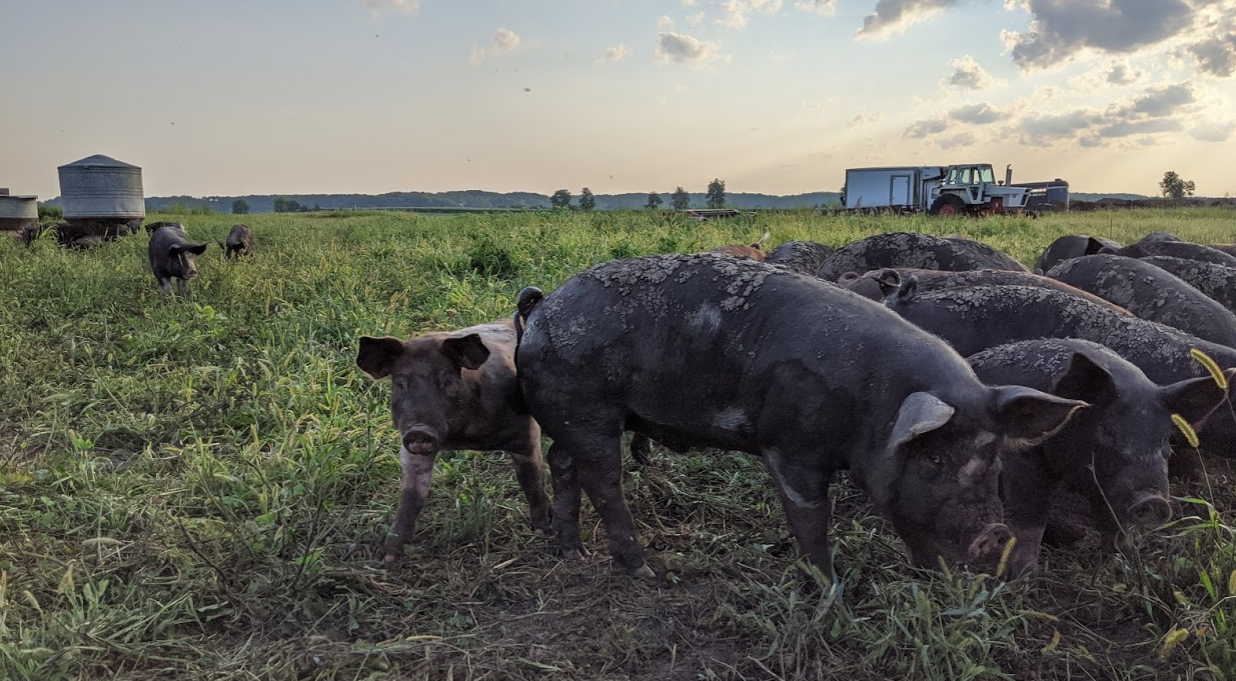
Pigs on pasture at the Riemer Family Farm. Pigs, which are highly intelligent animals, do not get the opportunity to enjoy fresh air and to express their “pigness” in factory farm buildings of CAFOs.

Nathan: I’ve heard a number of people call farming a calling like some people feel called to be pastors. Do you feel like farming is a calling for all of you as a family?

Kalena: I, at this point, feel very called to mission in the future. Maybe I could help people farm this way in other countries and still be a missionary.

Bryce: Well, I’m third generation so it’s not like I heard a calling and went to be a farmer. I would have to hear a pretty strong calling not to be a farmer.

Elli: You did not want the farm in college. It was a calling when you woke up to it.

Bryce: Yes. But ultimately selling the farm and letting it go would have been a tough decision. I do feel it’s where I’m supposed to be. I feel more in God’s plan and will now than I ever have. This opportunity to farm is the culmination of all the other things I’ve been doing.

Jen: Well, I think it’s a calling that’s developed. I don’t think one of us could say there has been a strong moment. It’s been a road. It’s been a journey. We’ve kind of planted these seeds. We can’t go back and flick them out of the ground.

Elli: I feel called to protect the environment, probably due to this farm, but it wouldn’t have to be through farming.

Nathan: Have you had spiritual experiences while farming?

Jen: I’d say the roosting of monarchs is pretty spiritual, actually.

Elli: And there’s like hundreds of finches across our road right now because of the sunflowers we planted. It’s crazy to see them all fly.

Bryce: Since school has started this year, we’re all homeschooling. We’re farming together every morning, and we go out as a team and a family and do all the work and then school the rest of the day on good days. My point is that we start the day together for the first time as a whole family. We have a meeting every morning, and we plan the day. We also do devotions, read, and pray together. It’s been really a great opportunity for our family to stay together. I guess that’s not technically while we’re farming, but it’s because of farming

Kalena: It’s happened a couple of times where it’s cloudy but then there’s an opening, and it seems like the sun is showering down right on our farm. And that’s really cool. I kind of think of it like God is just looking down on our farm. And just to look out over the pasture sometimes – it’s like, “Wow! It’s beautiful to see what God meant the land to look like.”

Jen: For me, too, it is energizing to be with the life, the fundamentals of life. And I think that’s the thing with the butterflies and the finches. It’s like the wholeness of the system and the vibrancy. Especially in contrast to our neighbors’ fields right now that are totally bare, because they’ve got corn silage. So it’s bare dirt when everything could be bright green. It’s just this contrast.

I’m an emotive person, so I see that and I’m just like, “Oh, this is horrible!” And then I got into my field and it’s like, “Butterflies! This is nice.” It’s energizing. A creation worshiper would worship that scene, but we worship because it’s a gift from God.

Nathan: Could you give me a brief overview of how the land has been transformed over time through your farming?

Elli: I remember when it was corn and beans. The field would be barren for like half the year. Now there’s always something green or very colorful on it. We never have bare soil anymore. We make hay off of it and that’s pretty much the only thing we do. So we’re not planting or harvesting anything really either. We’re always covering the ground.

We’re surrounded by bare fields (their neighbors’ fields) right now. Dust is flying off of it. There’s no more top soil all around us.

Bryce: My dad had beef cattle, and so he grazed them. He had a cow-calf herd and finished out some cattle on grain. But he didn’t rotationally graze. So the pasture was really short in a lot of areas and really tall and weedy in the others. It was 55 acres, so the cows and calves would walk from one end of the field to the other and back to the water and leave these paths everywhere. So there were ruts and whatnot from which the water would run off.

And so that was the pasture. And now there are no cow paths. There’s no weeds. And the tussocks are only where we want them to be in the old waterways and are providing frog habitat

And the whole farm now looks like that. My dad used to have corn and beans, which he would no-till, so there was no tillage going on, but it would involve spraying weeds. And then there were the alfalfa fields, the hay fields. There was always a constant battle with weeds.

And that’s one of the biggest transformations we noticed this year. Where are all of the weeds? Where are the thistles? Struggles we’ve had in the past just weren’t there this year.

Jen: And we’re running the cattle on another 129 acres. There’s no weeds. We do have some up north where the pigs are, because they’re pigs. But it (the lack of weeds in cattle pastures) is amazing.

Elli preparing to move cattle herd from one paddock to another. By rotationally grazing cattle on a regular basis, the cattle get a heathier diet and the vegetation has a chance to recover while also providing habitat for other living things of God’s earth.

Nathan:, I’ve often felt alone in my conviction that Creation matters, that it is part of the overall story told in the Bible from Genesis to Revelation. Have you felt alone at times in that conviction as well?

Elli: No church people helped in the CAFO fight. There are environmental people and church people, and the church people don’t really care. Our pastor is kind of getting there a little bit.

Kalena: And during the CAFO fight, there were other people you could talk to who shared the passion for the land, but for me it was mainly because of faith why I didn’t like the CAFO coming in, which I couldn’t really talk to with those people without being weird or being shut out again.

Jen: It was definitely two groups of people. I often get frustrated with every church potluck being full of really horrible food raised in really horrible ways. And the kids get all sorts of little plastic toys made in China by other kids. How can we be so passionate about our faith and not see this whole piece of discipleship?

Bryce: Well, I think this year it’s very clear that it’s political. You didn’t really think about it as much before, but everything is drawn as a line in the sand. Christian churchgoers have to be Republicans, and Republicans are supposed to not be environmentalist. So we have to close our eyes to that whole part of it.

Nathan: What advice do you have for Christians who aren’t farmers in terms of food and farming. What should they think about the food that they eat?

Kalena: They should think about what they’re buying. If they really want to live out their faith in every aspect, they have to think about every aspect.

Elli: Just start thinking about it. That will get you a whole lot farther than you are now.

Jen: I think the word I was looking for before was integrity. If I proclaim Christ, but I do these other things that are not Christ-like then I think we need to think about that more. I think that there are, like Bryce is saying, certain issues that have this elevated priority over the big picture of whole planet health because that’s not what we’re supposed to talk about. But I think that we neglect and we leave off the table this whole depth of what we can be as Christians when we limit our issues that we’re going to care about to abortion and welfare or whatever.

We need holistic management in our hearts.

Bryce: Everything that people eat was alive. And so people need to think about what their food came from. Did it live in a way that it was created to? If they can just start asking that question, they can decide for themselves where to come up with budget changes to find the money to pay for food that is God-honoring.

During the pandemic, many people have had new appreciation for the value of healthy food that is also good for God’s earth. Demand has been strong for the Riemer’s meat. They’ve made available online ordering and on-farm pickups.